Solar Flood Light vs LED Flood Light
Introduction
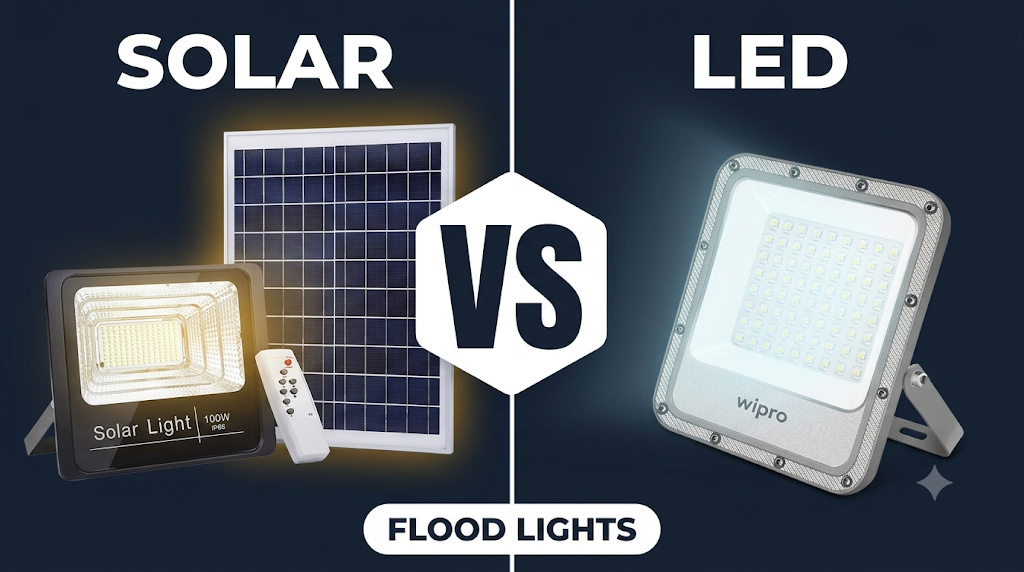
Outdoor lighting is important for security, visibility and safety around homes, gardens, parking areas, warehouses, commercial buildings and public spaces. Solar flood lights and LED flood lights are two popular options for illuminating large outdoor areas. Both use LED technology to produce bright light, but their power sources and installation requirements are different. Solar flood lights generate and store electricity through solar panels and batteries, whereas conventional LED flood lights generally operate using electricity supplied by the grid.
Choosing between these lighting systems depends on several factors, including electricity availability, installation cost, brightness requirements, operating hours and maintenance. Solar flood lights can reduce dependence on grid electricity and work in locations without regular power connections. On the other hand, grid-powered LED flood lights can provide consistent lighting without depending on sunlight or battery backup. Understanding their differences can help you select a suitable lighting solution for your property.
Quick Comparison Table
| Feature | Solar Flood Light | LED Flood Light |
|---|---|---|
| Power Source | Solar panel and battery | Electricity supply |
| Lighting Technology | LED | LED |
| Electricity Consumption from Grid | No, during normal solar operation | Yes |
| Battery | Required | Usually not required |
| Solar Panel | Required | Not required |
| Installation | May require panel and light mounting | Requires electrical connection |
| Running Cost | Generally low | Depends on electricity usage |
| Night Operation | Depends on stored battery energy | Depends on electricity supply |
| Cloudy Weather | Can reduce charging | Generally unaffected |
| Backup | Battery storage | Depends on alternate power supply |
| Maintenance | Panel cleaning and battery replacement | Electrical and fixture maintenance |
| Best For | Outdoor areas without convenient power connections | Areas requiring dependable grid-powered lighting |
1. Working Principle and Technology
Solar Flood Light
A solar flood light uses a solar panel to convert sunlight into electrical energy. The generated electricity charges a rechargeable battery during the daytime.
After sunset, the stored electricity powers the LED flood light. Many models include automatic light sensors that switch the light on at night and off during the daytime.
Some models also include motion sensors, remote controls and adjustable brightness settings.
LED Flood Light
A conventional LED flood light uses electricity from the main power supply. Its LED chips convert electrical energy into light through semiconductor technology.
When connected to a suitable power supply, the light can operate whenever required. It does not need a solar panel or an internal battery for ordinary operation.
Some LED flood lights can also be connected to timers, motion sensors and smart lighting controls.
2. Brightness and Lighting Performance
Solar Flood Light
The brightness of a solar flood light depends on its actual LED output, battery capacity, solar charging capability and operating settings.
Some models maintain a lower brightness level to conserve battery energy and increase operating time. Motion-sensor models may provide brighter illumination when movement is detected.
However, a product’s advertised wattage alone does not guarantee its actual brightness. Checking the lumen output and lighting coverage is more useful.
LED Flood Light
A grid-powered LED flood light can provide consistent illumination while the electricity supply remains available.
It is available in different lumen outputs and beam angles, making it suitable for small outdoor spaces as well as large commercial areas.
Since it does not depend on stored solar energy, it can maintain its specified brightness for extended operating periods when properly powered.
Winner: LED Flood Light for consistent brightness during continuous operation.
3. Electricity Consumption and Running Cost
Solar Flood Light
A solar flood light uses energy collected from sunlight and stored in its battery. During normal operation, it does not require electricity from the household grid.
This can help reduce electricity consumption, particularly when the light operates for several hours every night.
However, the initial purchase price includes the solar panel and battery, and the battery may eventually require replacement.
LED Flood Light
A conventional LED flood light consumes electricity from the grid whenever it operates.
Its electricity cost depends on the light’s actual power consumption, daily operating hours and local electricity tariff.
LED technology is generally energy-efficient compared with many traditional lighting technologies, but its running cost continues as long as it uses grid electricity.
Winner: Solar Flood Light for reducing regular grid electricity consumption.
4. Installation and Setup
Solar Flood Light
Solar flood lights are useful in locations where installing electrical wiring is difficult or expensive.
Depending on the model, the solar panel may be integrated into the light or connected through a separate cable. The installer needs to position the panel where it receives sufficient direct sunlight.
Many models can be installed without connecting the light to household electrical wiring.
LED Flood Light
A conventional LED flood light needs an appropriate electrical connection. Installation may require wiring, switches, mounting brackets and electrical protection.
If the location already has a suitable power connection, installation can be straightforward.
However, installing new electrical wiring in an open field, boundary wall or distant parking area may increase labour and material costs.
Winner: Solar Flood Light for locations without convenient electrical connections.
5. Performance During Cloudy and Rainy Weather
Solar Flood Light
Solar flood lights depend on solar energy to recharge their batteries. Cloudy weather, heavy rain and limited sunlight can reduce daily charging.
A properly sized battery may provide backup during short periods of poor sunlight, but prolonged cloudy weather can affect lighting duration or brightness.
The actual performance depends on solar panel capacity, battery storage and daily energy consumption.
LED Flood Light
A grid-powered LED flood light does not depend on sunlight. It can continue operating during cloudy weather and rain as long as the electricity supply remains available.
However, during a power cut, it will stop working unless connected to an inverter, generator or other backup system.
Winner: LED Flood Light for dependable operation during poor sunlight conditions.
6. Battery and Backup Requirements
Solar Flood Light
A rechargeable battery is an essential component of a solar flood light. It stores energy during the daytime and supplies electricity to the LED light at night.
Battery capacity determines how much energy can be stored, while battery condition affects long-term performance.
Over time, the battery may lose storage capacity and require replacement.
LED Flood Light
A conventional grid-powered LED flood light generally operates without a built-in battery.
It receives electricity directly from the power supply, so there is no routine battery replacement requirement.
If backup lighting is needed during power cuts, an external inverter or backup system can be installed.
Winner: LED Flood Light for avoiding a dedicated solar battery.
7. Maintenance and Durability
Solar Flood Light
Solar flood lights require occasional cleaning of the solar panel to remove dust, dirt and other materials that may reduce sunlight absorption.
The battery, electrical connections, LED unit and weather-resistant housing should also be checked periodically.
Battery replacement may become necessary after several years, depending on battery chemistry, temperature, charging conditions and usage.
LED Flood Light
Grid-powered LED flood lights generally require less maintenance because they do not normally include solar panels or rechargeable batteries.
Their maintenance mainly involves checking electrical connections, cleaning the fixture and replacing the unit or driver when necessary.
Both types can offer good durability when made with quality components and installed according to their specifications.
Winner: LED Flood Light for simpler routine maintenance.
8. Initial Purchase and Total Cost
Solar Flood Light
The purchase price of a solar flood light includes the LED unit, solar panel, battery and charging electronics.
Some models may cost more initially than basic grid-powered LED flood lights. However, they can reduce wiring expenses and ongoing grid electricity consumption.
Their long-term cost depends on battery replacement, product quality and available sunlight.
LED Flood Light
A conventional LED flood light can have a lower initial purchase price because it does not require an integrated solar panel and battery.
However, installation wiring and electricity consumption add to its overall cost.
For locations with existing electrical connections and regular operating requirements, a grid-powered LED flood light can be an economical choice.
Winner: Depends. Solar models may be more economical where wiring is expensive and sunlight is sufficient, while conventional LED models may cost less where grid connections already exist.
9. Safety and Weather Protection
Solar Flood Light
Solar flood lights generally operate using low-voltage DC electricity, depending on their design. This can reduce some electrical installation risks.
However, the solar panel, battery and light housing still need proper weather protection.
Always check the IP rating, mounting quality and manufacturer’s safety instructions.
LED Flood Light
Grid-powered LED flood lights require proper electrical insulation, grounding where applicable and suitable protective devices.
Their outdoor housings should be rated for the environmental conditions in which they are installed.
Incorrect wiring or poor-quality electrical connections can create safety risks.
Winner: Depends. Both can be safe when properly designed, certified and installed.
10. Best Applications and Suitable Locations
Solar Flood Light
Solar flood lights are suitable for:
- Gardens and outdoor pathways.
- Farmhouses and agricultural land.
- Boundary walls and gates.
- Remote parking areas.
- Outdoor sheds and storage spaces.
- Locations without convenient grid electricity.
- Security lighting with motion sensors.
They are particularly useful where running electrical cables would be difficult.
LED Flood Light
Conventional LED flood lights are suitable for:
- Commercial buildings and shops.
- Warehouses and factories.
- Sports grounds and playgrounds.
- Large parking facilities.
- Building exteriors.
- Security lighting requiring long operating hours.
- Areas with reliable electricity connections.
They are practical when consistent brightness and extended operation are important.
11. Advantages and Disadvantages
Solar Flood Light
Advantages
- Uses renewable solar energy.
- Reduces dependence on grid electricity.
- No regular grid wiring required for operation.
- Useful in remote locations.
- Can include automatic sensors.
- Helps reduce electricity bills.
Disadvantages
- Depends on sunlight for charging.
- Battery capacity limits operating time.
- Battery replacement may be required.
- Performance can decrease during prolonged cloudy weather.
- Initial cost can be higher than basic LED flood lights.
- Solar panels need periodic cleaning.
LED Flood Light
Advantages
- Consistent brightness with a reliable power supply.
- Does not require solar charging.
- No dedicated solar battery required.
- Available in different brightness levels and beam angles.
- Suitable for extended operating hours.
- Generally simpler routine maintenance.
Disadvantages
- Consumes grid electricity.
- Requires an electrical connection.
- Running costs depend on operating hours and electricity tariffs.
- Stops working during power cuts without backup.
- New wiring can increase installation expenses.
12. Which One Should You Choose?
The right choice depends on the location, electricity availability and lighting requirements.
Choose a solar flood light if you want to illuminate a garden, farmhouse, boundary wall, gate or remote outdoor area without installing electrical wiring. It is also useful when reducing regular grid electricity consumption is a priority.
Choose a conventional LED flood light if you need consistent brightness, extended operating hours and dependable lighting in an area with an existing electricity connection.
Before purchasing either option, compare actual lumen output, beam angle, power consumption, IP rating and expected operating hours. For solar models, also check solar panel wattage, battery capacity in Wh and backup performance.
Conclusion
Solar flood lights and conventional LED flood lights both provide effective outdoor illumination, but their power sources and operating requirements are different. Solar flood lights are useful for remote locations, areas without electrical connections and applications where reducing grid electricity consumption is important. Conventional LED flood lights are more suitable for continuous lighting, consistent brightness and locations with reliable electricity supplies.
Overall, solar flood lights are a practical choice for independent outdoor lighting, while grid-powered LED flood lights are better for dependable and extended operation. Compare the complete system cost and actual lighting performance before making a purchase.
Frequently Asked Questions (FAQs)
1. Is a solar flood light better than a normal LED flood light?
A solar flood light is better for locations without convenient electricity connections. A conventional LED flood light is generally better when consistent brightness and extended operating hours are required.
2. Does a solar flood light work at night?
Yes. It uses electricity stored in its rechargeable battery during the daytime to power the LED light at night.
3. Can an LED flood light work during a power cut?
A conventional grid-powered LED flood light stops working during a power cut unless it is connected to an inverter, generator or another backup power source.
4. Which flood light consumes less electricity?
A solar flood light generally consumes no regular grid electricity during normal solar-powered operation. A conventional LED flood light uses electricity from the grid.
5. Do solar flood lights work during rainy weather?
Yes, provided their batteries have sufficient stored energy. However, prolonged rainy weather can reduce solar charging and affect operating time.
6. Which flood light is better for outdoor security?
Both can be suitable for outdoor security. Solar flood lights are useful where wiring is difficult, while grid-powered LED flood lights are suitable for locations requiring consistent illumination.
7. How long does a solar flood light battery last?
Battery life depends on its chemistry, quality, temperature, charging conditions and usage. Check the manufacturer’s battery warranty and replacement availability before purchasing.
8. Are solar flood lights waterproof?
Many outdoor solar flood lights are designed to resist water and dust, but protection varies by model. Check the IP rating before installation.
Disclaimer
The specifications, brightness, battery capacity, solar panel output, prices and operating performance of solar and LED flood lights vary by manufacturer and model. Actual performance depends on installation conditions, electricity availability, sunlight exposure, weather and usage patterns. Always verify product specifications, IP ratings and warranty conditions before purchasing.