Solar CCTV Camera vs Wired CCTV Camera
Introduction
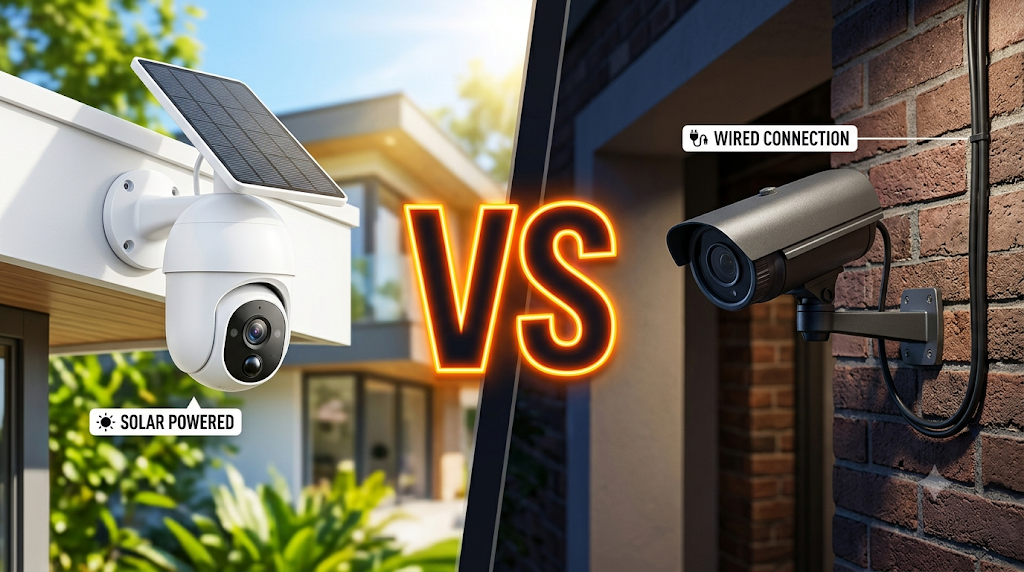
Security cameras have become an important part of home security, business monitoring, farm protection and property surveillance. Solar CCTV cameras and wired CCTV cameras are two options for monitoring indoor and outdoor locations. Both help users record video, monitor activities and improve security, but their power sources, installation requirements and operating capabilities are different. Solar CCTV cameras use solar panels and rechargeable batteries to operate, while wired CCTV cameras generally receive electricity through a direct power connection or a connected power supply.
Choosing between these systems depends on the location, availability of electricity, recording requirements, internet connectivity and installation budget. Solar CCTV cameras can be useful in remote areas where electrical wiring is difficult, whereas wired CCTV systems are often preferred for continuous surveillance and larger security installations. Understanding their differences can help you select a camera system that meets your security needs.
Quick Comparison Table
| Feature | Solar CCTV Camera | Wired CCTV Camera |
|---|---|---|
| Power Source | Solar panel and rechargeable battery | Direct electrical supply |
| Installation | Usually easier in remote locations | Requires power wiring |
| Internet Connection | Wi-Fi or cellular, depending on model | Wi-Fi, Ethernet or network configuration |
| Battery | Usually required | Not normally required |
| Recording | Depends on storage and power settings | Supports continuous recording with suitable setup |
| Power Backup | Internal rechargeable battery | Requires UPS or backup power |
| Maintenance | Panel cleaning and battery checks | Cable and electrical system checks |
| Remote Monitoring | Available on supported models | Available on supported network models |
| Weather Performance | Charging depends on sunlight | Generally unaffected by sunlight |
| Installation Cost | Can reduce electrical wiring expenses | Wiring and installation may increase costs |
| Best For | Remote locations and standalone monitoring | Homes, offices and larger surveillance systems |
1. Working Principle and Technology
Solar CCTV Camera
A solar CCTV camera uses a solar panel to generate electricity from sunlight. The generated electricity charges a rechargeable battery that powers the camera.
During the daytime, the panel collects solar energy, while the battery stores electricity for nighttime operation and periods without sunlight.
Depending on the model, solar CCTV cameras may include motion detection, night vision, two-way audio, mobile application support and remote monitoring.
Some models use Wi-Fi, while others support SIM cards and cellular networks.
Wired CCTV Camera
A wired CCTV camera receives electricity through a direct electrical connection or a connected power supply.
It may connect to a DVR or NVR system through coaxial or network cables, depending on the camera technology.
Many wired CCTV systems support continuous recording, centralized monitoring and multiple-camera installations.
Some IP cameras also support remote viewing through a network connection or mobile application.
2. Installation and Wiring Requirements
Solar CCTV Camera
Solar CCTV cameras generally require fewer electrical connections because their solar panels supply the operating energy.
Many models combine the camera and battery into one unit, while others use a separately mounted solar panel connected through a cable.
Installation usually involves mounting the camera, positioning the panel for sunlight and configuring the internet or cellular connection.
This makes solar cameras useful for farms, gates, boundary walls and remote buildings.
Wired CCTV Camera
Wired CCTV cameras require an appropriate electrical connection. Depending on the system, they may also need video cables, Ethernet cables or connections to a central recording device.
Installing several cameras can involve additional cable routing, drilling, conduits and installation labour.
However, a properly planned wired system can provide a stable connection between cameras and recording equipment.
Winner: Solar CCTV Camera for easier installation where electrical wiring is unavailable or difficult.
3. Power Supply and Electricity Consumption
Solar CCTV Camera
A solar CCTV camera uses sunlight to recharge its battery and does not normally require continuous electricity from the household grid.
Its energy performance depends on solar panel capacity, battery storage, camera power consumption and daily sunlight availability.
Motion-based recording can help reduce energy consumption compared with continuous operation, depending on the camera’s design and settings.
Wired CCTV Camera
A wired CCTV camera requires electricity to operate. Its power consumption depends on the camera, infrared night vision, additional features and connected accessories.
For a multi-camera system, the combined electricity consumption can increase with the number of cameras and recording equipment.
However, a suitable power supply can provide consistent operation without depending on solar charging.
Winner: Solar CCTV Camera for reducing regular grid electricity consumption.
4. Video Recording and Storage
Solar CCTV Camera
Solar CCTV cameras commonly support microSD cards, cloud storage or other manufacturer-supported storage options.
Some models record continuously, while others mainly record when motion is detected to conserve battery energy.
Users should check the maximum supported memory card capacity, recording settings, video resolution and available storage options before purchasing.
Continuous recording may not be available on every battery-powered solar camera.
Wired CCTV Camera
Wired CCTV systems commonly support centralized recording through DVR or NVR equipment.
Depending on the system configuration, they can record continuously, according to a schedule or when motion is detected.
A dedicated hard drive can provide centralized storage for multiple cameras.
This arrangement is useful for properties that require longer recording periods and centralized video management.
Winner: Wired CCTV Camera for continuous recording and centralized storage flexibility.
5. Internet Connectivity and Remote Monitoring
Solar CCTV Camera
Solar CCTV cameras may use Wi-Fi or cellular connectivity, depending on the model.
Wi-Fi cameras need a compatible wireless network, while 4G models use a supported SIM card and mobile network connection.
Once connected, users can view live footage, receive motion alerts and access recordings through a compatible mobile application.
However, the camera’s remote monitoring features depend on network coverage and the manufacturer’s software support.
Wired CCTV Camera
Wired CCTV cameras can use Ethernet connections, network video recorders or compatible wireless network arrangements.
A properly configured network system can allow users to monitor live video and recordings remotely through a mobile application or computer.
Wired network connections can provide stable communication, particularly in larger installations.
Winner: Depends. Solar cameras are convenient for remote locations with Wi-Fi or cellular coverage, while wired network cameras offer flexible connectivity for larger installations.
6. Performance During Cloudy and Rainy Weather
Solar CCTV Camera
Solar CCTV cameras depend on sunlight to recharge their batteries. Cloudy weather and prolonged rainfall can reduce daily energy generation.
A sufficiently sized battery may continue powering the camera during short periods of poor sunlight.
However, extended periods without adequate sunlight can reduce operating time, especially when the camera records frequently or uses additional features.
Wired CCTV Camera
A wired CCTV camera does not depend on sunlight for normal operation.
It can continue monitoring during cloudy weather and rain as long as the electrical supply remains available.
However, it may stop working during a power failure unless connected to a UPS, inverter or backup power system.
Winner: Wired CCTV Camera for operation independent of sunlight.
7. Night Vision and Low-Light Performance
Solar CCTV Camera
Many solar CCTV cameras include infrared night vision, colour night vision or motion-activated spotlights.
Their nighttime performance depends on the camera sensor, infrared LEDs, lighting arrangement and available battery energy.
Some models reduce certain functions to conserve power during extended nighttime operation.
Wired CCTV Camera
Wired CCTV cameras are available with infrared night vision, colour night vision and advanced low-light sensors.
Because they receive continuous electrical power, they can support additional lighting and recording features without depending on an internal rechargeable battery.
Actual night vision quality depends on the camera specifications and surrounding lighting conditions.
Winner: Depends. Both can provide effective nighttime surveillance. The camera sensor, infrared range and lighting quality matter more than the power source alone.
8. Maintenance and Durability
Solar CCTV Camera
Solar CCTV cameras require occasional cleaning of the solar panel to remove dust and dirt.
Their batteries also need monitoring because battery capacity can decrease with age and repeated charging cycles.
The camera housing, panel mounting and electrical connections should be inspected periodically, especially in outdoor locations.
Wired CCTV Camera
Wired CCTV cameras generally require less power-system maintenance because they do not normally include solar panels or rechargeable batteries.
However, cables, connectors, power adapters and recording equipment need periodic inspection.
Outdoor wiring should be protected against moisture, sunlight, rodents and physical damage.
Winner: Depends. Solar cameras require panel and battery maintenance, while wired systems require cable and power-supply maintenance.
9. Initial Cost and Installation Expenses
Solar CCTV Camera
A solar CCTV camera includes a camera, rechargeable battery and solar panel. Some models also include a SIM connection, memory card or additional accessories.
The initial purchase price may be higher than that of a basic wired camera.
However, solar cameras can reduce expenses associated with installing electrical wiring, particularly in remote locations.
Wired CCTV Camera
A basic wired CCTV camera may have a lower individual purchase price.
However, a complete installation may require cables, power supplies, DVR or NVR equipment, hard drives, connectors and labour.
For a property that already has suitable wiring, a wired system may offer better overall value.
Winner: Depends. Solar CCTV cameras may be economical in remote areas, while wired systems can be more cost-effective for properties with existing electrical and network infrastructure.
10. Security and Reliability
Solar CCTV Camera
Solar CCTV cameras are useful when monitoring locations where electricity is unavailable.
However, their operation depends on battery condition, charging performance and network connectivity.
If the battery becomes completely discharged, the camera may stop recording until sufficient energy is available.
Wired CCTV Camera
Wired CCTV cameras can provide dependable surveillance when connected to a stable power supply and properly configured recording equipment.
A centralized DVR or NVR can also simplify the management of multiple cameras.
However, power interruptions, damaged cables and network failures can affect the system.
Winner: Wired CCTV Camera for continuous surveillance when a reliable power supply and backup are available.
11. Advantages and Disadvantages
Solar CCTV Camera
Advantages
- Uses renewable solar energy.
- Reduces dependence on grid electricity.
- Useful for remote locations.
- Can reduce electrical wiring requirements.
- Supports mobile monitoring on compatible models.
- Some models include motion detection and two-way audio.
- Can operate during grid power cuts if the battery has sufficient charge.
Disadvantages
- Depends on sunlight for battery charging.
- Battery capacity limits operating time.
- Performance can decrease during prolonged cloudy weather.
- Some models use motion-based recording instead of continuous recording.
- Cellular models require network coverage and may involve data charges.
- Battery replacement may eventually be required.
Wired CCTV Camera
Advantages
- Supports continuous recording with suitable equipment.
- Does not depend on solar charging.
- Offers flexible DVR and NVR storage options.
- Suitable for multi-camera installations.
- Provides stable wired network connections where properly installed.
- No internal solar battery is normally required.
- Available in different resolutions and camera designs.
Disadvantages
- Requires an electrical power connection.
- Cable installation can increase expenses.
- Installation may involve drilling and additional labour.
- Power cuts can interrupt surveillance without backup.
- Damaged cables can affect camera operation.
- Moving cameras or changing their positions may require rewiring.
12. Which One Should You Choose?
The right choice depends on your property, security requirements and electricity availability.
Choose a solar CCTV camera if you want to monitor a farmhouse, agricultural land, remote gate, boundary wall or outdoor location where installing electrical wiring is difficult. It is particularly useful when a suitable sunlight source and Wi-Fi or cellular network are available.
Choose a wired CCTV camera if you need continuous recording, centralized storage, multiple-camera monitoring or a dependable surveillance system for a home, office, shop or commercial property.
Before purchasing either system, compare camera resolution, night vision, storage capacity, recording modes, weather protection and mobile application support. For solar models, also check battery capacity, solar panel output and backup performance. For wired systems, check cable compatibility, power requirements and DVR or NVR support.
Conclusion
Solar CCTV cameras and wired CCTV cameras both provide useful security solutions, but their power arrangements and recording capabilities differ. Solar CCTV cameras are convenient for remote locations and properties where electrical wiring is difficult. Wired CCTV cameras are generally more suitable for continuous recording, centralized storage and larger surveillance installations.
Overall, a solar CCTV camera is a practical choice for standalone outdoor monitoring, while a wired CCTV camera is better for a comprehensive security system requiring consistent operation and flexible recording. Select the system according to your location, power availability and surveillance requirements rather than choosing only by camera price or advertised resolution.
Frequently Asked Questions (FAQs)
1. Is a solar CCTV camera better than a wired CCTV camera?
A solar CCTV camera is better for remote locations without convenient electricity connections. A wired CCTV camera is generally better for continuous recording and larger surveillance systems.
2. Can a solar CCTV camera work at night?
Yes. It uses electricity stored in its rechargeable battery during the daytime. The battery powers the camera and its supported night vision features after sunset.
3. Does a solar CCTV camera need Wi-Fi?
Not always. Some models use Wi-Fi, while others support 4G cellular connectivity through a SIM card. Certain models also offer local recording without an internet connection.
4. Can a wired CCTV camera record continuously?
Yes. Many wired CCTV cameras support continuous recording when connected to a compatible DVR or NVR with sufficient storage and a reliable power supply.
5. Do solar CCTV cameras work during rainy weather?
Yes, provided their batteries have sufficient stored energy. However, prolonged cloudy or rainy conditions can reduce charging and affect operating time.
6. Which CCTV camera is better for a farmhouse?
A solar CCTV camera can be a practical option for a farmhouse where electrical wiring is unavailable. A wired camera may be preferable when electricity, network infrastructure and continuous recording are available.
7. Can solar CCTV cameras record without the internet?
Many solar CCTV cameras support local microSD card recording without an internet connection. However, remote viewing and cloud features generally require network connectivity.
8. Which CCTV camera requires less maintenance?
A wired CCTV camera generally avoids solar panel cleaning and battery replacement. However, its cables, power supplies and recording equipment still require inspection.
Disclaimer
The specifications, recording capabilities, battery capacity, solar panel output, prices, connectivity options and performance of CCTV cameras vary by manufacturer and model. Actual performance depends on installation conditions, sunlight availability, network coverage, storage capacity and power supply. Always verify product specifications, supported recording modes, weather-protection ratings and warranty conditions before purchasing.