Solar-Powered Fan vs Battery-Powered Fan
Introduction
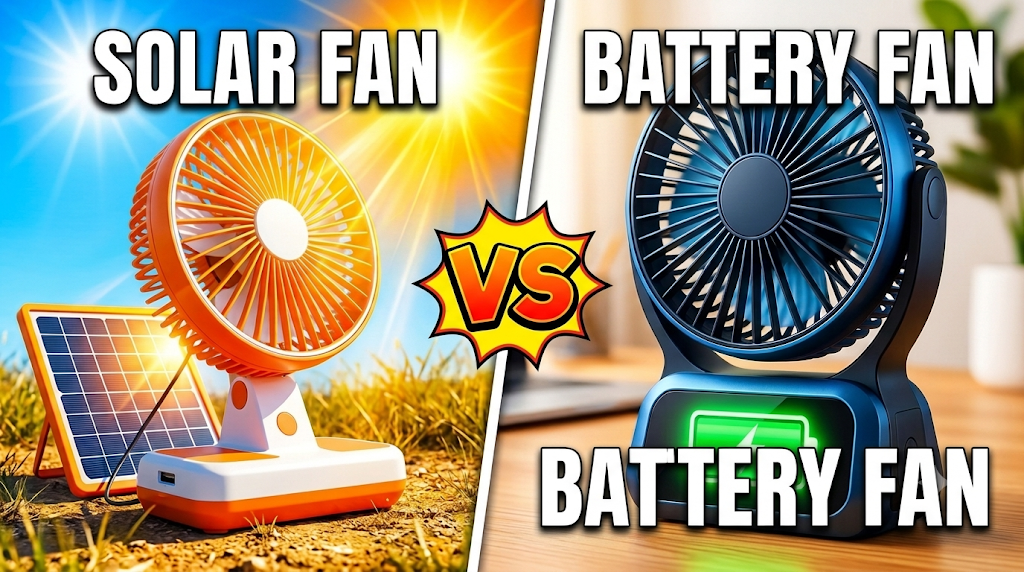
A solar-powered fan and a battery-powered fan both provide airflow without depending entirely on a continuous electricity supply. However, they use different methods to obtain and store energy. A solar-powered fan uses electricity generated by a solar panel, while a battery-powered fan operates using stored electrical energy. Some solar fans also include rechargeable batteries, allowing them to operate after sunset or when sunlight is unavailable. Understanding these differences helps buyers choose the right fan for homes, outdoor activities, shops and areas with frequent power cuts.
The best option depends on where you plan to use the fan, how many hours you need it to operate and whether you have access to sunlight for charging. A solar-powered fan can reduce dependence on grid electricity when suitable sunlight is available, whereas a battery-powered fan offers greater flexibility when it can be charged through a wall adapter or USB connection. Before purchasing either option, it is important to compare charging methods, battery capacity, operating time, portability, maintenance and overall convenience.
Quick Comparison Table
| Feature | Solar-Powered Fan | Battery-Powered Fan |
|---|---|---|
| Main energy source | Solar energy | Stored battery energy |
| Charging method | Solar panel, sometimes mains charging | Wall charger, USB or supported solar input |
| Battery | Optional or included | Usually included |
| Electricity dependency | Low when sunlight is available | Depends on how the battery is charged |
| Daytime operation | Can operate using solar energy | Operates using stored energy |
| Night operation | Requires a charged battery or another power source | Yes, with sufficient battery charge |
| Cloudy weather | Solar charging may decrease | Not directly affected while charged |
| Portability | Depends on panel size and design | Usually convenient to carry |
| Running cost | Low after installation, excluding maintenance | Charging electricity and battery replacement |
| Maintenance | Panel cleaning and battery care if fitted | Battery and charging-system care |
| Best use | Sunny locations and regular daytime operation | Homes, travel and emergency backup |
1. Working Principle
Solar-Powered Fan
A solar-powered fan converts sunlight into electricity through photovoltaic solar panels. The generated electricity powers the fan directly or passes through a charge controller to charge a battery.
Some models operate only when sufficient sunlight is available, while battery-backed models can continue running after sunset. The actual operating time depends on solar panel output, battery capacity and fan power consumption.
Battery-Powered Fan
A battery-powered fan uses stored electricity to operate its motor. Its internal rechargeable battery is generally charged through a wall adapter or USB connection, depending on the model.
Once charged, the fan can operate without a direct electricity connection. Its running time depends on battery capacity, fan speed and additional features such as LED lights or oscillation.
Winner: Depends. Solar-powered fans offer direct access to renewable energy, while battery-powered fans provide straightforward operation using stored electricity.
2. Charging Options
Solar-Powered Fan
Solar-powered fans use solar panels to generate electricity. Some models have integrated panels, while others require a separate solar panel.
Their charging performance depends on sunlight intensity, panel positioning, shading and weather conditions. Certain models also support mains charging, but this feature should be checked before purchasing.
Battery-Powered Fan
Battery-powered fans commonly support charging through an AC adapter or USB connection. This makes charging convenient in homes, offices and other places with electricity.
Some models also support solar charging through a compatible solar panel. However, solar compatibility should not be assumed unless the manufacturer specifies it.
Winner: Battery-Powered Fan. It generally offers more convenient charging in locations with access to electricity, while solar-powered models are useful where sunlight is readily available.
3. Battery Backup and Night Operation
Solar-Powered Fan
A solar-powered fan without a battery generally cannot operate after sunlight becomes unavailable. However, a battery-backed solar fan stores energy during the day and uses it later.
The available backup time depends on battery capacity, charging conditions and the fan’s power consumption.
Battery-Powered Fan
A battery-powered fan can operate during nighttime and power cuts as long as its battery has sufficient charge.
Users can recharge it before use and keep it ready for emergencies. However, the battery eventually needs recharging.
Winner: Battery-Powered Fan. It is generally more convenient for immediate nighttime use because it does not depend on current sunlight or a separate solar installation.
4. Electricity Consumption and Running Cost
Solar-Powered Fan
A solar-powered fan can operate using electricity generated by its solar panel, reducing the need to draw power from the electricity grid.
Once the system is installed, its operating energy can be obtained from sunlight. However, the initial purchase may include additional expenses for solar panels, batteries and charging equipment.
Battery-Powered Fan
A battery-powered fan consumes electricity when its battery is recharged through the mains supply.
Its charging cost depends on battery capacity, charging efficiency, electricity rates and usage frequency. Models with efficient motors and suitable battery capacity can help reduce energy consumption.
Winner: Solar-Powered Fan. It has an advantage when sufficient solar energy is available and the system is properly sized.
5. Portability and Convenience
Solar-Powered Fan
Portable solar fans are available, but models with separate solar panels may require additional space and setup.
The user needs to position the panel where it receives adequate sunlight. This can make some solar-powered systems less convenient for frequent movement.
Battery-Powered Fan
Battery-powered fans are generally easy to move between rooms, offices, vehicles and outdoor locations.
They do not need a solar panel during operation, making them suitable for users who want a simple portable cooling solution.
Winner: Battery-Powered Fan. It is generally more convenient for travelling and everyday movement.
6. Performance During Cloudy Weather
Solar-Powered Fan
Solar panel output decreases when sunlight becomes weak due to clouds, shade or poor positioning. A direct-powered solar fan may slow down or stop when available power becomes insufficient.
A battery-backed model can continue operating using stored energy, although its battery must have enough charge.
Battery-Powered Fan
A battery-powered fan operates using stored electricity, so its performance is not directly affected by cloudy weather.
It can continue working at its selected speed until the battery needs recharging.
Winner: Battery-Powered Fan. It offers more predictable operation during cloudy weather, provided the battery is charged.
7. Maintenance and Durability
Solar-Powered Fan
Solar-powered fans require attention to the solar panel, electrical connections and battery if one is included.
Dust and dirt on the panel can reduce its electricity generation, so periodic cleaning is necessary. The battery may also need replacement after its useful service life.
Battery-Powered Fan
Battery-powered fans require routine cleaning and proper charging practices. Their rechargeable batteries gradually lose capacity with use and may eventually need replacement.
The actual lifespan depends on battery chemistry, operating temperature, charging habits and product quality.
Winner: Depends. Both types require maintenance. Solar models have additional panel-related maintenance, while battery-powered models have fewer external components.
8. Initial Purchase Cost
Solar-Powered Fan
A solar-powered fan may cost more when it includes a solar panel, charge controller and rechargeable battery.
If these components are sold separately, the buyer must consider the total system cost rather than only the advertised fan price.
Battery-Powered Fan
A battery-powered fan generally requires a fan and rechargeable battery, with a compatible charger.
It may be a more economical option for users who need a small portable fan without investing in a separate solar setup.
Winner: Battery-Powered Fan. It is generally the simpler and more affordable starting option, although actual prices depend on features and battery capacity.
9. Best Applications
Solar-Powered Fan
Solar-powered fans are suitable for:
- Homes receiving good sunlight.
- Farms and agricultural buildings.
- Outdoor work areas.
- Shops and small workspaces.
- Locations where reducing grid electricity use is important.
Battery-Powered Fan
Battery-powered fans are suitable for:
- Homes during power cuts.
- Bedrooms and living rooms.
- Offices and shops.
- Camping and travelling.
- Emergency cooling arrangements.
Winner: Depends. Solar-powered fans are useful for regular daytime operation with sunlight, while battery-powered fans are better suited to portable use and flexible indoor operation.
10. Environmental Impact
Solar-Powered Fan
Solar-powered fans use renewable solar energy during operation. They can reduce dependence on electricity generated from fossil fuels.
However, solar panels and batteries require materials and manufacturing processes, and responsible disposal is important.
Battery-Powered Fan
Battery-powered fans usually need electricity from the grid for recharging. Their environmental impact depends partly on the electricity source and the battery’s manufacturing and disposal.
Some models can also be charged using renewable electricity or compatible solar panels.
Winner: Solar-Powered Fan. It generally offers an environmental advantage when it uses renewable solar electricity instead of grid electricity generated from fossil fuels.
Solar-Powered Fan vs Battery-Powered Fan: Final Verdict
Both solar-powered and battery-powered fans offer useful advantages, but the right choice depends on your electricity access, charging facilities and operating requirements.
A solar-powered fan is a good choice for people who receive sufficient sunlight and want to reduce dependence on grid electricity. A battery-powered fan is more suitable for users who need portability, convenient charging and reliable operation during power cuts or at night.
If you want a fan for everyday home use, travelling or emergency backup, a battery-powered model is generally the more convenient option. However, if your priority is using renewable energy and you have a suitable sunny location, a solar-powered fan can be a better long-term choice.
Overall Winner: Depends on Your Requirements.
Frequently Asked Questions (FAQs)
1. Which is better, a solar-powered fan or a battery-powered fan?
A battery-powered fan is generally better for portability and convenient charging, while a solar-powered fan is better for using renewable energy and reducing grid electricity consumption.
2. Can a solar-powered fan work at night?
Yes, but it needs a rechargeable battery or another suitable power source. A direct solar fan without battery storage normally stops when sufficient sunlight is unavailable.
3. Can a battery-powered fan be charged using a solar panel?
Some battery-powered fans support solar charging. However, the solar panel must meet the manufacturer’s specified voltage, current and connector requirements.
4. Which fan is better during power cuts?
Both can work during power cuts if they have sufficient stored energy. A battery-powered fan is generally simpler to prepare because it can be charged before an outage.
5. Does a solar-powered fan need a battery?
Not always. Some solar fans operate directly from solar panels, while others include batteries to store electricity for nighttime and low-sunlight operation.
6. Which fan is better for travelling?
A battery-powered fan is generally better for travelling because it is easy to carry and does not require a separate solar panel during operation.
7. Which fan has lower running costs?
A solar-powered fan can have lower operating costs because it uses sunlight. However, the initial system cost, battery replacement and maintenance should also be considered.
Disclaimer
This comparison is based on general differences between solar-powered and battery-powered fans. Actual performance, battery backup, charging speed, power consumption and operating time vary by model, battery capacity, solar panel output and usage conditions. Always check the manufacturer’s specifications and compatibility requirements before purchasing.