Portable Solar Panel vs Fixed Solar Panel
Introduction
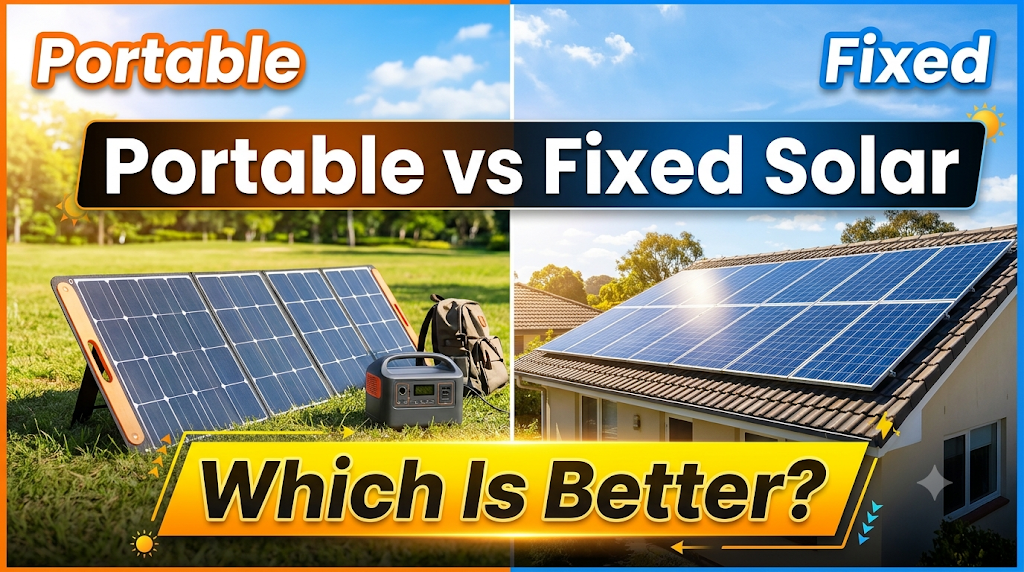
Solar panels are available in different designs to meet residential, commercial, outdoor and off-grid electricity requirements. Portable solar panels and fixed solar panels are two common options for generating electricity from sunlight. Both use photovoltaic technology to convert sunlight into electrical energy, but their construction, installation methods, portability and applications are different. Portable solar panels are designed to be moved and used at different locations, while fixed solar panels are installed permanently on rooftops, ground-mounted structures or other suitable surfaces.
Choosing between these two types depends on how much electricity you need, where you want to generate it and whether you require a permanent or temporary solar power solution. Portable solar panels are useful for camping, travelling, outdoor activities and small backup systems. Fixed solar panels are generally more suitable for homes, businesses and installations requiring regular electricity generation. Understanding their differences can help you select the right solar panel for your requirements.
Quick Comparison Table
| Feature | Portable Solar Panel | Fixed Solar Panel |
|---|---|---|
| Installation | Temporary and movable | Permanent installation |
| Portability | Easy to transport, depending on size | Not designed for regular movement |
| Mounting | Foldable stands or temporary supports | Rooftop or ground-mounted structure |
| Power Capacity | Generally smaller | Available in larger capacities |
| Electricity Generation | Suitable for temporary applications | Suitable for regular electricity generation |
| Position Adjustment | Can be repositioned manually | Usually remains in a fixed position |
| Wiring | Usually connected when required | Permanently connected to the system |
| Maintenance | Requires cleaning and careful handling | Requires periodic inspection and cleaning |
| Initial Cost | Can be higher per watt for some models | Often more economical per watt in larger installations |
| Best For | Camping, travel and portable backup | Homes, offices and commercial properties |
1. Design and Construction
Portable Solar Panel
A portable solar panel is designed for convenient transportation and temporary electricity generation.
Many models use foldable sections with protective fabric covers, handles and built-in stands. Some portable panels use rigid frames, while others use flexible or lightweight construction.
They can be connected to compatible portable power stations, solar generators or other suitable charging systems.
Their design makes them useful when electricity is needed at different locations.
Fixed Solar Panel
A fixed solar panel is designed for permanent installation on rooftops, ground-mounted structures or other suitable surfaces.
These panels generally use rigid frames and protective glass to withstand outdoor conditions.
They are connected to a solar inverter, charge controller or other compatible equipment depending on the system configuration.
Fixed panels are commonly used in residential, commercial and industrial solar installations.
2. Installation and Setup
Portable Solar Panel
Portable solar panels generally require less installation work.
Users can unfold or position the panel, adjust its stand towards the sunlight and connect it to a compatible power station or charging device.
No permanent mounting structure is normally required.
However, users must ensure that the panel is positioned securely and that the electrical connectors are compatible with the connected equipment.
Fixed Solar Panel
Fixed solar panels require a permanent mounting arrangement.
Installation may involve rooftop structures, mounting rails, brackets, electrical cables, protective equipment and inverter connections.
The installer must consider roof strength, sunlight exposure, panel orientation, tilt angle and shading.
Although the initial installation requires more work, the system can generate electricity regularly without daily setup.
Winner: Portable Solar Panel for easier temporary setup, while fixed panels are better for permanent installations.
3. Portability and Transportation
Portable Solar Panel
Portability is the main advantage of this type of solar panel.
Foldable models can be carried in vehicles and transported to camping sites, outdoor locations and temporary work areas.
Some lightweight models are easy to move and reposition according to sunlight availability.
However, larger portable panels can still be heavy and may require careful handling.
Fixed Solar Panel
Fixed solar panels are installed permanently and are not designed for regular transportation.
Their rigid construction and mounting arrangements make relocation difficult.
If the system needs to be moved, the panels generally require professional removal and reinstallation.
Winner: Portable Solar Panel for transportation and mobility.
4. Power Capacity and Electricity Generation
Portable Solar Panel
Portable solar panels are generally available in smaller power capacities because their design prioritizes transportation and convenience.
They can generate electricity for mobile devices, laptops, portable power stations and selected small appliances when connected to compatible equipment.
Actual electricity generation depends on panel wattage, sunlight intensity, temperature, positioning and shading.
They may not be suitable for meeting large household electricity requirements on their own.
Fixed Solar Panel
Fixed solar panels are available in a wide range of power ratings and can be combined into larger solar arrays.
A residential or commercial system can use multiple panels to generate electricity according to its energy requirements.
Their permanent installation makes them suitable for regular electricity generation throughout the year.
Actual output depends on installed capacity, location, weather, orientation, shading and system efficiency.
Winner: Fixed Solar Panel for larger electricity generation and household or commercial applications.
5. Sunlight Positioning and Efficiency
Portable Solar Panel
Portable solar panels can be repositioned throughout the day to improve their exposure to sunlight.
Users can adjust their direction and tilt according to the sun’s position.
This flexibility can help improve energy collection when the panel is used correctly.
However, users may need to adjust the panel manually, and its position can change because of wind or movement.
Fixed Solar Panel
Fixed solar panels are installed at a selected direction and tilt angle based on the location and system design.
They generally remain in the same position throughout the year.
A properly designed fixed installation can provide reliable electricity generation without requiring daily manual adjustment.
However, the panel angle may not be ideal for every season.
Winner: Portable Solar Panel for manual positioning flexibility, while fixed panels offer more convenient permanent operation.
6. Cost and Value for Money
Portable Solar Panel
Portable solar panels can have a higher cost per watt in some product categories because of their foldable construction, lightweight materials, protective covers and portability features.
Users may also need to purchase a compatible power station, charging controller or connecting accessories.
They are generally a practical investment when electricity is required temporarily at different locations.
Fixed Solar Panel
Fixed solar panels are often more economical per watt in larger installations because of standardized panel construction and bulk purchasing.
However, the complete system also requires mounting structures, electrical connections, installation labour and compatible power equipment.
For long-term household electricity generation, fixed panels can offer better overall value.
Winner: Fixed Solar Panel for larger permanent installations and generally lower cost per watt.
7. Durability and Weather Resistance
Portable Solar Panel
Portable solar panels are designed for transportation, so their construction varies by model.
Foldable panels may use protective fabric, plastic covers or other lightweight materials.
They need careful handling to prevent damage during folding, transportation and storage.
Their resistance to rain, dust and physical impact depends on the manufacturer’s specifications.
Fixed Solar Panel
Fixed solar panels are generally designed for long-term outdoor installation.
Rigid frames, protective glass and mounting structures help them withstand normal outdoor conditions.
However, they still require proper installation and protection against extreme weather, physical damage and incorrect handling.
Winner: Fixed Solar Panel for long-term permanent outdoor installation.
8. Maintenance and Cleaning
Portable Solar Panel
Portable solar panels require regular cleaning to remove dust and dirt from their surfaces.
Their folding joints, cables, connectors and protective covers should also be checked periodically.
Since they are frequently moved, users should inspect them for scratches, cracks and other physical damage.
Fixed Solar Panel
Fixed solar panels also require occasional cleaning and inspection.
Dust, leaves, bird droppings and other materials can reduce sunlight absorption.
The mounting structure, cables, connectors and electrical components should be checked periodically by a qualified professional.
Winner: Fixed Solar Panel for routine handling convenience, as it does not require repeated folding, transportation and setup.
9. Applications and Suitable Locations
Portable Solar Panel
Portable solar panels are suitable for:
- Camping and outdoor activities.
- Road trips and travelling.
- Portable power stations.
- Mobile charging requirements.
- Remote work locations.
- Temporary electricity backup.
- Outdoor photography and recreational activities.
They are especially useful when users need electricity away from permanent power connections.
Fixed Solar Panel
Fixed solar panels are suitable for:
- Residential rooftop solar systems.
- Commercial buildings.
- Industrial facilities.
- Schools and institutions.
- Agricultural applications.
- Permanent off-grid installations.
- Large solar electricity projects.
They are useful when regular electricity generation is required over a long period.
10. Advantages and Disadvantages
Portable Solar Panel
Advantages
- Easy to transport and reposition.
- Requires little or no permanent installation.
- Useful for camping and travelling.
- Can charge compatible portable power stations.
- Available in foldable and lightweight designs.
- Can be adjusted according to sunlight direction.
Disadvantages
- Generally smaller power capacity.
- Can be more expensive per watt.
- Requires manual positioning and setup.
- May need careful handling during transportation.
- Not ideal for large household electricity requirements.
- Some models have limited weather protection.
Fixed Solar Panel
Advantages
- Suitable for regular electricity generation.
- Available in larger system capacities.
- Generally lower cost per watt in larger installations.
- Designed for permanent outdoor use.
- Can support residential and commercial solar systems.
- Does not require daily setup or repositioning.
Disadvantages
- Requires permanent installation.
- Not convenient to transport.
- Initial mounting and installation expenses.
- Panel direction and tilt are generally fixed.
- Relocation can require professional work.
- Shading and poor installation positioning can reduce output.
11. Which One Should You Choose?
The right choice depends on your electricity requirements and how you plan to use solar energy.
Choose a portable solar panel if you need a movable electricity-generation solution for camping, travelling, outdoor activities or charging a portable power station. It is a practical option when you do not need a permanent solar installation.
Choose a fixed solar panel if you want regular electricity generation for your home, office, shop, farmhouse or commercial property. It is generally more suitable for larger installations and long-term solar power requirements.
Before purchasing either type, compare panel wattage, efficiency, dimensions, weight, connector compatibility, warranty and expected electricity generation. For portable models, also check folding arrangements and weather protection. For fixed installations, consider roof strength, shading, mounting structures and inverter compatibility.
Conclusion
Portable solar panels and fixed solar panels both convert sunlight into electricity, but they are designed for different applications. Portable solar panels offer mobility, convenient setup and flexibility for outdoor electricity requirements. Fixed solar panels provide a more permanent solution for regular electricity generation and larger energy needs.
Overall, portable solar panels are better for travelling, camping and temporary power requirements, while fixed solar panels are better for homes, businesses and permanent solar installations. Select the option that matches your required power capacity, installation location and long-term electricity needs.
Frequently Asked Questions (FAQs)
1. What is the main difference between portable and fixed solar panels?
Portable solar panels are designed to be moved and used at different locations, while fixed solar panels are permanently installed on rooftops or ground-mounted structures.
2. Which solar panel is better for home use?
Fixed solar panels are generally better for home use because they support larger installations and regular electricity generation.
3. Can portable solar panels power a house?
Small portable solar panels are generally not sufficient for running an entire house. Larger portable systems can provide backup for selected appliances, depending on their capacity and connected equipment.
4. Can portable solar panels charge a power station?
Yes. Many portable solar panels are designed to charge compatible power stations. However, users must check voltage, current, connector type and maximum solar input specifications.
5. Are fixed solar panels more efficient than portable solar panels?
Not necessarily. Both can use similar photovoltaic technologies. Actual efficiency depends on the solar cells, construction, temperature and operating conditions rather than portability alone.
6. Which solar panel is easier to maintain?
Both require periodic cleaning and inspection. Fixed panels generally require less frequent handling, while portable panels need careful storage and transportation.
7. Can portable solar panels work during cloudy weather?
Yes, they can generate some electricity in cloudy conditions, but their output generally decreases because less sunlight reaches the solar cells.
8. How long do fixed solar panels last?
Many fixed solar panels are designed to operate for 25 years or longer. Actual performance and lifespan depend on product quality, environmental conditions, installation and maintenance.
Disclaimer
The specifications, wattage, efficiency, prices, construction materials and performance of portable and fixed solar panels vary by manufacturer and model. Actual electricity generation depends on sunlight exposure, temperature, shading, panel positioning and installation conditions. Always verify product specifications, electrical compatibility, warranty details and installation requirements before purchasing.