AC-Coupled vs DC-Coupled Solar Battery
Introduction
AC-coupled and DC-coupled solar batteries are two different ways of connecting battery storage to a solar power system. Both configurations allow homeowners to store electricity generated by solar panels and use it later when sunlight is unavailable. The main difference is where the battery connects to the solar system and how electricity moves between solar panels, batteries, inverters and household appliances. Understanding these differences is important when installing a new solar system or adding battery storage to an existing rooftop solar installation.
An AC-coupled system generally uses a separate battery inverter, while a DC-coupled system connects the solar panels and battery through a compatible hybrid inverter or DC power-management arrangement. Each option has advantages in terms of energy conversion, installation, compatibility, expansion and cost. The right choice depends on whether you already have solar panels, whether your existing inverter needs replacement and how efficiently you want to store and use solar electricity.
Quick Comparison Table
| Feature | AC-Coupled Solar Battery | DC-Coupled Solar Battery |
|---|---|---|
| Battery connection | AC side | DC side |
| Inverter arrangement | Separate battery inverter | Shared compatible hybrid inverter |
| Solar-to-battery conversion | More conversion stages | Fewer conversion stages |
| Energy efficiency | Generally slightly lower | Generally higher |
| Existing solar system | Easier to retrofit | May require inverter replacement |
| New solar installation | Suitable | Often preferred |
| Installation complexity | Generally easier for retrofits | Depends on system design |
| Initial equipment | May require an additional inverter | Can use one hybrid inverter |
| Grid charging | Supported by many systems | Depends on hybrid inverter |
| Battery expansion | Depends on inverter and battery compatibility | Depends on hybrid inverter limits |
| Maintenance | Separate inverter equipment | Integrated inverter arrangement |
| Best use | Adding batteries to existing solar | Installing new solar with battery storage |
1. Working Principle
AC-Coupled Solar Battery
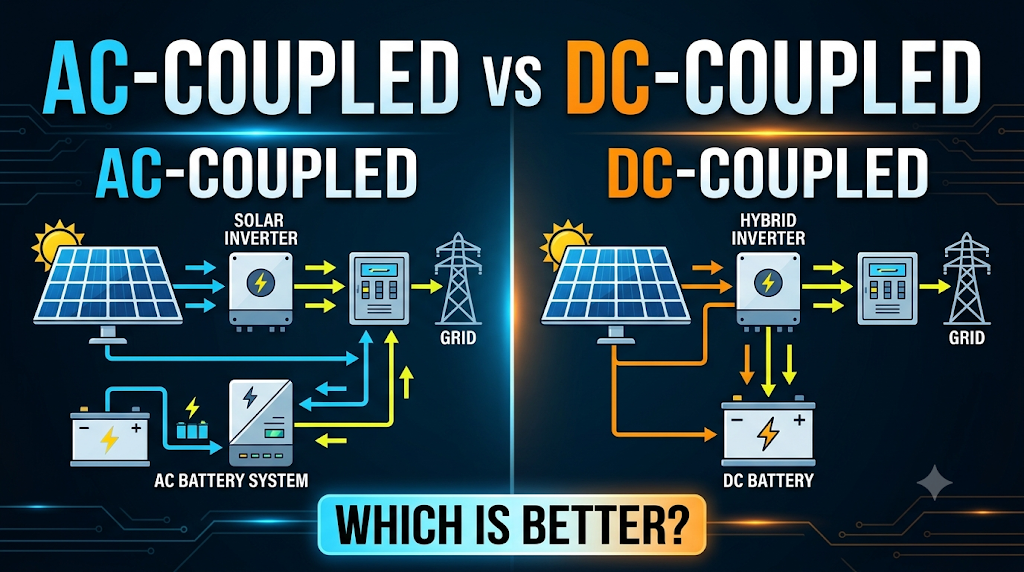
An AC-coupled solar battery connects to the AC side of the solar installation through a separate battery inverter.
Solar panels first generate DC electricity, which the existing solar inverter converts into AC electricity. When excess solar electricity is available, the battery inverter converts the AC electricity back into DC to charge the battery.
When stored electricity is needed, the battery inverter converts DC battery electricity into AC for household appliances.
This arrangement allows battery storage to work alongside an existing solar inverter.
DC-Coupled Solar Battery
A DC-coupled solar battery connects to the DC side of the solar installation through a compatible hybrid inverter or charge controller.
Solar panels generate DC electricity, which can charge the battery through an appropriate DC charging system. When household appliances need electricity, the hybrid inverter converts the stored DC electricity into AC.
This arrangement reduces the number of conversion stages between solar panels and battery storage.
Winner: DC-Coupled Solar Battery. It generally offers a simpler energy-conversion path for storing solar electricity.
2. Energy Conversion Efficiency
AC-Coupled Solar Battery
In an AC-coupled arrangement, solar electricity may pass through multiple conversion stages before reaching the battery and returning to household appliances.
These conversions create energy losses. However, actual performance depends on inverter efficiency, battery characteristics, system design and operating conditions.
DC-Coupled Solar Battery
A DC-coupled system can send solar electricity directly to battery storage through a compatible charge controller or hybrid inverter.
Because it avoids some DC-to-AC-to-DC conversion steps, it generally offers better solar charging efficiency.
Winner: DC-Coupled Solar Battery. It generally has fewer conversion losses when storing solar-generated electricity.
3. Installation Cost
AC-Coupled Solar Battery
AC-coupled systems can be economical when adding a battery to an existing solar installation.
The existing solar inverter can usually remain in place, while a separate battery inverter is installed. This can avoid the expense and disruption of replacing a working solar inverter.
However, the additional inverter and electrical equipment also contribute to the total installation cost.
DC-Coupled Solar Battery
DC-coupled systems can reduce equipment requirements when solar panels and battery storage are installed together.
A compatible hybrid inverter can manage both solar generation and battery charging, potentially reducing the need for separate inverters.
However, converting an existing system to DC coupling may require replacing the current inverter and modifying electrical connections.
Winner: Depends. DC coupling can be economical for new installations, while AC coupling can be more economical for suitable existing solar systems.
4. Compatibility with Existing Solar Systems
AC-Coupled Solar Battery
AC coupling is generally easier to integrate with an existing grid-connected solar installation.
Since the battery has its own inverter, homeowners may be able to retain their existing solar panels and inverter without major changes.
However, the battery inverter, control system and electrical protection must still be compatible with the installation.
DC-Coupled Solar Battery
DC coupling requires compatible connections between solar panels, batteries, charge controllers and hybrid inverters.
An existing conventional grid-tied inverter may need to be replaced with a compatible hybrid inverter before a DC-coupled battery can be installed.
Winner: AC-Coupled Solar Battery. It is generally more convenient when adding storage to an existing solar system.
5. Battery Charging and Discharging
AC-Coupled Solar Battery
An AC-coupled battery receives electricity through its battery inverter. It can store excess solar electricity after the solar inverter converts it into AC.
When required, the stored electricity is converted back into AC for home consumption.
Many AC-coupled systems can also support grid charging, depending on their configuration and settings.
DC-Coupled Solar Battery
A DC-coupled battery receives electricity through a compatible DC charging arrangement.
Solar electricity can charge the battery without first being converted into AC. During discharge, the hybrid inverter supplies AC electricity to household appliances.
Grid charging may also be supported by some hybrid inverter models.
Winner: DC-Coupled Solar Battery. It generally provides a more direct path for solar battery charging.
6. Installation Complexity
AC-Coupled Solar Battery
AC coupling can simplify battery installation when an existing solar system is already working properly.
The battery inverter connects to the AC electrical system, reducing the need to redesign the existing solar panel connections.
However, additional equipment, wiring, protection and system controls are still required.
DC-Coupled Solar Battery
DC coupling requires proper coordination between the solar panels, battery, hybrid inverter and charging equipment.
When installing everything together, the arrangement can be straightforward. Retrofitting an existing conventional solar installation can be more complicated because of inverter compatibility and wiring requirements.
Winner: AC-Coupled Solar Battery. It generally has an installation advantage for retrofitting an existing solar system.
7. Battery Backup During Power Cuts
AC-Coupled Solar Battery
An AC-coupled system can provide backup electricity during a grid outage when it includes a suitable battery inverter, backup output and isolation equipment.
The system must be designed to disconnect safely from the grid and supply the required household circuits.
Not every AC-coupled installation automatically provides backup functionality.
DC-Coupled Solar Battery
A DC-coupled system can also provide backup electricity through a compatible hybrid inverter.
Depending on the design, it may use stored battery energy and available solar generation to supply selected household appliances during an outage.
Backup power depends on inverter specifications, battery capacity, electrical protection and installation configuration.
Winner: Tie. Both systems can provide backup electricity when designed with suitable backup functionality.
8. Maintenance and Reliability
AC-Coupled Solar Battery
AC-coupled systems use separate solar and battery inverter equipment.
This arrangement can make individual components easier to identify and service. However, there are additional electrical components and connections to maintain.
DC-Coupled Solar Battery
DC-coupled systems can use one hybrid inverter to manage solar generation and battery storage.
This can reduce the number of separate inverter units, but the hybrid inverter becomes an important shared component.
The reliability of either arrangement depends on product quality, installation standards, operating temperature and maintenance.
Winner: Depends. Both configurations can provide reliable operation when properly designed and maintained.
9. Future Expansion
AC-Coupled Solar Battery
AC-coupled systems can offer flexibility when adding battery storage to an existing solar installation.
However, additional batteries must be compatible with the battery inverter, communication system and available power capacity.
DC-Coupled Solar Battery
DC-coupled systems can support additional battery modules when the hybrid inverter and battery manufacturer allow expansion.
However, battery voltage, capacity, charging current and inverter limits must be considered before adding more storage.
Winner: Depends. Expansion possibilities depend more on the selected equipment and its supported configuration than on coupling type alone.
10. Best Applications
AC-Coupled Solar Battery
AC-coupled systems are suitable for:
- Homes with existing rooftop solar panels.
- Homeowners who want to add battery storage.
- Installations where the existing solar inverter is working properly.
- Solar systems where replacing the existing inverter is not economical.
- Projects requiring separate solar and battery inverter equipment.
DC-Coupled Solar Battery
DC-coupled systems are suitable for:
- New solar panel installations with battery storage.
- Homes planning an integrated solar and battery system.
- Installations prioritising solar storage efficiency.
- Compatible hybrid inverter systems.
- Off-grid and hybrid solar installations.
Winner: Depends. AC coupling is generally better for suitable existing solar installations, while DC coupling is often better for new solar-plus-battery installations.
AC-Coupled vs DC-Coupled Solar Battery: Final Verdict
Both AC-coupled and DC-coupled solar batteries can provide effective home energy storage, but they are designed for different installation requirements.
An AC-coupled solar battery is generally the better choice when you already have a working rooftop solar system and want to add battery storage without replacing your existing solar inverter. It offers installation flexibility and can reduce retrofit disruption.
A DC-coupled solar battery is generally the better choice when installing solar panels and battery storage together. It can reduce energy conversion losses and may require fewer inverter components when a compatible hybrid inverter is used.
Overall Winner: DC-Coupled Solar Battery for New Installations.
Best for Existing Solar Systems: AC-Coupled Solar Battery.
The final decision should consider inverter compatibility, battery capacity, backup requirements, installation cost and the manufacturer’s specifications.
Frequently Asked Questions (FAQs)
1. What is the main difference between AC-coupled and DC-coupled solar batteries?
The main difference is where the battery connects. An AC-coupled battery connects to the AC side through a separate battery inverter, while a DC-coupled battery connects to the DC side through a compatible hybrid inverter or charging system.
2. Which is more efficient, AC-coupled or DC-coupled?
DC-coupled systems generally offer better efficiency for storing solar electricity because they avoid some additional conversion stages.
3. Can an AC-coupled battery work with an existing solar inverter?
Yes. AC-coupled batteries are commonly used to add storage to existing solar installations, provided the equipment and electrical configuration are compatible.
4. Is a DC-coupled battery better for a new solar installation?
Generally, yes. A DC-coupled system can combine solar generation and battery storage through a compatible hybrid inverter, reducing conversion losses and potentially equipment requirements.
5. Can both AC-coupled and DC-coupled batteries provide backup during power cuts?
Yes. Both can provide backup power if the system includes suitable backup functionality, isolation equipment and compatible inverters.
6. Can an AC-coupled battery charge from the electricity grid?
Many AC-coupled battery systems support grid charging, but the feature depends on the battery inverter, system configuration and local regulations.
7. Which solar battery system is better for home use?
DC coupling is often preferable for a new integrated solar installation, while AC coupling is generally more convenient when adding battery storage to an existing solar system.
Disclaimer
This comparison is based on general AC-coupled and DC-coupled solar battery configurations. Actual efficiency, installation costs, compatibility, backup functionality and expansion options vary by inverter, battery model, solar panel arrangement and installation conditions. Always consult a qualified solar installer and check manufacturer specifications before purchasing or installing a system.