Lead-Acid vs Lithium-Ion Home Backup Battery
This comparison will cover battery life, backup time, charging speed, efficiency, maintenance, safety, installation cost and long-term value.
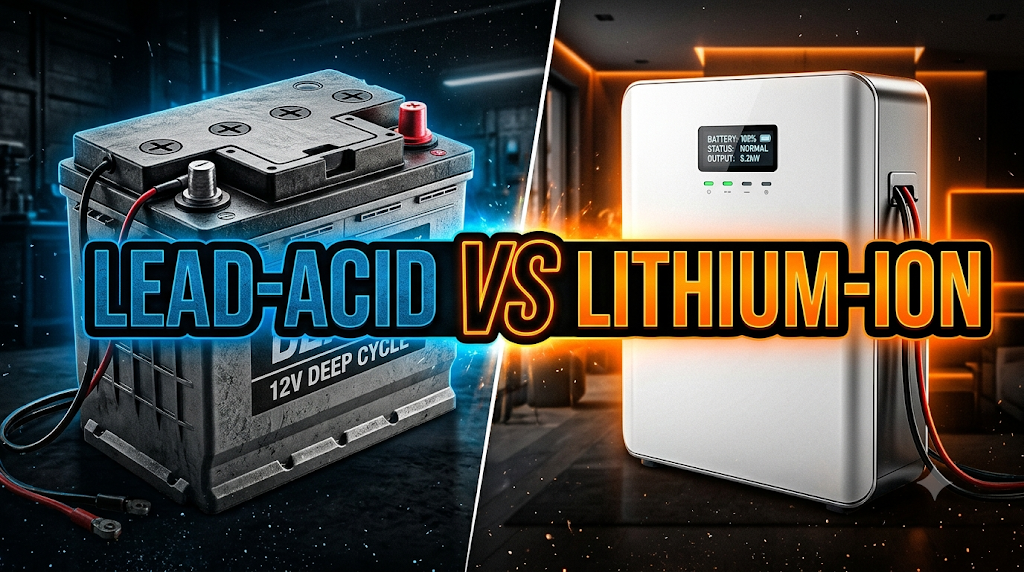
40. Lead-Acid vs Lithium-Ion Home Backup Battery: Which Is Better?
Introduction
Lead-acid and lithium-ion batteries are two popular technologies used for home backup electricity. Both store electrical energy and supply power to household appliances when the main electricity supply is unavailable. Lead-acid batteries, including tubular and flat-plate models, have been widely used with home inverters for many years. Lithium-ion batteries, particularly Lithium Iron Phosphate (LiFePO4 or LFP), are becoming increasingly popular because of their longer cycle life, higher usable capacity and faster charging capabilities.
Choosing between these batteries depends on your budget, electricity requirements, backup duration and expected usage. Lead-acid batteries generally have a lower initial purchase cost, making them attractive for households looking for an affordable backup solution. Lithium-ion batteries usually cost more initially but offer advantages in charging speed, maintenance, space requirements and long-term performance. Comparing their features helps homeowners select a battery that provides suitable backup and value over its service life.
Quick Comparison Table
| Feature | Lead-Acid Battery | Lithium-Ion Battery |
|---|---|---|
| Initial cost | Generally lower | Generally higher |
| Battery lifespan | Generally shorter | Generally longer |
| Cycle life | Lower | Higher |
| Usable capacity | Usually around 50% for regular deep-cycle use | Often 80–90% or more, depending on model |
| Charging speed | Generally slower | Generally faster |
| Charging efficiency | Generally lower | Generally higher |
| Maintenance | May require water topping | Generally maintenance-free |
| Weight | Heavy | Lighter |
| Space requirement | Larger | More compact |
| Backup performance | Suitable for home backup | Suitable for home backup |
| Safety requirements | Ventilation and correct installation | BMS and thermal protection |
| Best use | Budget-friendly backup | Long-term, frequent backup |
1. Battery Working Technology
Lead-Acid Home Backup Battery
A lead-acid battery stores electricity through a chemical reaction between lead plates and an electrolyte solution containing sulphuric acid.
During charging, electrical energy is converted into chemical energy. During a power cut, the stored energy is converted back into electricity to operate household appliances through an inverter.
Common home backup options include flat-plate, tubular, AGM and gel batteries. Their construction, maintenance requirements and performance differ.
Lithium-Ion Home Backup Battery
A lithium-ion battery stores and releases electricity through the movement of lithium ions between its electrodes.
Home backup systems commonly use Lithium Iron Phosphate (LiFePO4 or LFP) technology. These batteries generally include a Battery Management System (BMS) to monitor cell voltage, temperature and charging and discharging conditions.
The BMS helps protect the battery against unsafe operating conditions and supports reliable performance.
Winner: Lithium-Ion Battery. It offers more advanced energy storage technology and generally better performance for frequent home backup use.
2. Battery Lifespan
Lead-Acid Home Backup Battery
Lead-acid batteries generally have a shorter service life than lithium-ion batteries.
Their lifespan depends on battery construction, charging practices, operating temperature, depth of discharge and maintenance. Frequently discharging a lead-acid battery too deeply can reduce its useful life.
Tubular batteries are commonly selected for home inverters because they are designed for repeated backup cycles.
Lithium-Ion Home Backup Battery
Lithium-ion batteries, particularly LFP models, generally offer a longer cycle life.
They can withstand more charging and discharging cycles when operated within the manufacturer’s recommended limits. Their actual lifespan depends on cell quality, temperature, charge levels and BMS protection.
Winner: Lithium-Ion Battery. It generally provides a longer service life and can reduce the frequency of battery replacement.
3. Charging Speed
Lead-Acid Home Backup Battery
Lead-acid batteries generally require more time to recharge, particularly during the final stage of charging.
Their charging speed depends on battery capacity, charger output, temperature and battery condition. Repeated incomplete charging can also affect battery health.
Lithium-Ion Home Backup Battery
Lithium-ion batteries generally accept higher charging rates than comparable lead-acid batteries.
This allows them to recharge more quickly when the inverter or charger supports the required charging current.
Faster charging is particularly useful in areas where electricity is available for only a few hours between power cuts.
Winner: Lithium-Ion Battery. It generally offers faster charging and better charge acceptance.
4. Backup Capacity and Usable Energy
Lead-Acid Home Backup Battery
A lead-acid battery’s rated capacity is not normally used completely during regular home backup operation.
For many deep-cycle applications, using approximately 50% of rated capacity helps limit excessive discharge and extend battery life.
For example, a 150Ah lead-acid battery should not automatically be treated as providing 150Ah of regularly usable capacity.
Lithium-Ion Home Backup Battery
Lithium-ion batteries generally allow a higher percentage of their rated capacity to be used.
Depending on the battery model and manufacturer’s recommended depth of discharge, approximately 80–90% or more may be usable.
This means a lithium battery with a lower rated capacity can sometimes provide comparable usable energy to a larger lead-acid battery.
Winner: Lithium-Ion Battery. It generally provides more usable energy from its rated capacity.
5. Maintenance Requirements
Lead-Acid Home Backup Battery
Flooded lead-acid batteries require periodic maintenance, including checking electrolyte levels and adding distilled water when necessary.
Users may also need to clean battery terminals and inspect connections for corrosion.
Sealed AGM and gel lead-acid batteries do not normally require regular water topping, but they still need proper charging and inspection.
Lithium-Ion Home Backup Battery
Lithium-ion batteries generally require very little routine maintenance.
LFP home batteries usually have an integrated BMS that monitors battery operation. Users should still follow manufacturer instructions and keep the installation area clean and suitable for operation.
Winner: Lithium-Ion Battery. It requires less routine maintenance than flooded lead-acid batteries.
6. Charging Efficiency and Energy Loss
Lead-Acid Home Backup Battery
Lead-acid batteries generally have lower charging and discharging efficiency than lithium-ion batteries.
Some of the electricity used during charging is lost through internal resistance and chemical processes.
Their efficiency can also decrease when batteries are old, poorly maintained or operated under unsuitable conditions.
Lithium-Ion Home Backup Battery
Lithium-ion batteries generally offer higher round-trip efficiency.
More of the electricity used for charging can be recovered during discharge, making them useful for frequent backup and solar energy storage applications.
Actual efficiency depends on battery chemistry, inverter efficiency, charging rate and operating conditions.
Winner: Lithium-Ion Battery. It generally provides better energy efficiency.
7. Weight and Installation Space
Lead-Acid Home Backup Battery
Lead-acid batteries are relatively heavy because they contain lead plates and electrolyte.
A home requiring multiple batteries may need additional floor space and a suitable installation arrangement.
Proper ventilation is important, particularly for flooded batteries.
Lithium-Ion Home Backup Battery
Lithium-ion batteries generally store more energy in a smaller and lighter package.
This makes them easier to accommodate in homes where floor space is limited.
However, installation must still follow the manufacturer’s requirements for mounting, ventilation, temperature and electrical protection.
Winner: Lithium-Ion Battery. It generally offers a more compact and lightweight installation.
8. Safety and Protection
Lead-Acid Home Backup Battery
Lead-acid batteries contain corrosive sulphuric acid. Flooded batteries can release hydrogen gas during charging, so adequate ventilation is necessary.
Users should avoid sparks, open flames and incorrect charging practices around battery installations.
Proper handling and maintenance are important for safe operation.
Lithium-Ion Home Backup Battery
Lithium-ion batteries require suitable electronic protection because overheating, overcharging, physical damage or internal faults can create safety risks.
A quality LFP battery with an appropriate BMS, temperature monitoring and compatible inverter is important for home installations.
LFP chemistry generally has better thermal stability than several other lithium-ion chemistries, but it is not risk-free.
Winner: Depends. Both battery types require proper installation and protection. Quality LFP batteries offer good thermal stability, while lead-acid batteries require attention to acid handling and ventilation.
9. Initial Purchase Cost and Long-Term Value
Lead-Acid Home Backup Battery
Lead-acid batteries generally have a lower upfront purchase price.
This makes them attractive for households that need basic inverter backup and want to minimise their initial investment.
However, shorter service life, maintenance and more frequent replacement can increase the total cost over several years.
Lithium-Ion Home Backup Battery
Lithium-ion batteries generally require a higher initial investment.
However, their longer cycle life, higher usable capacity, faster charging and lower maintenance requirements can provide better long-term value.
The final cost also depends on battery capacity, inverter compatibility, warranty and installation expenses.
Winner: Depends. Lead-acid is generally better for a limited initial budget, while lithium-ion can offer better long-term value for frequent use.
10. Best Applications
Lead-Acid Home Backup Battery
Lead-acid batteries are suitable for:
- Homes with limited battery budgets.
- Basic inverter backup requirements.
- Households with occasional power cuts.
- Existing inverters designed for lead-acid batteries.
- Users who are comfortable with battery maintenance.
Lithium-Ion Home Backup Battery
Lithium-ion batteries are suitable for:
- Homes experiencing frequent power cuts.
- Solar energy storage systems.
- Households requiring faster battery charging.
- Installations with limited space.
- Users looking for longer battery life and lower maintenance.
Winner: Depends. Lead-acid is suitable for affordable basic backup, while lithium-ion is generally better for frequent and long-term use.
Lead-Acid vs Lithium-Ion Home Backup Battery: Final Verdict
Both lead-acid and lithium-ion batteries can provide reliable electricity backup when correctly selected and installed. However, they offer different advantages.
A lead-acid battery is a practical choice for homeowners who want a lower initial investment and need basic backup for lights, fans and other essential appliances. Tubular lead-acid batteries remain a common option for traditional home inverter systems.
A lithium-ion battery is generally the better choice for homeowners who want faster charging, higher usable capacity, longer battery life and less maintenance. LFP batteries are particularly attractive for modern home backup and solar storage systems.
Overall Winner: Lithium-Ion Battery.
Best for a Lower Initial Budget: Lead-Acid Battery.
Best for Long-Term Performance: Lithium-Ion Battery.
Before purchasing, check the battery’s usable capacity, inverter compatibility, charging specifications, warranty, safety protection and installation requirements.
Frequently Asked Questions (FAQs)
1. Which is better for home backup, lead-acid or lithium-ion?
Lithium-ion is generally better for long-term home backup because it offers faster charging, higher usable capacity, longer cycle life and lower maintenance. Lead-acid is more affordable initially.
2. Which battery lasts longer, lead-acid or lithium-ion?
Lithium-ion batteries generally last longer than lead-acid batteries, particularly when comparing quality LFP batteries with conventional deep-cycle lead-acid models.
3. Is a lithium-ion battery worth the extra cost?
It can be worth the additional investment for households with frequent power cuts, regular battery cycling and long-term backup requirements. The decision should consider the total cost over the battery’s service life.
4. Can I use a lithium-ion battery with my existing home inverter?
Not every inverter supports lithium-ion batteries. Check the inverter manufacturer’s compatibility list, charging voltage, current limits and communication requirements before connecting one.
5. Which battery charges faster?
Lithium-ion batteries generally charge faster than lead-acid batteries when the charger and inverter support their required charging rates.
6. Is a lithium-ion battery safe for home use?
A quality lithium-ion battery, particularly an LFP model with a suitable BMS and proper installation, can be used safely in homes. Correct charging, temperature protection and manufacturer instructions are important.
7. Which battery is better for solar power systems?
Lithium-ion, especially LFP, is generally better for frequent solar charging and discharging because of its higher usable capacity and longer cycle life. Lead-acid can also be used when the system is properly designed.
Disclaimer
This comparison is based on general characteristics of lead-acid and lithium-ion home backup batteries. Actual lifespan, charging time, usable capacity, efficiency, safety and pricing vary by battery chemistry, brand, model, usage and environmental conditions. Battery specifications and inverter compatibility should always be checked before purchasing or installation.