Online UPS vs Line-Interactive UPS
Introduction
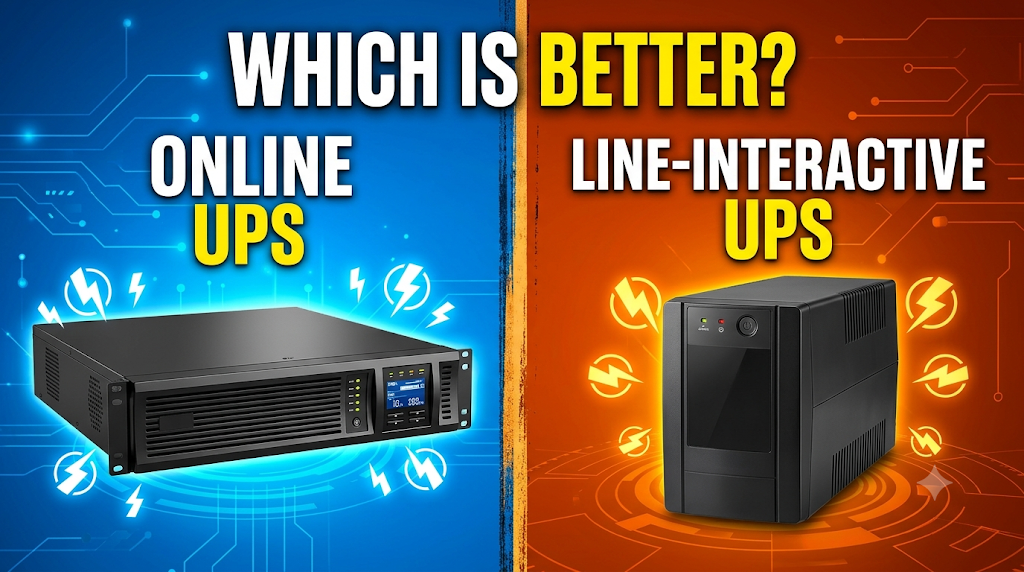
Online UPS and line-interactive UPS are two popular types of Uninterruptible Power Supply (UPS) systems used to protect computers, servers, networking equipment and other electronic devices from power interruptions. Both provide battery backup during power cuts, but their working principles and levels of electrical protection are different. A line-interactive UPS uses Automatic Voltage Regulation (AVR) to correct certain voltage fluctuations and switches to battery power when the input supply goes outside its acceptable range. An online UPS uses double-conversion technology to continuously supply power through its inverter.
Choosing between these UPS types depends on the sensitivity of your equipment, the quality of your electricity supply, backup requirements and available budget. A line-interactive UPS is generally suitable for desktop computers, small offices and networking equipment because it offers a good balance of cost and protection. An online UPS is designed for critical equipment that requires continuous power and better isolation from electrical disturbances. Comparing their features helps users select the right UPS for home, office, computer lab and server applications.
Quick Comparison Table
| Feature | Online UPS | Line-Interactive UPS |
|---|---|---|
| Technology | Double conversion | AVR and battery inverter |
| Power supply | Continuously through inverter | Normally through conditioned mains |
| Transfer time | Zero in normal online mode | Brief, model-dependent |
| Voltage regulation | Continuous output regulation | AVR corrects certain voltage variations |
| Frequency regulation | Independent output regulation | Generally follows input frequency |
| Power protection | Very high | Good |
| Battery usage | Battery is available on the DC bus | Battery used during specified power events |
| Power efficiency | Generally lower in normal double-conversion mode | Generally higher |
| Heat generation | Generally higher | Generally lower |
| Noise | May have continuous cooling fan noise | Often quieter |
| Initial cost | Generally higher | Generally lower |
| Best use | Servers and critical equipment | Computers and small offices |
1. Working Principle
Online UPS
An online UPS uses double-conversion technology to supply electricity to connected equipment.
First, it converts incoming AC electricity into DC electricity through a rectifier. The DC supply supports the inverter and charges the battery. The inverter then converts DC electricity back into AC electricity for connected devices.
The output is continuously supplied by the inverter during normal online operation. When the mains supply fails, the battery supports the DC bus, so there is no normal mains-to-battery transfer interruption.
Line-Interactive UPS
A line-interactive UPS normally supplies electricity through a voltage-conditioning circuit.
It includes an Automatic Voltage Regulator (AVR), which can correct certain low-voltage and high-voltage conditions without using battery power.
When the input supply fails or goes outside the UPS operating range, the system switches to its battery-powered inverter to continue supplying electricity.
Winner: Online UPS. Its double-conversion design provides continuous inverter-regulated power to connected equipment.
2. Switching Time During Power Cuts
Online UPS
An online UPS continuously supplies its output through the inverter during normal double-conversion operation.
When the mains electricity fails, the battery takes over the DC supply without requiring a separate output transfer from mains to inverter.
This makes online UPS systems suitable for equipment that cannot tolerate even a brief interruption.
Line-Interactive UPS
A line-interactive UPS normally supplies power through its AVR circuit.
When the mains supply fails, it switches to battery operation. This introduces a short transfer time, which varies according to the UPS model.
Many modern computers can tolerate the transfer time of a suitable line-interactive UPS, but compatibility should always be checked.
Winner: Online UPS. It provides zero normal mains-to-battery transfer time in double-conversion mode.
3. Voltage Regulation
Online UPS
An online UPS continuously regulates its output through its inverter.
Incoming electricity is converted into DC and then recreated as AC, helping protect connected equipment from many input voltage disturbances.
This makes it useful in locations where electricity supply quality is poor or unstable.
Line-Interactive UPS
A line-interactive UPS uses AVR to correct certain voltage fluctuations.
It can increase or decrease voltage within its supported operating range without switching to battery power.
However, it does not provide the same continuous output regulation as an online double-conversion UPS.
Winner: Online UPS. It generally provides better output voltage regulation and isolation from input disturbances.
4. Power Protection
Online UPS
An online UPS provides a high level of power protection through its continuous double-conversion process.
It can reduce the effects of voltage fluctuations, frequency variations and many electrical disturbances before supplying power to connected equipment.
It is commonly used for critical IT infrastructure and sensitive electronic systems.
Line-Interactive UPS
A line-interactive UPS provides useful protection through AVR, filtering and battery backup.
It is suitable for many everyday computer and office applications, but some input disturbances may still pass through to connected equipment.
Its actual protection capabilities depend on the model and specifications.
Winner: Online UPS. It generally provides more comprehensive power conditioning.
5. Energy Efficiency and Electricity Consumption
Online UPS
An online UPS continuously operates its rectifier and inverter during normal double-conversion operation.
This creates additional conversion losses and can result in higher electricity consumption compared with a line-interactive UPS.
Some advanced models include high-efficiency operating modes, but these may change how the UPS supplies power.
Line-Interactive UPS
A line-interactive UPS generally operates more efficiently because incoming electricity normally passes through its AVR and conditioning circuit rather than undergoing continuous double conversion.
Its inverter mainly supplies power when battery operation is required.
Winner: Line-Interactive UPS. It generally consumes less electricity during normal operation.
6. Initial Purchase Cost
Online UPS
Online UPS systems generally cost more because they use additional power-conversion components and provide a higher level of electrical protection.
Their price depends on capacity, power factor, battery configuration, monitoring features and manufacturer.
They are often selected when equipment protection is more important than the initial purchase cost.
Line-Interactive UPS
Line-interactive UPS systems generally have a lower purchase price.
They provide a practical balance between battery backup, voltage regulation and cost for desktop computers and small office equipment.
Winner: Line-Interactive UPS. It is generally more affordable for everyday computer backup requirements.
7. Heat Generation and Noise
Online UPS
An online UPS continuously operates its power-conversion components.
This can generate more heat, and cooling fans may operate regularly to maintain suitable internal temperatures.
Fan noise and heat output vary by capacity, design and operating load.
Line-Interactive UPS
A line-interactive UPS generally produces less heat during normal operation because it does not continuously perform double conversion.
Smaller models may operate quietly, although cooling fans and audible alerts are included in some designs.
Winner: Line-Interactive UPS. It generally produces less heat and may be quieter for home and small-office use.
8. Battery Usage and Lifespan
Online UPS
In an online UPS, the battery is connected to the DC bus and supports the inverter when the mains supply fails.
The battery does not necessarily undergo continuous charging and discharging during normal operation. Its lifespan depends on battery chemistry, temperature, charging management and operating conditions.
Some online UPS systems support external battery banks for longer backup.
Line-Interactive UPS
A line-interactive UPS uses its battery when the incoming voltage or frequency conditions exceed its supported operating range.
Its AVR can correct certain voltage fluctuations without using battery power, potentially reducing unnecessary battery cycling.
The battery still requires periodic replacement according to its condition and manufacturer recommendations.
Winner: Depends. Both can provide good battery life with suitable charging systems and operating conditions. A line-interactive UPS can reduce battery usage during moderate voltage fluctuations through AVR.
9. Maintenance and Reliability
Online UPS
Online UPS systems contain rectifiers, inverters, cooling components and battery systems.
These components require proper maintenance and periodic inspection. Because the inverter operates continuously, cooling and temperature management are particularly important.
Line-Interactive UPS
Line-interactive UPS systems generally have a simpler power-conversion arrangement.
Their maintenance usually includes battery checks, electrical connections and inspection of the AVR and inverter circuits.
Actual reliability depends on component quality, operating conditions and maintenance.
Winner: Line-Interactive UPS. Its simpler design generally makes it a more economical option to operate and maintain.
10. Best Applications
Online UPS
Online UPS systems are suitable for:
- Servers and data centres.
- Critical computer systems.
- Network infrastructure.
- Medical and laboratory equipment where specified.
- Industrial control equipment.
- Businesses requiring continuous power protection.
- Locations with unstable electricity supplies.
Line-Interactive UPS
Line-interactive UPS systems are suitable for:
- Desktop computers and monitors.
- Home offices.
- Small business computers.
- Routers and networking equipment.
- CCTV systems.
- Printers and other compatible electronic equipment.
- Computer labs with normal backup requirements.
Winner: Depends. Online UPS is better for critical equipment, while line-interactive UPS is generally more practical for ordinary computers and small offices.
Online UPS vs Line-Interactive UPS: Final Verdict
Online UPS and line-interactive UPS systems both provide useful protection against power interruptions, but they are designed for different levels of protection.
An online UPS is the better choice when equipment requires continuous inverter-supplied electricity, zero normal transfer time and stronger protection against electrical disturbances. It is particularly suitable for servers, critical IT infrastructure and sensitive equipment.
A line-interactive UPS is generally the better choice for desktop computers, home offices and small businesses. It offers AVR voltage regulation, fast battery switching, good efficiency and a lower initial cost.
For most home computer users, a quality line-interactive UPS with suitable watt capacity and pure sine-wave output, where required by the computer power supply, is generally sufficient. For critical equipment or highly unstable electricity supplies, an online UPS is worth considering.
Overall Winner for Critical Equipment: Online UPS.
Best for Home and Small Office Computers: Line-Interactive UPS.
Best for Higher Power Protection: Online UPS.
Before purchasing, compare the actual transfer time, output waveform, watt capacity, input voltage range, battery backup and manufacturer specifications.
Frequently Asked Questions (FAQs)
1. What is the main difference between online UPS and line-interactive UPS?
An online UPS continuously supplies power through its inverter using double-conversion technology. A line-interactive UPS normally supplies conditioned mains electricity through AVR and switches to battery power when necessary.
2. Which UPS has zero transfer time?
An online double-conversion UPS provides zero normal transfer time between mains failure and battery-supported inverter output.
3. Which UPS is better for a desktop computer?
A line-interactive UPS is generally sufficient for most desktop computers. However, an online UPS can provide additional protection where electricity supply quality is poor or equipment has stricter power requirements.
4. Which UPS consumes less electricity?
A line-interactive UPS generally consumes less electricity during normal operation because it avoids continuous double conversion.
5. Is an online UPS better for servers?
Yes. Online double-conversion UPS systems are commonly preferred for servers because they provide zero normal transfer time and better output power conditioning.
6. Does a line-interactive UPS protect against voltage fluctuations?
Yes. Its AVR can correct certain low-voltage and high-voltage conditions without using battery power. The supported correction range depends on the model.
7. Which UPS is more expensive?
An online UPS is generally more expensive than a line-interactive UPS because of its more complex double-conversion design and higher level of power protection.
8. Can a line-interactive UPS work with a computer having an active PFC power supply?
Yes, provided the UPS offers a compatible output waveform and suitable specifications. A pure sine-wave line-interactive UPS is a good option for many modern active-PFC computer power supplies.
Disclaimer
This comparison is based on general characteristics of online double-conversion and line-interactive UPS systems. Actual transfer time, efficiency, output voltage, waveform, battery lifespan and protection features vary by model and manufacturer. Always check the technical specifications and connected equipment requirements before purchasing a UPS.