Automatic Voltage Stabilizer vs Manual Voltage Stabilizer
Introduction
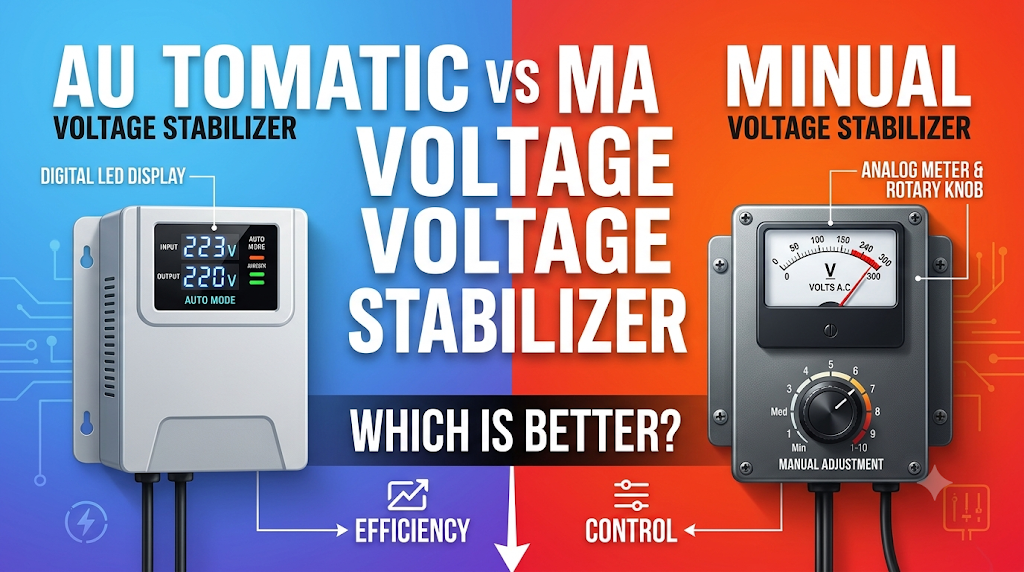
An automatic voltage stabilizer and a manual voltage stabilizer are designed to regulate electrical voltage and help protect connected equipment from voltage fluctuations. However, they differ in how voltage adjustments are made. An automatic voltage stabilizer detects changes in input voltage and adjusts its output without requiring regular human intervention. A manual voltage stabilizer, on the other hand, requires the user or an operator to adjust the voltage settings when necessary. Both types can be useful, but their suitability depends on the electrical load, operating conditions and level of convenience required.
Choosing between an automatic and manual voltage stabilizer involves considering convenience, response to voltage changes, maintenance, operating cost and safety. Automatic models are generally more suitable for homes, offices and installations where voltage changes occur frequently. Manual models may be useful in controlled environments where an operator can monitor the voltage and make adjustments when needed. Understanding their differences helps buyers select a stabilizer that matches their equipment and electrical requirements.
Quick Comparison Table
| Feature | Automatic Voltage Stabilizer | Manual Voltage Stabilizer |
|---|---|---|
| Voltage Adjustment | Automatic | Manual |
| Human Intervention | Not normally required | Required |
| Response to Fluctuations | Automatically responds | Depends on operator |
| Convenience | High | Lower |
| Continuous Monitoring | Electronic control | Operator monitoring |
| Operating Requirements | Electricity and control circuit | Electricity and manual operation |
| Voltage Accuracy | Model-dependent | Depends on adjustment and design |
| Protection Features | Available in many models | Depends on model |
| Initial Cost | Generally higher | Generally lower |
| Maintenance | Depends on technology | Depends on construction |
| Best For | Homes, offices and regular use | Controlled applications and supervised use |
1. Working Principle
Automatic Voltage Stabilizer
An automatic voltage stabilizer continuously monitors the incoming electrical voltage through its sensing and control circuit. When the input voltage rises or falls, the stabilizer detects the variation and automatically adjusts its output voltage using its internal regulation mechanism.
Depending on the model, it may use a servo motor, relay switching or electronic power components. The user does not need to adjust the voltage every time the supply changes.
Manual Voltage Stabilizer
A manual voltage stabilizer requires the operator to adjust the voltage using a switch, selector or adjustment control, depending on its design.
The operator checks the incoming or output voltage and makes the necessary adjustment. It does not automatically respond to every voltage fluctuation unless the particular model includes automatic control features.
Winner: Automatic Voltage Stabilizer for convenient voltage regulation without regular manual intervention.
2. Voltage Adjustment
Automatic stabilizers adjust voltage according to the detected input conditions. This makes them convenient in locations where electricity supply frequently fluctuates.
Manual stabilizers depend on the operator to change the settings. If the voltage changes suddenly and nobody makes an adjustment, the connected equipment may receive an unsuitable voltage.
Winner: Automatic Voltage Stabilizer for continuous automatic adjustment.
3. Response to Voltage Fluctuations
Automatic stabilizers detect voltage changes and correct their output according to their control technology. Relay-based models generally work in steps, while servo and static models use different voltage correction mechanisms.
Manual stabilizers cannot automatically respond to voltage fluctuations. Their response depends on how quickly an operator notices the change and adjusts the setting.
Winner: Automatic Voltage Stabilizer for applications involving frequent voltage fluctuations.
4. Ease of Use
Automatic stabilizers are generally easy to operate. After proper installation and configuration, they regulate voltage without requiring regular user involvement.
Manual stabilizers require users to understand the voltage settings and make adjustments when necessary. This can become inconvenient when the stabilizer is used for long periods or when several people operate the electrical system.
Winner: Automatic Voltage Stabilizer for everyday convenience.
5. Voltage Accuracy
Voltage accuracy depends on the internal design and specifications of the stabilizer.
Automatic stabilizers can maintain a specified output voltage within their rated regulation limits. However, their accuracy varies between relay-based, servo and static models.
Manual stabilizers depend on the adjustment mechanism and the operator’s ability to select the correct setting. Some models provide voltage meters to help with adjustments.
Verdict: Automatic Voltage Stabilizer is generally more convenient for maintaining a consistent output, but the actual accuracy must be compared using manufacturer specifications.
6. Safety and Equipment Protection
Automatic stabilizers may include features such as high-voltage cutoff, low-voltage cutoff, overload protection, short-circuit protection and time delay. The available features depend on the model.
Manual stabilizers may also include protective devices, but users must ensure that the voltage is adjusted correctly. A manual stabilizer without suitable automatic protection may not adequately protect equipment during sudden voltage changes.
Winner: Automatic Voltage Stabilizer for applications where automatic voltage monitoring and protection are required, provided the necessary safety features are included.
7. Maintenance Requirements
Automatic stabilizers contain sensing circuits, control components and voltage regulation mechanisms. Their maintenance requirements depend on whether they use relays, motors or electronic switching systems.
Manual stabilizers may have simpler adjustment mechanisms, but switches, connections and other internal components can still require inspection.
Neither type is completely maintenance-free. Proper installation, ventilation and periodic electrical inspection are important for both.
Verdict: Depends. Maintenance is determined more by the internal technology and construction than by whether adjustment is automatic or manual.
8. Initial Purchase Cost
Automatic voltage stabilizers generally cost more because they include sensing and control systems that regulate voltage without operator involvement.
Manual voltage stabilizers are often more economical because their construction and adjustment systems can be simpler.
However, the final price depends on capacity, voltage range, accuracy, protection features and manufacturer.
Winner: Manual Voltage Stabilizer for buyers prioritising a lower initial purchase cost.
9. Suitable Applications
Where Is an Automatic Voltage Stabilizer Suitable?
- Residential electrical installations
- Air conditioners and refrigerators
- Computers and electronic equipment
- Commercial offices
- Shops and small businesses
- Equipment requiring continuous voltage regulation
- Locations with frequent voltage fluctuations
Where Is a Manual Voltage Stabilizer Suitable?
- Controlled electrical testing environments
- Supervised electrical installations
- Applications where an operator manages voltage settings
- Certain workshop and laboratory applications
- Situations where simple manual voltage adjustment is sufficient
The stabilizer must be compatible with the connected equipment and its electrical requirements.
10. Which Is Better for Home Use?
For most homes, an automatic voltage stabilizer is the more practical option. Household appliances such as air conditioners, refrigerators and other electrical equipment may operate for several hours without continuous supervision. Automatic voltage regulation reduces the need for users to monitor and adjust the voltage.
A manual stabilizer may be less expensive, but it requires someone to check voltage conditions and make adjustments when necessary.
For homes with multiple air conditioners, pumps and other heavy appliances, the stabilizer should be selected according to the total connected load, starting current, input voltage range and required capacity.
An automatic stabilizer with suitable overload and voltage protection is generally a better choice for everyday residential use.
Advantages and Disadvantages
Automatic Voltage Stabilizer
Advantages
- Automatically adjusts output voltage.
- Requires little user intervention.
- Convenient for everyday operation.
- Suitable for locations with frequent voltage fluctuations.
- Can include automatic protection features.
- Available in different capacities and technologies.
Disadvantages
- Generally has a higher initial cost.
- Contains electronic control components.
- Repair requirements depend on its internal technology.
- Some models may have limited voltage correction ranges.
- Requires correct capacity selection and installation.
Manual Voltage Stabilizer
Advantages
- Generally lower initial purchase cost.
- Can have a relatively simple construction.
- Allows direct operator control of voltage settings.
- Suitable for certain supervised applications.
- May be economical for limited or controlled use.
Disadvantages
- Requires manual voltage adjustment.
- Cannot automatically respond to changing voltage.
- Less convenient for everyday household use.
- Depends on operator attention.
- Incorrect adjustment may affect connected equipment.
Frequently Asked Questions (FAQs)
1. What is the main difference between automatic and manual voltage stabilizers?
An automatic stabilizer detects voltage fluctuations and adjusts the output automatically. A manual stabilizer requires an operator to change the voltage settings.
2. Which voltage stabilizer is better for home use?
An automatic voltage stabilizer is generally better for homes because it regulates voltage without requiring continuous human intervention.
3. Does an automatic voltage stabilizer work without manual adjustment?
Yes. Once correctly installed and configured, it automatically adjusts the output voltage within its specified operating range.
4. Is a manual voltage stabilizer cheaper?
Manual stabilizers are generally less expensive initially because their construction can be simpler. Actual prices depend on capacity and features.
5. Can an automatic voltage stabilizer protect an air conditioner?
Yes. A suitably rated automatic stabilizer can regulate voltage supplied to an air conditioner. Its capacity, starting current and protection features must match the appliance requirements.
6. Does an automatic voltage stabilizer provide power backup?
No. A voltage stabilizer regulates voltage but does not normally provide electricity during a power failure. A UPS or inverter with batteries is required for backup.
7. Which stabilizer requires less human attention?
An automatic voltage stabilizer requires less human attention because it adjusts voltage without regular manual operation.
Conclusion
An automatic voltage stabilizer is generally the better choice for homes, offices and applications where voltage fluctuations occur regularly. It provides automatic adjustment, greater convenience and can include useful protection features. A manual voltage stabilizer may be suitable for supervised applications where an operator can monitor and control voltage settings, particularly when initial cost is an important consideration. Before purchasing either type, compare its capacity, voltage range, accuracy and protection features with the requirements of the connected equipment.
Disclaimer
Voltage stabilizer performance, capacity, accuracy, operating range and pricing vary by manufacturer and model. Always check the official technical specifications and equipment compatibility before purchasing or installing a stabilizer. Consult a qualified electrical professional for installations involving heavy electrical loads.