Here is Parkhu.com Article #32, following your rules: original English comparison content, a quick comparison table after the introduction, practical feature comparisons, FAQs before the disclaimer, and the five Image SEO fields with Copy buttons.
Built-In Dishwasher vs Freestanding Dishwasher
Introduction
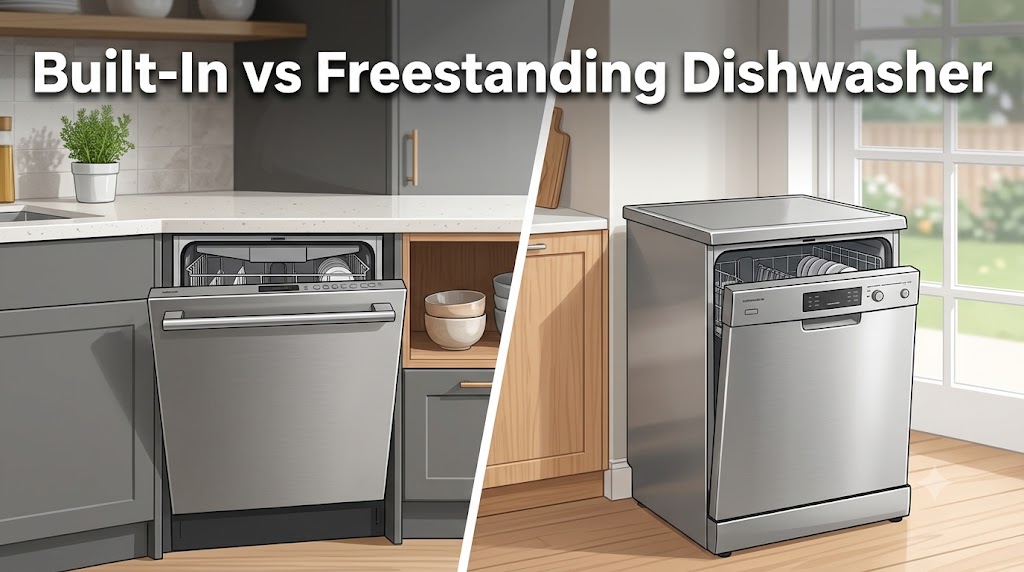
Choosing between a built-in dishwasher and a freestanding dishwasher depends on your kitchen layout, installation preferences, budget, and long-term plans. Both types are designed to wash dishes automatically, but they differ in how they fit into your kitchen. A built-in dishwasher integrates with your kitchen cabinets, creating a streamlined appearance, whereas a freestanding dishwasher operates as a separate appliance that can be placed wherever suitable water, drainage, and electrical connections are available.
Before making a decision, consider more than just appearance. Installation requirements, flexibility, maintenance access, replacement costs, and available space can affect your overall experience. A built-in model may be a better choice for a planned modular kitchen, while a freestanding model may suit an existing kitchen that does not require major modifications. Understanding these practical differences will help you choose a dishwasher that fits your household needs.
Quick Comparison Table
| Feature | Built-In Dishwasher | Freestanding Dishwasher |
|---|---|---|
| Installation | Installed within kitchen cabinetry | Installed as a standalone appliance |
| Appearance | Integrates with kitchen cabinets | Exterior remains visible |
| Kitchen planning | Requires a suitable cabinet space | Requires a suitable floor space |
| Installation work | May require cabinetry adjustments | Usually requires fewer cabinet modifications |
| Placement flexibility | Generally limited once installed | Generally more flexible |
| Relocation | Usually more complicated | Usually easier to relocate |
| Cleaning performance | Depends on the model and its features | Depends on the model and its features |
| Capacity | Varies by model and size | Varies by model and size |
| Maintenance access | May require moving the appliance | Generally easier to access |
| Replacement | May involve installation or cabinetry work | Usually more straightforward |
| Best suited for | Planned or renovated modular kitchens | Existing kitchens and flexible layouts |
1. Installation and Setup
Built-In Dishwasher
A built-in dishwasher is designed to fit into a dedicated space within kitchen cabinetry. Depending on the model, it may sit behind a matching cabinet door or have a visible control panel. Proper measurements and suitable plumbing and electrical connections are essential before installation.
Because the appliance must fit the available opening, installation may require coordination with a kitchen designer, carpenter, or qualified installer. Planning these requirements in advance can help avoid fitting problems.
Freestanding Dishwasher
A freestanding dishwasher is a separate appliance with its own finished exterior. It can be placed in a suitable kitchen or utility area with access to water, drainage, and electricity.
Installation generally involves fewer cabinetry requirements. However, the available space, hose connections, ventilation requirements, and manufacturer’s installation instructions must still be checked.
Winner: Freestanding dishwasher for installation flexibility and simpler setup in many existing kitchens.
2. Appearance and Kitchen Design
Built-In Dishwasher
A built-in dishwasher can create a coordinated kitchen appearance because it fits within the cabinetry. Fully integrated models can be concealed behind a matching cabinet panel, while semi-integrated models retain a visible control panel.
This design is particularly suitable for homeowners who want their appliances to blend into a modern modular kitchen.
Freestanding Dishwasher
A freestanding dishwasher has its own visible exterior, which may be finished in stainless steel, white, or another available colour. It does not need a matching cabinet panel.
Although it may look less integrated, a well-positioned freestanding model can still fit comfortably into many kitchen designs.
Winner: Built-in dishwasher for a seamless, cabinet-integrated appearance.
3. Space Requirements
Built-In Dishwasher
A built-in dishwasher requires a properly sized cabinet opening or dedicated installation space. Its dimensions must match the available kitchen layout, including the clearance needed to open the door and load dishes.
It can make the kitchen look organised, but it does not automatically occupy less physical space than a freestanding model of comparable dimensions.
Freestanding Dishwasher
A freestanding dishwasher needs enough floor space and room for its door to open. It can be positioned in a suitable location without requiring the entire appliance to be surrounded by cabinetry.
However, it still needs adequate clearance and accessible connections. A small kitchen may benefit from a slimline model if the selected product supports the household’s dishwashing needs.
Winner: Depends on your kitchen layout. Built-in models integrate with cabinetry, while freestanding models offer more placement options.
4. Cleaning Performance
Built-In Dishwasher
A built-in dishwasher can provide effective cleaning through its spray system, wash programmes, filtration, and drying features. Its installation style alone does not guarantee better cleaning.
When comparing models, check the available wash cycles, rack arrangement, detergent requirements, and suitability for the dishes you use regularly.
Freestanding Dishwasher
A freestanding dishwasher uses the same basic dishwashing principles. Depending on the model, it may offer multiple wash programmes, adjustable racks, and different drying options.
A well-equipped freestanding model may clean dishes as effectively as a comparable built-in model.
Winner: Tie. Cleaning performance depends primarily on the individual model’s design, features, loading, and maintenance rather than whether it is built-in or freestanding.
5. Capacity and Loading Convenience
Built-In Dishwasher
Built-in dishwashers are available in different sizes and capacities. Depending on the model, they may include adjustable racks, dedicated cutlery trays, and foldable supports for different types of cookware.
Before purchasing, compare the usable rack space and place-setting capacity rather than assuming all built-in dishwashers hold the same number of dishes.
Freestanding Dishwasher
Freestanding models are also available in different capacities. Their rack arrangements and internal layouts vary, so some models may accommodate large plates, pots, or cutlery more conveniently than others.
A household’s actual needs depend on the number of people, cooking habits, and frequency of dishwashing.
Winner: Tie. Compare the capacity and rack design of specific models instead of choosing based only on installation type.
6. Installation and Purchase Costs
Built-In Dishwasher
A built-in dishwasher may involve additional expenses if the kitchen needs cabinet modifications, a custom front panel, or specialist installation. These requirements can increase the overall project cost.
However, the final cost depends on the selected model, the existing kitchen layout, and the work required. A kitchen already designed for an integrated dishwasher may need fewer modifications.
Freestanding Dishwasher
A freestanding dishwasher generally avoids the cost of a custom cabinet front and may require less installation work.
Nevertheless, plumbing changes, electrical work, delivery, and other installation requirements can still add to the total expense.
Winner: Freestanding dishwasher when avoiding cabinetry modifications is a priority. Compare the complete installed cost before deciding.
7. Maintenance and Repairs
Built-In Dishwasher
A built-in dishwasher may need to be pulled out of its cabinet space for certain repairs or servicing. This can require additional time and care, particularly when the appliance is tightly fitted.
Routine tasks, such as cleaning the filter and checking the spray arms, can usually be performed according to the manufacturer’s instructions without removing the appliance.
Freestanding Dishwasher
A freestanding dishwasher generally provides easier access to its exterior and may be simpler to move when a technician needs to inspect the appliance.
However, major repairs can require moving either type. Serviceability depends on the appliance design and the installation conditions.
Winner: Freestanding dishwasher for easier access and movement in many kitchen setups.
8. Flexibility and Relocation
Built-In Dishwasher
A built-in dishwasher is intended to remain in its designated cabinet space. Moving it to another kitchen may require disconnection, removal of any cabinet panel, and adjustments to the new installation space.
It is therefore better suited to households planning a long-term kitchen arrangement.
Freestanding Dishwasher
A freestanding dishwasher can generally be disconnected and relocated more easily when moving house or rearranging the kitchen.
The new location must still provide compatible water, drainage, and electrical connections, and the appliance must be transported according to the manufacturer’s guidance.
Winner: Freestanding dishwasher for households that value flexibility or may move in the future.
9. Replacement and Long-Term Convenience
Built-In Dishwasher
Replacing a built-in dishwasher requires checking the dimensions of the cabinet opening, connections, and any fitted front panel. A replacement model with different dimensions may require adjustments.
If you plan to keep the same kitchen layout for many years, this may be a manageable trade-off for the integrated appearance.
Freestanding Dishwasher
A freestanding dishwasher is generally easier to replace because it does not usually depend on a custom cabinet front. You still need to confirm the new appliance’s dimensions and connection requirements.
This can make future upgrades more straightforward when the replacement model fits the existing space.
Winner: Freestanding dishwasher for easier replacement in many existing kitchens.
10. Which Dishwasher Is Better for Different Households?
| Household Situation | Better Choice | Reason |
|---|---|---|
| New modular kitchen | Built-in dishwasher | Integrates with the planned cabinetry |
| Existing kitchen without a dedicated cabinet space | Freestanding dishwasher | Usually requires fewer cabinet modifications |
| Homeowner prioritising a seamless design | Built-in dishwasher | Can blend into the kitchen cabinets |
| Household expecting to move | Freestanding dishwasher | Generally easier to relocate |
| Buyer trying to avoid custom cabinetry work | Freestanding dishwasher | Usually needs fewer cabinet adjustments |
| Kitchen with a dedicated integrated-appliance space | Built-in dishwasher | Fits the planned layout |
| Buyer prioritising cleaning performance | Depends on the model | Compare wash programmes and cleaning features |
| Buyer prioritising capacity | Depends on the model | Compare dimensions, place settings, and rack design |
Final Verdict: Built-In Dishwasher vs Freestanding Dishwasher
A built-in dishwasher is better for a planned modular kitchen where appearance and cabinet integration are priorities. It creates a coordinated look and suits homeowners who expect to keep their kitchen layout relatively unchanged.
A freestanding dishwasher is better for flexibility, easier relocation, and avoiding unnecessary cabinetry modifications. It can be a practical option for an existing kitchen or a household that may change its layout in the future.
Neither type is automatically better in cleaning performance, capacity, reliability, or energy consumption. Compare the specifications, installation requirements, warranty, and total cost of individual models before purchasing.
The right choice is the dishwasher that fits your kitchen, budget, and daily requirements.
FAQs
1. What is the main difference between a built-in and a freestanding dishwasher?
A built-in dishwasher fits within kitchen cabinetry, while a freestanding dishwasher is a standalone appliance with its own finished exterior. Their main difference is installation and appearance.
2. Is a built-in dishwasher better than a freestanding dishwasher?
A built-in dishwasher is better for an integrated kitchen design. A freestanding dishwasher is generally better when installation flexibility and easier relocation are more important.
3. Which dishwasher is easier to install?
A freestanding dishwasher is generally easier to install because it usually requires fewer cabinetry modifications. Both types need suitable water, drainage, and electrical connections.
4. Do built-in dishwashers clean better?
Not necessarily. Cleaning performance depends on the model’s wash system, programmes, loading, detergent, and maintenance rather than its installation type alone.
5. Which dishwasher is better for a modular kitchen?
A built-in dishwasher is often the preferred choice for a modular kitchen because it can align with the cabinets and create a coordinated appearance.
6. Can a freestanding dishwasher be placed under a kitchen counter?
Some freestanding models are designed to fit under a counter, particularly when their top cover can be removed according to the manufacturer’s instructions. Check the specific model before installation.
7. Which dishwasher is cheaper to install?
A freestanding dishwasher may cost less to install when no cabinet modifications are needed. The actual cost depends on the appliance and the existing plumbing, electrical connections, and kitchen layout.
8. Which dishwasher is easier to repair?
A freestanding dishwasher may be easier to access or move for servicing. However, repair difficulty depends on the fault, appliance design, and installation.
9. Does a built-in dishwasher save kitchen space?
It integrates neatly into cabinetry, which can make the kitchen look more organised. However, a built-in model does not necessarily occupy less physical space than a comparable freestanding model.
10. Which dishwasher should I buy for my home?
Choose a built-in model if you prioritise a seamless kitchen design and have a suitable cabinet space. Choose a freestanding model if you prefer flexible placement, simpler installation, and easier relocation.
Disclaimer
Dishwasher features, dimensions, capacities, installation requirements, prices, and warranty terms vary by model and manufacturer. Product availability and installation costs may change over time. Always check the manufacturer’s specifications and installation instructions before purchasing.