Cat5e vs Cat6 Ethernet Cable
Introduction
Cat5e and Cat6 are two commonly used Ethernet cable categories for wired networking. Both can connect computers, routers, switches, network cameras, access points, and other devices to a network. Cat5e is designed for Gigabit Ethernet and is often sufficient for homes and basic office networks. Cat6 is a newer cable category with improved performance specifications and better control of interference. However, the better choice depends on the network speed you need, cable installation conditions, and whether you want additional performance headroom for future upgrades.
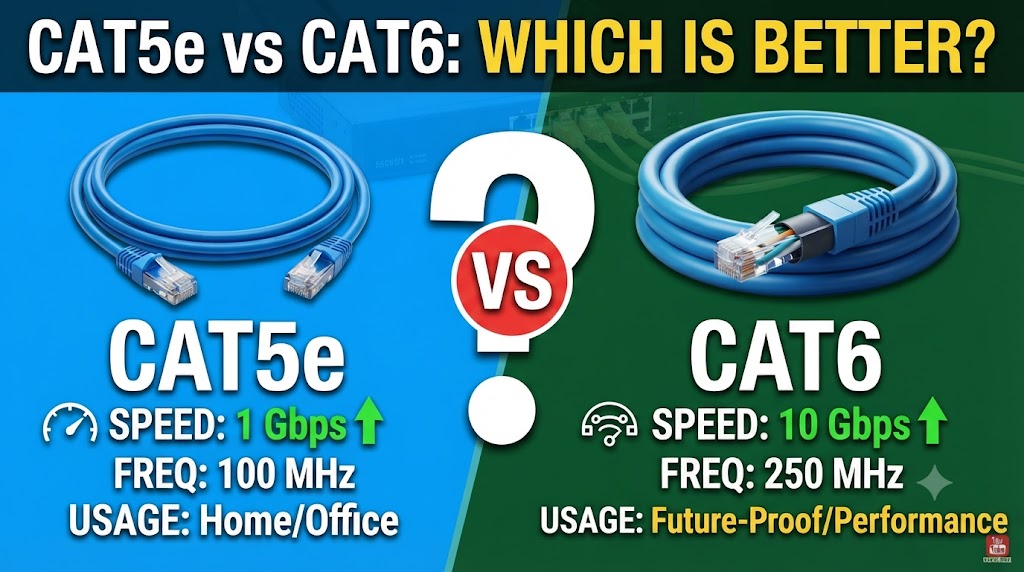
The main difference between Cat5e and Cat6 is their performance capability rather than their basic purpose. Cat5e supports up to 1 Gbps Ethernet over standard 100-meter channel lengths, while Cat6 can support 10 Gbps over shorter distances, typically up to 55 meters under suitable conditions. Cat6 also has stricter specifications for reducing crosstalk. Therefore, choosing between them should be based on your current network requirements and how much future capacity you want from the cabling.
Quick Comparison Table
| Feature | Cat5e | Cat6 |
|---|---|---|
| Cable Category | Category 5e | Category 6 |
| Typical Maximum Ethernet Speed | Up to 1 Gbps | Up to 10 Gbps* |
| 1 Gbps Distance | Up to 100 m | Up to 100 m |
| 10 Gbps Distance | Not designed for 10 Gbps | Up to 55 m* |
| Frequency Rating | Up to 100 MHz | Up to 250 MHz |
| Crosstalk Control | Good | Better |
| Cable Cost | Generally lower | Generally higher |
| Installation | Easier and more flexible | Can be somewhat thicker/stiffer |
| Home Networking | Suitable | Suitable |
| Future Upgrade Headroom | Lower | Higher |
*10 Gbps performance over Cat6 depends on installation conditions and channel length.
Cat5e vs Cat6: Speed
For ordinary Gigabit Ethernet, both Cat5e and Cat6 can provide up to 1 Gbps when the network equipment and installation support that speed.
Cat5e is therefore sufficient for many home networks, small offices, printers, computers, and other devices that use Gigabit Ethernet.
Cat6 provides additional capability because it can support 10 Gbps Ethernet over shorter distances, generally up to 55 meters depending on the installation.
Which is better for speed?
Cat6 has the advantage if you want higher-speed networking or additional room for future upgrades.
However, installing Cat6 does not automatically make a network faster. The router, switch, network adapter, and other equipment must also support the higher speed.
Cat5e vs Cat6: Maximum Distance
Both cable categories can support Gigabit Ethernet up to approximately 100 meters for a standard Ethernet channel when properly installed.
The difference becomes more important when considering 10 Gbps networking. Cat6 can support 10 Gbps over shorter distances, while Cat5e is not intended as a standard 10 Gbps cabling solution.
For a typical home where cable runs are well below 100 meters, distance usually does not make much difference between Cat5e and Cat6 for Gigabit Ethernet.
Cat5e vs Cat6: Frequency
Cat5e is rated for frequencies up to 100 MHz, while Cat6 is rated up to 250 MHz.
A higher frequency rating does not simply mean that your internet connection will automatically become faster. Instead, it reflects the cable’s ability to handle higher-frequency signals under its specified performance requirements.
Cat6 also has tighter requirements for crosstalk performance, which helps when multiple cables or high-speed signals are present.
Cat5e vs Cat6: Crosstalk and Interference
Crosstalk occurs when signals from one pair of wires interfere with another pair. Cable construction and electrical specifications are designed to reduce this interference.
Cat6 has stricter crosstalk requirements than Cat5e. Some Cat6 cables also use a physical separator between the twisted pairs, although this is not present in every Cat6 cable.
This can make Cat6 more suitable for installations where maintaining stronger signal performance is important.
Practical difference
For a small home network with short cable runs, you may not notice a practical difference between good-quality Cat5e and Cat6 when both are used for 1 Gbps Ethernet.
For higher-speed networking or more demanding installations, Cat6 provides more performance headroom.
Cat5e vs Cat6: Cable Thickness and Installation
Cat5e cables are generally easier to handle because they can be relatively flexible.
Cat6 cables can be thicker or stiffer, particularly designs with internal separators or additional construction intended to improve electrical performance.
This can make Cat6 slightly more difficult to route through tight spaces.
For a new installation, however, the difference is usually manageable when the correct cable and connectors are used.
Cat5e vs Cat6: Cost
Cat5e is generally less expensive than Cat6.
If you need a large amount of cable for a basic Gigabit network, Cat5e can reduce the cabling cost.
Cat6 usually costs more, but the additional cost can provide greater capacity for future networking requirements.
Which offers better value?
It depends on the installation.
If the network will remain at Gigabit speeds and keeping the initial cost low is important, Cat5e can be sufficient.
If you are installing permanent cabling and want greater future upgrade headroom, Cat6 may justify the additional cost.
Cat5e vs Cat6 for Home Networks
For most normal home networks, either cable can work well.
Cat5e is suitable for:
- Computers
- Smart TVs
- Printers
- Gaming consoles
- Gigabit switches
- Routers with Gigabit Ethernet
- Network cameras using Gigabit Ethernet
Cat6 is useful when you are building a new network and want additional cabling capacity for future upgrades.
For example, if you are running Ethernet cables inside walls during a renovation, replacing them later can be difficult. Using Cat6 can provide more headroom without requiring another cable installation.
Cat5e vs Cat6 for CCTV Cameras
Both Cat5e and Cat6 can be used for many IP CCTV installations.
For a standard Gigabit PoE camera network, Cat5e can be sufficient when the cable quality, distance, connectors, and networking equipment meet the requirements.
Cat6 can be useful for larger or more demanding installations, particularly when you want better performance headroom for future network upgrades.
For CCTV, however, choosing Cat6 alone does not guarantee better camera image quality. Camera resolution, bitrate, switch capacity, recording equipment, and network configuration also matter.
Cat5e vs Cat6 for Gaming
For online gaming, the cable category itself usually does not determine your internet connection speed.
A good Cat5e cable can already support Gigabit Ethernet, which is more than enough for many gaming setups.
Cat6 can still be a sensible choice for a new permanent installation, especially if you also use the network for high-speed file transfers, a NAS, or other bandwidth-heavy applications.
Cat5e vs Cat6: Which One Should You Choose?
Choose Cat5e if:
- You mainly need Gigabit Ethernet.
- Your cable runs are within normal Ethernet distances.
- You want to keep the installation cost lower.
- You are upgrading an existing basic network.
- You do not expect to need 10 Gbps networking over the installed cable.
Choose Cat6 if:
- You are installing new permanent Ethernet cabling.
- You want greater future upgrade headroom.
- You may use 10 Gbps networking over shorter cable runs.
- You want stronger crosstalk performance.
- The additional cable cost fits your budget.
Overall Winner: Depends on Your Needs
There is no single choice that is better for every network.
Cat5e is a practical option for standard Gigabit Ethernet and can be enough for many homes and small offices.
Cat6 is the more capable option when you want additional performance headroom and the possibility of 10 Gbps networking over shorter distances.
For a new permanent installation, Cat6 can be a sensible choice if the price difference is acceptable. For a basic Gigabit network where cost and simplicity matter, Cat5e can do the job without requiring the additional capability of Cat6.
Conclusion
Cat5e and Cat6 both provide reliable wired networking when properly installed and matched with compatible equipment. Cat5e is generally sufficient for Gigabit Ethernet, while Cat6 offers a higher frequency rating, stricter crosstalk specifications, and the ability to support 10 Gbps Ethernet over shorter distances. The right choice therefore depends on your current equipment, cable length, budget, and future networking plans.
If you are replacing an existing cable for a simple Gigabit connection, Cat5e may be enough. If you are installing new cables for long-term use and want more room for future network upgrades, Cat6 is worth considering.
Disclaimer
Network performance can vary depending on cable quality, cable length, connectors, installation conditions, and the capabilities of routers, switches, network adapters, and other connected devices. Ethernet standards and product specifications may also vary by manufacturer and model. Always check the specifications of the actual products before making a purchase.