Solar Water Heater vs Electric Water Heater
Introduction
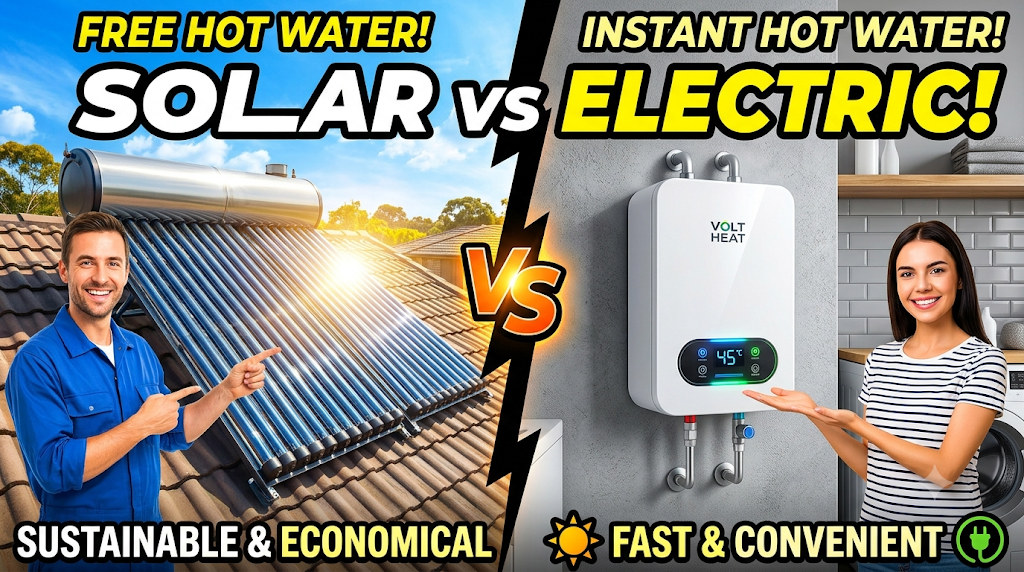
Water heating is an important household requirement, especially during winter when hot water is needed for bathing, washing, and other daily activities. Two commonly used options are solar water heaters and electric water heaters. A solar water heater uses energy from sunlight to heat water, while an electric water heater uses electricity to operate a heating element. Both systems provide hot water, but they differ in operating costs, installation requirements, heating performance, maintenance, and dependence on weather conditions.
Choosing between a solar water heater and an electric water heater depends on household water consumption, available rooftop space, sunlight conditions, electricity costs, and budget. Solar water heaters can reduce electricity consumption by using renewable solar energy, whereas electric water heaters offer convenient heating regardless of sunlight availability. Understanding their differences helps homeowners select a water-heating system that meets their daily requirements while managing long-term expenses.
Quick Comparison Table
| Feature | Solar Water Heater | Electric Water Heater |
|---|---|---|
| Energy source | Sunlight | Electricity |
| Operating cost | Generally lower | Depends on electricity usage |
| Initial cost | Generally higher | Generally lower |
| Heating method | Solar thermal energy | Electric heating element |
| Weather dependency | Yes | No |
| Night-time heating | Requires stored hot water or backup | Available |
| Installation | Requires suitable space and plumbing | Relatively simple |
| Maintenance | Periodic system maintenance | Periodic maintenance |
| Electricity consumption | Low for passive systems; higher with pumps | Uses electricity for heating |
| Environmental impact | Generally lower during operation | Depends on electricity source |
| Best suited for | Homes with good sunlight | Homes needing convenient heating |
1. What Is a Solar Water Heater?
Om Solar Solutions – Solar Energy in India
A solar water heater is a system that uses sunlight to heat water for household or commercial purposes. It generally consists of solar collectors, an insulated storage tank, connecting pipes, and supporting structures. The collectors absorb solar energy and transfer heat to the water, which is then stored for later use.
Solar water heaters are commonly installed on rooftops where they can receive sufficient sunlight. They are available in different designs, including flat plate collector and evacuated tube collector systems. Depending on the model, they may operate through natural circulation or use a pump to move water through the collectors.
Advantages of Solar Water Heaters
- Lower operating costs: They use sunlight as their primary heating energy source.
- Reduced electricity consumption: They can significantly reduce the electricity required for water heating.
- Renewable energy: They use solar thermal energy instead of depending entirely on conventional electricity.
- Suitable for regular usage: They can supply stored hot water for daily household requirements.
- Long-term savings: They can reduce water-heating expenses over their useful life.
Disadvantages of Solar Water Heaters
- Higher initial investment: Collectors, storage tanks, and installation can increase the upfront cost.
- Weather dependency: Heating performance can decrease during cloudy and rainy conditions.
- Rooftop space requirement: Collectors and storage tanks need suitable installation space.
- Backup requirement: An electric or other auxiliary heating arrangement may be needed when sunlight is insufficient.
- Installation complexity: Plumbing and collector positioning require proper planning.
2. What Is an Electric Water Heater?
Hindware 25 L Storage Water Geyser (AMOUR NEO, Black) – NeverOwned India
An electric water heater uses electrical energy to heat water through an internal heating element. It is commonly known as an electric geyser in India. These appliances are available in storage and instant models, allowing households to select a suitable option according to their water consumption and available space.
Storage electric water heaters heat water inside an insulated tank and keep it available for use. Instant electric water heaters heat water as it passes through the appliance, subject to their heating capacity and water flow requirements. They are widely used in homes, apartments, bathrooms, and commercial buildings.
Advantages of Electric Water Heaters
- Convenient operation: They can heat water whenever electricity is available.
- Weather independent: Their heating performance does not depend on sunlight.
- Compact options: Instant and small-capacity models are suitable for limited spaces.
- Easy installation: Many models can be installed with standard plumbing and electrical connections.
- Temperature control: Many models include thermostats and automatic temperature controls.
Disadvantages of Electric Water Heaters
- Electricity consumption: Heating water can increase household electricity bills.
- Operating expenses: Regular usage may become expensive depending on electricity tariffs.
- Power dependency: They cannot provide electric heating during a power outage without an alternative supply.
- Heating element maintenance: Heating elements and thermostats may require repair or replacement.
- Environmental impact: Their indirect emissions depend on how the electricity is generated.
3. Solar Water Heater vs Electric Water Heater: Key Differences
Energy Source
Solar water heaters use sunlight to generate heat, making them a renewable-energy-based water-heating option. Their performance depends on available solar radiation.
Electric water heaters use electricity to heat water through an internal heating element. They can operate during the day or night whenever a suitable electricity supply is available.
Winner: Solar Water Heater for using renewable energy.
Initial Installation Cost
Solar water heaters generally require a higher initial investment because they include collectors, storage tanks, mounting structures, and additional plumbing.
Electric water heaters generally have a lower purchase and installation cost. Their installation is also simpler in most residential buildings.
Winner: Electric Water Heater for lower initial cost.
Monthly Operating Cost
Solar water heaters use sunlight as their primary heating source, which can reduce regular electricity expenses. However, some systems use pumps or electric backup heating.
Electric water heaters consume electricity whenever their heating elements operate. The monthly expense depends on water consumption, appliance capacity, efficiency, and electricity tariffs.
Winner: Solar Water Heater for lower operating costs when sufficient sunlight is available.
Heating Performance
Solar water heaters can provide good heating performance on sunny days. However, their output may decrease during cloudy weather, winter fog, or extended rainy periods.
Electric water heaters provide more predictable heating because their performance does not depend on sunlight. Their heating time depends on appliance capacity, electrical rating, and incoming water temperature.
Winner: Electric Water Heater for consistent heating regardless of weather.
Maintenance Requirements
Solar water heaters require periodic inspection of collectors, pipes, storage tanks, insulation, and circulation systems. Hard-water conditions can also create scaling problems.
Electric water heaters require inspection of the heating element, thermostat, electrical connections, and storage tank. Sediment and scale may also affect performance.
Winner: Depends on system design, water quality, and maintenance requirements.
Environmental Impact
Solar water heaters use renewable solar energy and can reduce electricity consumption for water heating. This can help reduce indirect carbon emissions.
Electric water heaters depend on the electricity supply. Their environmental impact varies according to the proportion of renewable and fossil-fuel-based electricity used.
Winner: Solar Water Heater in locations with suitable sunlight and when it replaces conventional electricity consumption.
Long-Term Savings
Solar water heaters generally have higher upfront costs but can provide savings through reduced electricity consumption over time.
Electric water heaters are less expensive to purchase, but regular electricity consumption can increase their lifetime operating expenses.
Winner: Solar Water Heater when the system receives sufficient sunlight and household hot-water demand is regular.
4. Which Water Heater Is Better for Different Households?
Small Families
An electric water heater may be a practical choice for small families with limited hot-water requirements. It offers convenient operation without requiring a large rooftop installation.
Large Families
Solar water heaters can be useful for larger families that consume substantial amounts of hot water daily. Selecting the correct storage capacity and collector size is important.
Homes in Sunny Regions
Solar water heaters are particularly attractive in locations that receive good sunlight throughout much of the year. They can reduce electricity consumption for regular water heating.
Homes With Limited Rooftop Space
Electric water heaters are generally more suitable for apartments and buildings where rooftop access or installation space is limited.
Homes in Cloudy and Cold Regions
Electric water heaters offer more predictable heating during periods of limited sunlight. A solar water heater can also be used with a suitable backup heating arrangement.
5. Which Water Heater Should You Choose?
Choose a Solar Water Heater If:
- You receive good sunlight throughout the year.
- Your household uses hot water regularly.
- You have sufficient rooftop installation space.
- You want to reduce long-term electricity expenses.
- You can afford a higher initial investment.
Choose an Electric Water Heater If:
- You want a lower initial purchase cost.
- You live in an apartment or have limited rooftop space.
- You need hot water regardless of weather conditions.
- Your household has relatively low hot-water requirements.
- You prefer a simple and convenient installation.
6. Is a Solar Water Heater Worth the Investment?
A solar water heater can be a worthwhile investment for households with regular hot-water consumption and sufficient sunlight. Although the initial purchase and installation cost may be higher, reduced electricity consumption can provide long-term savings.
However, the actual financial benefit depends on the system’s capacity, installation cost, electricity tariff, weather conditions, water usage, and maintenance expenses. Households should compare the expected annual electricity savings with the additional upfront investment before making a decision.
An electric water heater may still be the better option for households with limited water consumption, restricted rooftop access, or a preference for lower initial expenses.
Conclusion
Solar water heaters and electric water heaters both provide convenient hot-water solutions, but they serve different household requirements. Solar water heaters are attractive for reducing electricity consumption and long-term operating expenses, particularly in sunny regions. Electric water heaters offer convenient, weather-independent heating and generally require a lower initial investment.
Overall Winner: Solar Water Heater is the better choice for households with regular hot-water consumption, good sunlight, and sufficient rooftop space. Electric Water Heater is better for smaller households, apartments, and users who prioritise convenience and lower initial costs.
Frequently Asked Questions (FAQs)
1. Which is better, a solar water heater or an electric water heater?
A solar water heater is generally better for long-term operating savings, while an electric water heater is more convenient when sunlight or rooftop space is limited.
2. Does a solar water heater work during cloudy weather?
Yes, it can still collect some solar energy during cloudy conditions, but its heating performance may decrease. Backup heating may be required.
3. Does a solar water heater require electricity?
Passive solar water heaters can operate without electricity. Active systems that use circulation pumps require electricity, and backup heating may also consume electricity.
4. Is a solar water heater suitable for winter?
Yes. It can heat water during winter when sufficient sunlight is available, although heating performance may be lower than during sunnier seasons.
5. Which water heater consumes more electricity?
An electric water heater generally consumes more electricity because it uses electricity as its primary heating source. A solar water heater may use electricity only for pumps or backup heating, depending on its design.
6. Can a solar water heater provide hot water at night?
Yes. A solar water heater with an insulated storage tank can provide hot water at night using heat collected and stored during the day.
7. Which water heater is better for a family of four?
Both can work for a family of four. The correct choice depends on daily hot-water consumption, storage capacity, sunlight availability, and budget.
Disclaimer
The information in this article is provided for general educational and comparison purposes. Solar water heater prices, electric water heater costs, heating capacity, electricity consumption, and performance may vary depending on the manufacturer, model, location, weather conditions, water quality, and usage patterns. Consult a qualified professional before purchasing or installing a water-heating system.