VPN vs Proxy
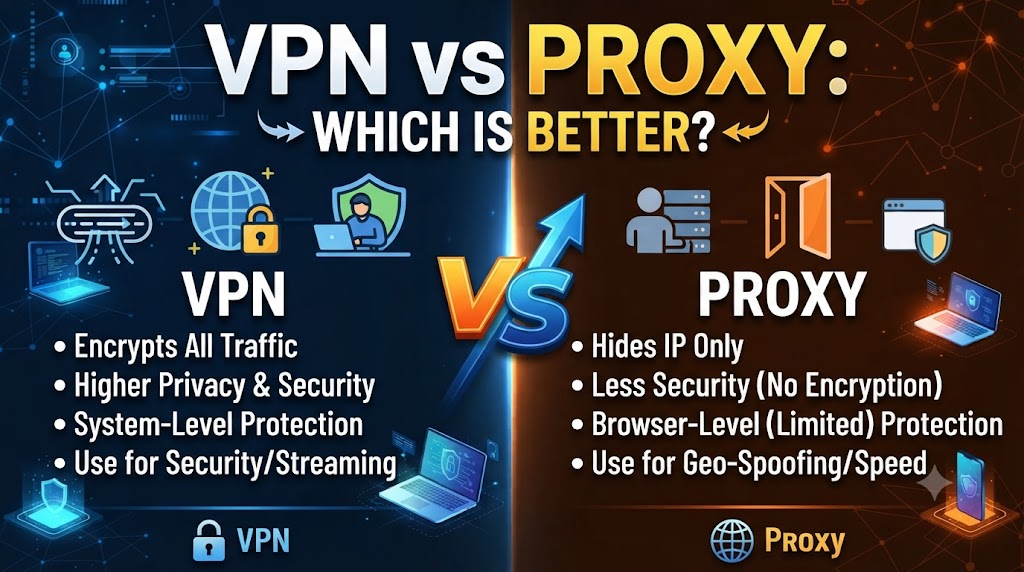
VPNs and proxy servers can both act as intermediaries between your device and the internet, but they work differently and provide different levels of protection. A VPN (Virtual Private Network) creates an encrypted connection between your device and a VPN server, while a proxy generally forwards traffic through another server without providing the same device-wide encryption.
The right choice depends on what you need. A VPN can be useful when you want broader traffic protection and privacy on untrusted networks, while a proxy can be useful for specific applications or simple IP-address routing. The exact features also depend on the VPN or proxy service and how it is configured.
Quick Comparison: VPN vs Proxy
| Feature | VPN | Proxy |
|---|---|---|
| Main Function | Routes traffic through a VPN server | Routes traffic through a proxy server |
| Encryption | Typically encrypts the VPN connection | Usually does not encrypt traffic by itself |
| Coverage | Can protect traffic from multiple apps/device traffic depending on configuration | Usually configured for a specific app or protocol |
| IP Address | Can hide your public IP from destination services | Can hide your IP from destination services |
| Privacy | Generally provides broader protection | More limited |
| Public Wi-Fi | Useful for protecting traffic on untrusted networks | Does not provide equivalent protection by itself |
| Setup | Usually requires an app or network configuration | Often configured per application or network |
| Speed | Can add overhead | May have less overhead |
| Best For | Privacy and broader traffic protection | Specific routing or application needs |
What Is a VPN?
A VPN creates an encrypted tunnel between your device and a VPN server. Internet traffic routed through that tunnel is sent to the VPN server before reaching its destination.
Websites and online services may see the VPN server’s public IP address instead of your original public IP address.
A VPN can therefore provide both traffic protection and IP-address masking, depending on the service and configuration.
What Is a Proxy?
A proxy server acts as an intermediary between your application and the destination server.
For example, an application configured to use a proxy sends its requests to the proxy, which then forwards them to the destination.
Some proxies can make the destination see the proxy’s IP address instead of the user’s IP address. However, a proxy does not automatically provide encryption for all traffic from the device.
VPN vs Proxy: Encryption
One of the biggest differences is encryption.
A VPN normally creates an encrypted tunnel between the device and the VPN server. This can help protect traffic from local network observers, particularly when using an untrusted network.
A typical proxy mainly forwards traffic and does not provide the same device-to-VPN-server encryption. Some proxy protocols or services may support encryption, but this depends on the specific implementation.
Advantage: VPN
VPN vs Proxy: Privacy
A VPN can route traffic from multiple applications through its encrypted tunnel, depending on the VPN configuration.
A proxy is often configured for a particular application, such as a web browser, meaning other applications may continue using the normal internet connection.
Both VPNs and proxies can change the IP address visible to the destination, but privacy also depends on the provider’s logging practices, configuration, and other factors.
Advantage: VPN for broader protection
VPN vs Proxy for Public Wi-Fi
Public Wi-Fi networks can expose users to security risks, particularly when traffic is not properly protected.
A properly configured VPN can encrypt traffic between the device and the VPN server, providing an additional layer of protection on an untrusted network.
A standard proxy does not automatically provide the same level of protection because it may only handle traffic from a specific application and may not encrypt the connection.
Advantage: VPN
VPN vs Proxy: Speed
A VPN can introduce some additional processing and routing overhead because traffic is encrypted and sent through a VPN server.
A proxy can sometimes have less overhead, particularly when it is only forwarding traffic for one application.
However, actual speed depends on the service, server location, network quality, congestion, encryption method, and other factors.
Advantage: Depends
VPN vs Proxy for Changing IP Address
Both VPNs and proxies can make a destination website or service see the intermediary server’s IP address instead of your original public IP address.
A VPN typically routes broader device traffic through the VPN connection, while a proxy may only affect applications configured to use it.
Advantage: Depends
VPN vs Proxy for Streaming
Some users use VPNs or proxies to route streaming traffic through another server.
However, streaming platforms can detect and restrict VPN or proxy traffic, and availability of content varies by service, country, account, and licensing arrangements.
A VPN generally provides broader traffic routing, while a proxy may be useful for a particular application.
Advantage: Depends
VPN vs Proxy for Gaming
A proxy can sometimes be configured for a particular gaming application, but support varies by game and platform.
A VPN can route gaming traffic through its server, but this may increase latency depending on the server location and network route.
Neither technology automatically improves gaming performance.
Advantage: Depends
VPN vs Proxy: Security
A VPN generally provides stronger protection than a basic proxy because it can encrypt traffic between the device and the VPN server.
However, a VPN is not a replacement for antivirus software, secure passwords, software updates, firewalls, or safe browsing practices.
A proxy can still be useful for specific network-routing purposes, but a basic proxy should not be treated as an equivalent security solution.
Advantage: VPN
VPN vs Proxy: Ease of Use
Modern VPN services commonly provide dedicated applications that allow users to connect with a few steps.
Proxies may require manual configuration inside a browser, operating system, or individual application, although some proxy services also provide easy-to-use software.
The actual setup difficulty depends on the specific service.
Advantage: Depends
VPN vs Proxy: Cost
Both VPN and proxy services are available in free and paid forms.
Free services may have limitations involving speed, server locations, bandwidth, features, privacy practices, or data usage. Paid services can offer additional features, but pricing varies considerably.
The cost should therefore be evaluated together with the service’s features and privacy policies.
Advantage: Depends
VPN vs Proxy: Which Should You Choose?
Choose a VPN if:
- You want encrypted traffic between your device and the VPN server.
- You regularly use public or untrusted Wi-Fi.
- You want broader traffic protection.
- You want to route traffic from multiple applications through a VPN.
- You want to hide your public IP address from destination services.
- Privacy and network security are important considerations.
Choose a Proxy if:
- You only need to route traffic from a specific application.
- You need a simple intermediary server.
- Encryption is not your primary requirement.
- You are configuring a particular browser or application.
- Your use case specifically requires a proxy protocol.
Overall Winner: Depends on Your Requirements
A VPN and a proxy are not interchangeable technologies. A VPN generally provides broader traffic protection and encryption, while a proxy can be useful for application-specific routing and IP-address changes.
For users who need encrypted traffic and broader protection, a VPN is generally the more appropriate technology. For specific application-level routing where encryption is not the main requirement, a proxy can be sufficient.
Disclaimer
VPN and proxy features vary by provider, protocol, application, and configuration. A VPN does not make a user completely anonymous or automatically protect against every online threat. Proxy services can also have different privacy and logging policies. Always review the provider’s terms and privacy policy before using a service.