IPv4 vs IPv6
IPv4 and IPv6 are two versions of the Internet Protocol used to identify devices and deliver data across networks. IPv4 is the older and still widely used version, while IPv6 was developed to provide a much larger address space and support the continued growth of internet-connected devices.
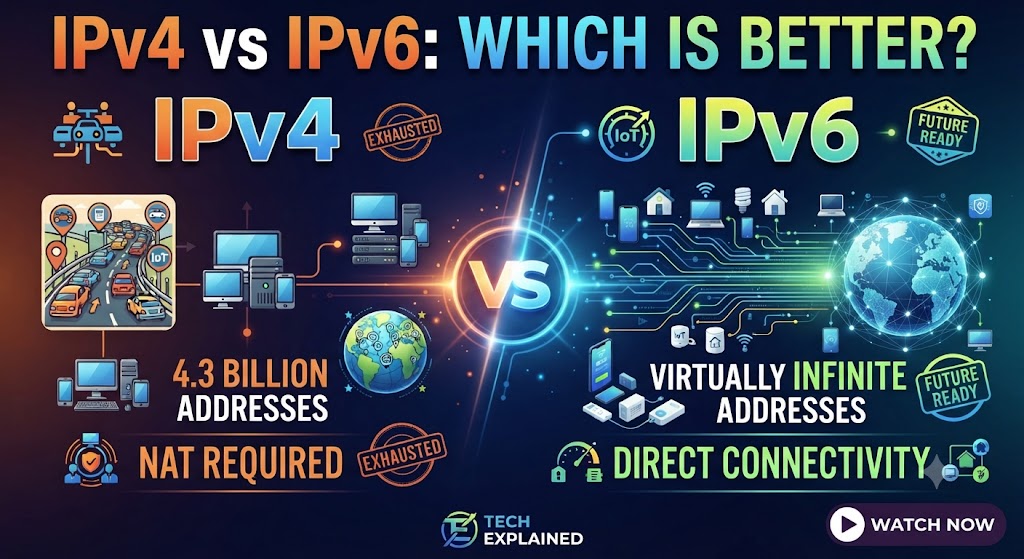
The biggest difference is the number of available IP addresses. IPv4 uses 32-bit addresses, providing about 4.3 billion possible addresses, while IPv6 uses 128-bit addresses, providing an extremely large address space. IPv6 also introduces changes to address configuration and network operation. The better choice depends on compatibility, network requirements, and the services being used.
Quick Comparison: IPv4 vs IPv6
| Feature | IPv4 | IPv6 |
|---|---|---|
| Address Size | 32-bit | 128-bit |
| Address Format | Decimal, such as 192.168.1.1 | Hexadecimal, such as 2001:db8::1 |
| Address Availability | Limited | Extremely large |
| Address Configuration | DHCP or manual | SLAAC, DHCPv6, or manual |
| NAT | Commonly used | Generally not required for address conservation |
| Broadcast | Supported | No traditional broadcast |
| Multicast | Supported | Supported |
| Header | More complex | Simplified base header |
| Compatibility | Very widespread | Increasingly widespread |
| Best For | Existing networks and compatibility | Large-scale modern networks |
IPv4 vs IPv6: Address Space
The most important difference between IPv4 and IPv6 is their address capacity.
IPv4 uses 32-bit addresses, resulting in approximately 4.3 billion possible addresses.
IPv6 uses 128-bit addresses, creating an enormously larger address space. This was designed to accommodate the continued growth of the internet and the increasing number of connected devices.
Advantage: IPv6
IPv4 vs IPv6: Address Format
IPv4 addresses are written as four decimal numbers separated by periods.
For example:
192.168.1.10
IPv6 addresses are written using hexadecimal numbers separated by colons.
For example:
2001:db8::10
IPv4 addresses are generally easier for people to read and remember because they are shorter.
Advantage: IPv4 for simplicity
IPv4 vs IPv6: Internet Compatibility
IPv4 has been used for decades and remains extremely widespread across networks and devices.
IPv6 adoption continues to grow, but not every network, application, or device environment supports IPv6 in exactly the same way.
Many modern networks use both IPv4 and IPv6 through dual-stack configurations, allowing devices and services to communicate using either protocol when supported.
Advantage: IPv4 for compatibility
IPv4 vs IPv6: Number of Devices
The limited IPv4 address space created the need for techniques such as NAT, which allows multiple private devices to share a public IPv4 address.
IPv6 provides an enormously larger address space, making it possible to assign globally unique addresses to a much larger number of devices.
This is particularly relevant as internet-connected devices continue to grow.
Advantage: IPv6
IPv4 vs IPv6: NAT
Network Address Translation, or NAT, is widely used with IPv4 to allow multiple devices using private addresses to share a public IPv4 address.
IPv6 was designed with a sufficiently large address space that address conservation does not require NAT in the same way.
However, IPv6 networks can still use other forms of translation for specific compatibility or architectural purposes.
Advantage: IPv6
IPv4 vs IPv6: Configuration
IPv4 networks commonly use DHCP to automatically assign addresses and other network settings, although manual configuration is also possible.
IPv6 supports several configuration methods, including SLAAC (Stateless Address Autoconfiguration), DHCPv6, and manual configuration.
SLAAC can allow compatible IPv6 devices to configure their addresses automatically based on information advertised by the router.
Advantage: Depends
IPv4 vs IPv6: Security
IPv6 was designed with security-related capabilities, including support for IPsec. However, having IPv6 does not automatically make a network secure.
Security depends on firewalls, router configuration, access controls, software updates, encryption, and other network security practices.
IPv4 can also be secured effectively with appropriate network controls.
Advantage: Depends
IPv4 vs IPv6: Performance
IPv6 does not automatically make an internet connection faster than IPv4.
Actual performance depends on factors such as routing, ISP infrastructure, network equipment, server configuration, latency, and the specific path used by the traffic.
In some networks IPv6 can perform similarly to IPv4, while in others one protocol may have different routing or performance characteristics.
Advantage: Depends
IPv4 vs IPv6 for Gaming
Both IPv4 and IPv6 can support online gaming.
Gaming performance depends heavily on latency, routing, server location, network quality, and the game infrastructure rather than simply the IP version.
If a game, console, router, and ISP support IPv6 properly, IPv6 can be used without requiring IPv4 for the connection. However, IPv4 remains important because many gaming services and networks continue to support it.
Advantage: Depends
IPv4 vs IPv6 for Home Networks
IPv4 remains very common in home networking, with private address ranges and NAT typically used by routers.
Modern routers may support both IPv4 and IPv6. A dual-stack setup can allow devices to use IPv4 or IPv6 depending on the destination and network support.
For a new home network, IPv6 support can be useful while maintaining IPv4 compatibility.
Advantage: Depends
IPv4 vs IPv6 for Businesses
Businesses may continue using IPv4 because of existing infrastructure, applications, and compatibility requirements.
IPv6 can provide a much larger address space and can be important for organizations planning for long-term network growth.
Many organizations therefore use both protocols rather than immediately replacing IPv4 everywhere.
Advantage: Depends
IPv4 vs IPv6: Which Should You Choose?
Choose IPv4 when:
- Your existing devices and applications primarily depend on IPv4.
- Compatibility with older systems is important.
- Your ISP or network infrastructure primarily supports IPv4.
- You are maintaining an established IPv4 network.
Choose IPv6 when:
- Your network and ISP fully support IPv6.
- You need a much larger address space.
- You are designing for long-term network expansion.
- You want to use modern IPv6 networking capabilities.
- You are deploying infrastructure that supports both protocols.
For many networks, using both IPv4 and IPv6 through dual-stack networking is a practical approach.
Overall Winner: Depends on Network Requirements
IPv4 remains important because of its broad compatibility and extensive existing deployment. IPv6 provides a vastly larger address space and was designed to support the continued expansion of internet-connected networks.
For many users and organizations, the practical approach is not choosing one protocol exclusively but supporting both IPv4 and IPv6 where possible.
Disclaimer
IPv4 and IPv6 behavior can vary depending on the ISP, router, operating system, applications, and network configuration. Performance and availability should be evaluated on the specific network rather than assumed from the protocol version alone. Network standards, device support, and ISP services may change over time.