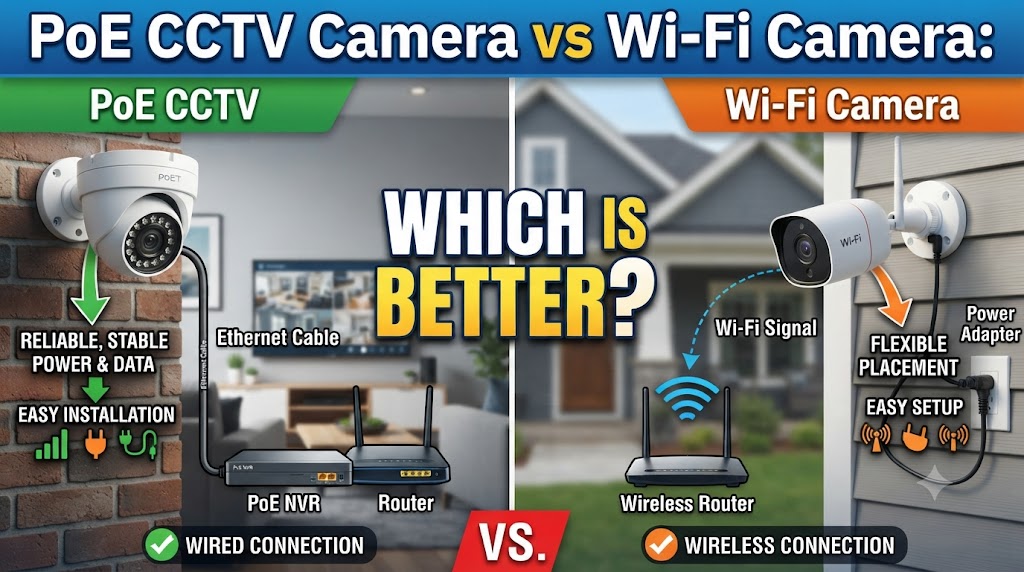
PoE CCTV Camera vs Wi-Fi Camera
Choosing between a PoE CCTV camera and a Wi-Fi camera mainly depends on how you want the camera to connect, how reliable the connection needs to be, and what type of installation you have. A PoE camera uses an Ethernet cable to carry network data and, on supported systems, power through the same cable. A Wi-Fi camera sends video over a wireless network, although it still normally needs a separate power source. (Axis Communications)
Both technologies can provide remote viewing, recording and modern surveillance features. However, they behave differently when it comes to cabling, network stability, power, installation, distance and expansion. This PoE CCTV camera vs Wi-Fi camera comparison explains the practical differences so you can choose according to your property and surveillance requirements.
Quick Comparison Table
| Feature | PoE CCTV Camera | Wi-Fi Camera |
|---|---|---|
| Network connection | Ethernet cable | Wi-Fi |
| Power | Can use PoE through Ethernet cable | Usually separate power adapter |
| Data + power cable | One Ethernet cable on supported PoE setup | Usually separate power connection |
| Network stability | Generally consistent with suitable wired infrastructure | Depends on Wi-Fi signal and interference |
| Installation | Requires Ethernet cabling | Easier where running network cable is difficult |
| Internet required | Not necessarily for local recording | Not necessarily for local recording, depending on system |
| Interference | Wired connection is less affected by wireless interference | Can be affected by obstacles and wireless interference |
| NVR compatibility | Common in IP/PoE systems | Depends on camera and NVR compatibility |
| Expansion | Requires suitable cabling and network ports | Requires sufficient Wi-Fi coverage and capacity |
| Best suited for | Permanent, reliable installations | Flexible installations where wireless connectivity is useful |
What Is a PoE CCTV Camera?
PoE stands for Power over Ethernet.
A PoE CCTV camera can receive electrical power and transmit network data through the same Ethernet cable when the camera and network equipment support PoE. This can reduce the number of separate cables needed at the camera location. Axis, for example, describes PoE cameras as using one network cable for both power and connectivity. (Axis Communications)
A typical PoE CCTV system may include:
- PoE cameras
- Cat5e or Cat6 Ethernet cables
- PoE switch or PoE NVR
- NVR for recording
- Router or network connection for remote access
The exact arrangement depends on the camera, NVR and network design.
What Is a Wi-Fi CCTV Camera?
A Wi-Fi CCTV camera sends its video data through a wireless network rather than using an Ethernet cable for the network connection.
However, Wi-Fi does not normally mean completely wireless.
Most Wi-Fi cameras still require electrical power through a power adapter or another power source. Hikvision’s setup instructions, for example, show that a Wi-Fi camera can be configured over Ethernet initially and then powered separately when operating wirelessly. (Hikvision Support USA)
Some battery-powered security cameras are an exception, but battery operation is a separate consideration and depends on the specific camera.
PoE CCTV Camera vs Wi-Fi Camera: Installation
Installation is one of the biggest differences.
A PoE camera requires an Ethernet cable between the camera and the PoE network equipment. This means you need a suitable cable route from the camera location to the PoE switch or NVR.
A Wi-Fi camera does not need an Ethernet cable for its network connection. This can make installation easier when running Ethernet cable would be difficult.
Which Is Easier to Install?
Wi-Fi cameras can be easier to install when cable routing is difficult.
For example, a Wi-Fi camera can be useful in a location where installing a long Ethernet cable would require significant drilling or construction work.
However, the camera still needs a suitable power source unless it is a battery-powered model.
PoE installation requires more initial cable work, but the same Ethernet cable can provide both data and power on supported systems.
PoE CCTV Camera vs Wi-Fi Camera: Power
Power is an important difference that is sometimes overlooked.
With PoE, the Ethernet cable can carry both data and electrical power. This can simplify the camera-side installation because a separate power adapter may not be necessary. (Axis Communications)
A typical Wi-Fi camera still needs electrical power even though its video connection is wireless.
Therefore:
PoE: one Ethernet cable can handle network connectivity and power.
Wi-Fi: wireless network connection, but usually a separate power connection.
The actual power requirement depends on the camera model. Cameras with IR illumination, heaters or other additional features may consume more power. Manufacturers publish typical and maximum power figures for specific models. (Axis White Papers)
PoE CCTV Camera vs Wi-Fi Camera: Network Stability
For a permanent CCTV installation, network stability is an important consideration.
A PoE camera uses a physical Ethernet connection. If the cable, switch and network are properly installed, the camera has a dedicated wired path to the network.
A Wi-Fi camera depends on the wireless connection between the camera and access point or router.
Wireless performance can be affected by:
- Walls
- Distance
- Metal objects
- Other wireless devices
- Radio interference
- Network congestion
- Router or access-point placement
Hikvision notes that wireless performance can be affected by interference and obstacles in different environments. (Hikvision)
Axis also notes that network infrastructure can affect video connectivity and that bandwidth limitations can cause problems for network video. (Axis Documentation)
Which Is More Stable?
For a fixed CCTV installation where running Ethernet cable is practical, PoE generally provides a more predictable wired connection.
Wi-Fi can work very well when the wireless signal is strong and the network is properly designed, but its performance depends more heavily on the wireless environment.
PoE CCTV Camera vs Wi-Fi Camera: Video Quality
The connection type itself does not automatically determine the camera’s image quality.
A high-resolution Wi-Fi camera can produce excellent video, while a lower-end PoE camera may produce less detailed footage.
Image quality depends on factors such as:
- Resolution
- Image sensor
- Lens
- Bitrate
- Compression
- Low-light performance
- Frame rate
- Camera placement
Therefore, do not choose a camera simply because it is PoE or Wi-Fi.
Which Has Better Image Quality?
Neither technology automatically wins.
Compare the actual camera specifications and nighttime performance rather than the connection method.
PoE CCTV Camera vs Wi-Fi Camera: Bandwidth
Both types of cameras use network bandwidth to transmit video.
A high-resolution camera with a high bitrate can require substantial network capacity regardless of whether the connection is wired or wireless.
With Wi-Fi, available wireless bandwidth is shared with other wireless devices and can be affected by interference and signal strength.
With PoE, the camera uses the wired network infrastructure. The switch and network backbone still need enough capacity for all connected cameras.
Axis notes that network video uses bandwidth according to configuration and that high-quality, high-frame-rate video requires more bandwidth. (Axis Documentation)
Practical Meaning
For multiple high-resolution cameras, a properly planned wired network can make bandwidth management more predictable.
A Wi-Fi system can also support multiple cameras, but the wireless network needs to be designed for the total video traffic rather than simply adding cameras one by one.
PoE CCTV Camera vs Wi-Fi Camera: Distance
Ethernet and Wi-Fi have different distance considerations.
Standard Ethernet camera connections commonly have a recommended maximum cable length of around 100 metres between network devices without additional network equipment. Hikvision recommends using switches to extend network-camera connections beyond 100 metres in suitable installations. (Hikvision)
Wi-Fi range depends on the access point, camera, frequency band, walls, obstacles and interference.
A camera that is physically close to a router may still have a poor connection if several walls or other obstacles interfere with the wireless signal.
Which Is Better for Long Distance?
Neither has a universal distance advantage.
PoE can be extended using appropriate switches, fiber or other network infrastructure.
Wi-Fi can cover larger areas using properly positioned access points or wireless equipment.
The actual property and network design matter more than the advertised maximum range.
PoE CCTV Camera vs Wi-Fi Camera: Remote Viewing
Both PoE and Wi-Fi cameras can support remote viewing when the camera or recorder is properly connected to the network and the manufacturer provides the necessary remote-access system.
PoE does not require the camera to be connected directly to the internet.
For example, a PoE camera can connect to an NVR on a local network and the NVR can provide remote access.
Likewise, a Wi-Fi camera can communicate through a wireless router and provide remote access when supported.
Does PoE Need the Internet?
No, not for basic local CCTV recording.
A PoE camera can communicate with an NVR on a local network without requiring internet access.
Internet connectivity becomes relevant when you want features such as remote viewing from outside the local network or cloud-based services.
The same basic principle applies to many Wi-Fi CCTV systems.
PoE CCTV Camera vs Wi-Fi Camera: NVR Recording
PoE cameras are commonly used with NVR systems.
A PoE NVR may have built-in PoE ports, allowing compatible cameras to connect directly to the recorder through Ethernet cables.
Wi-Fi cameras can also work with NVRs, but compatibility must be checked. The camera and recorder need to support the relevant network protocols and features.
Do not assume that every Wi-Fi camera will automatically work with every NVR.
Which Is Better for NVR Systems?
PoE is generally straightforward for a dedicated wired NVR installation.
Wi-Fi can be suitable when wireless cameras are specifically supported by the chosen recording system.
PoE CCTV Camera vs Wi-Fi Camera: Reliability During Network Problems
A wired PoE camera can continue communicating with a local NVR even if the internet connection goes down, provided the local network and power remain available.
Similarly, a Wi-Fi camera can continue working locally if the Wi-Fi network and power remain available, depending on its design.
However, if the Wi-Fi connection itself becomes unavailable, the camera may lose communication with the recorder or cloud service.
This is why the difference between internet failure and local network failure is important.
Practical Example
If your internet connection fails:
PoE + local NVR: local recording can continue in a properly configured system.
Wi-Fi + local recording: recording can also continue if the camera remains connected to the local Wi-Fi network and the recording setup supports it.
Therefore, Wi-Fi does not automatically mean that a camera stops recording whenever the internet fails.
PoE CCTV Camera vs Wi-Fi Camera: Security
Both wired and wireless CCTV systems need proper network security.
For Wi-Fi cameras, use strong Wi-Fi security and passwords and keep the camera firmware updated.
For PoE systems, the wired network and network devices also need protection.
Security considerations include:
- Strong passwords
- Updated firmware
- Secure router configuration
- Controlled user access
- Appropriate network segmentation
- Secure remote-access settings
The connection type alone does not make a CCTV system secure or insecure.
PoE CCTV Camera vs Wi-Fi Camera for Home Use
Both options can work well in homes.
PoE can be useful for:
- Main gates
- Driveways
- Front entrances
- Large houses
- Outdoor areas
- Multiple-camera installations
- Permanent surveillance
Wi-Fi can be useful for:
- Apartments
- Small homes
- Indoor rooms
- Temporary installations
- Locations where Ethernet cable installation is difficult
- Additional cameras where good Wi-Fi coverage already exists
For a new home CCTV installation where cable routing is practical, PoE can provide a structured and reliable setup.
For a small installation where drilling and cable routing are major concerns, Wi-Fi can reduce installation work.
PoE CCTV Camera vs Wi-Fi Camera for Shops and Businesses
For shops and businesses, the choice often depends on the number of cameras and the importance of continuous connectivity.
A small shop may use Wi-Fi cameras successfully if there is strong wireless coverage.
A larger shop, warehouse or office with several cameras may benefit from a wired PoE network because it provides a structured connection for the cameras and can simplify power distribution.
For critical surveillance locations, cable-based connectivity can reduce dependence on wireless conditions.
PoE CCTV Camera vs Wi-Fi Camera: Expansion
Adding cameras to a PoE system generally requires available PoE ports and suitable cabling.
A PoE switch can provide additional ports, but the network infrastructure must have enough capacity and the switch must have sufficient PoE power budget.
Hikvision’s PoE switch specifications, for example, list both per-port power and an overall PoE power budget, showing why these figures matter when adding multiple cameras. (Hikvision)
With Wi-Fi cameras, expansion depends on the capacity and coverage of the wireless network.
Adding too many cameras to a wireless network can increase the amount of video traffic competing for available wireless capacity.
Which Is Better for Multiple Cameras?
For a larger permanent CCTV installation, PoE is often easier to plan as a dedicated camera network.
Wi-Fi can still work for multiple cameras, but the wireless infrastructure needs careful planning.
PoE CCTV Camera vs Wi-Fi Camera: Installation Cost
The total cost is not determined only by the camera price.
For PoE, consider:
- Ethernet cables
- PoE switch or PoE NVR
- NVR
- Network accessories
- Installation labour
For Wi-Fi, consider:
- Wi-Fi cameras
- Power adapters
- Router or access points
- NVR or other recording solution
- Additional access points if coverage is weak
If Ethernet cabling already exists, PoE can be convenient.
If cable installation would require substantial construction work, Wi-Fi may reduce installation effort.
Which Is Cheaper?
It depends on the property.
A cheap Wi-Fi camera is not necessarily cheaper after adding power, storage, additional access points and other equipment.
Similarly, PoE can require more initial cabling but may provide a more structured system for multiple cameras.
Compare the complete installation rather than only the camera price.
PoE CCTV Camera vs Wi-Fi Camera: Outdoor Use
Outdoor cameras face additional challenges.
PoE can be useful for outdoor installations because one Ethernet cable can provide both network connectivity and power on supported cameras.
However, the cable installation needs appropriate protection against weather, electrical issues and physical damage.
Wi-Fi outdoor cameras avoid the need for an Ethernet data cable, but they still require reliable power unless they are battery-powered.
The Wi-Fi signal also needs to reach the outdoor camera reliably.
Practical Meaning
For a gate or boundary camera located far from the router, do not assume that Wi-Fi will work simply because a phone can connect from somewhere nearby.
Test the actual signal at the camera location.
PoE CCTV Camera vs Wi-Fi Camera: Which Should You Choose?
Choose a PoE CCTV camera if you want:
- A stable wired network connection
- One Ethernet cable for power and data on supported systems
- A permanent CCTV installation
- Multiple cameras
- NVR-based recording
- Better control over the physical network connection
- A system that can be expanded using wired infrastructure
Choose a Wi-Fi camera if you want:
- Easier installation where Ethernet cabling is difficult
- Flexible camera placement
- A solution for smaller installations
- Wireless network connectivity
- Less cable work for data transmission
- A camera for a location with strong and reliable Wi-Fi coverage
Final Verdict
In the PoE CCTV camera vs Wi-Fi camera comparison, the better option depends mainly on the installation environment.
PoE cameras are well suited to permanent CCTV systems where Ethernet cabling is practical. They can provide network connectivity and power through one cable on supported equipment, making them particularly useful for structured multi-camera installations. (Axis Communications)
Wi-Fi cameras can be more convenient where running Ethernet cable is difficult. However, they still normally need a power source, and their wireless performance depends on signal strength, obstacles, interference and network capacity. (Hikvision Support USA)
For a new, permanent multi-camera CCTV installation, PoE is a practical option when proper cabling is possible. For a small or difficult-to-cable installation, Wi-Fi can be a convenient alternative.
The most important factors are your cable-routing options, Wi-Fi coverage, number of cameras, recording method, power availability and future expansion plans.
Internal Linking Suggestions
You can internally link this article to your other Parkhu CCTV comparison articles:
- 2MP vs 5MP CCTV Camera: Which Resolution Is Better?
- 5MP vs 8MP CCTV Camera: Which Should You Buy?
- IP Camera vs Analog Camera: Which CCTV System Is Better?
- Night Vision vs Color Night Vision CCTV: Which Is Better?
These internal links connect camera resolution, camera technology, nighttime performance and network connectivity.
Disclaimer
CCTV specifications, prices, features, compatibility and availability can change by manufacturer, model and region. PoE availability, power requirements, Wi-Fi range and recording compatibility also vary between products. Always check the manufacturer’s current specifications and installation requirements before purchasing or installing a CCTV camera.