Desert Cooler vs Personal Air Cooler
Introduction
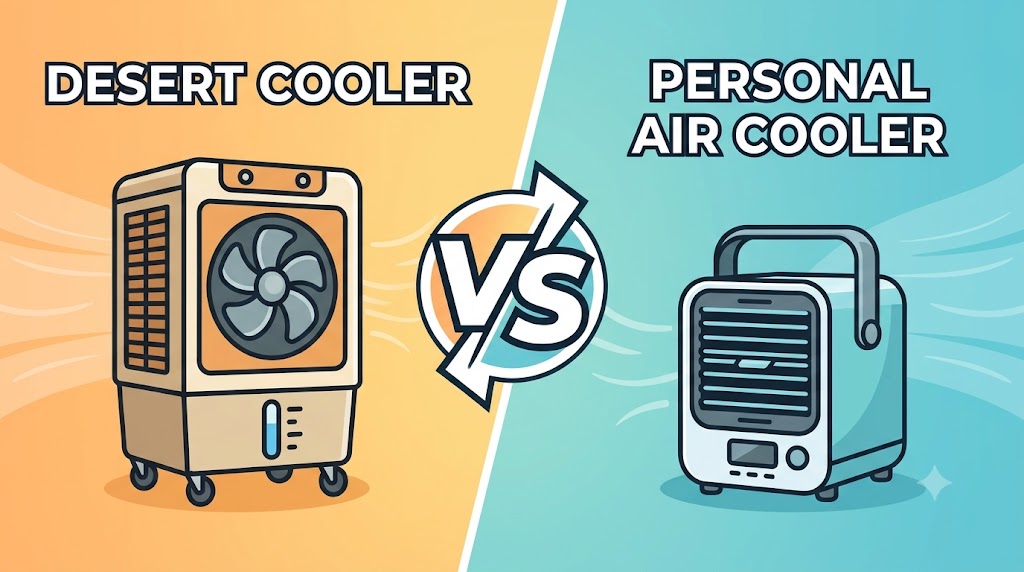
Desert coolers and personal air coolers both use water evaporation to cool air, but they are designed for different cooling needs. A desert cooler generally has a larger fan, bigger cooling pads, and a higher-capacity water tank to deliver air over a wider area. A personal air cooler is more compact and is designed to provide focused cooling for an individual or a small room. These differences affect airflow, noise, portability, water refilling, and electricity consumption. Choosing the right type depends primarily on your room size, ventilation, climate, and how you plan to use the cooler.
A desert cooler can be a suitable option for a large bedroom, living room, hall, or semi-open space, particularly in hot and dry weather. A personal cooler is generally more practical for a small bedroom, study area, or workspace where portability and lower power consumption matter. However, a larger cooler is not automatically the better choice for every room. Both types work best with adequate ventilation, and their cooling effectiveness decreases as humidity rises. Before purchasing, compare the actual air delivery, tank capacity, power consumption, noise level, and manufacturer-recommended room coverage.
Quick Comparison Table
| Feature | Desert Cooler | Personal Air Cooler |
|---|---|---|
| Best use | Large rooms and open areas | Small rooms and personal spaces |
| Airflow | Generally stronger and wider-reaching | Generally more focused |
| Water tank | Usually larger | Usually smaller |
| Electricity consumption | Generally higher | Generally lower |
| Portability | Bulkier and heavier | Compact and easier to move |
| Noise | Often louder at high speeds | Often quieter |
| Water refilling | Usually less frequent, depending on usage | Usually more frequent, depending on usage |
| Floor space | Requires more space | Requires less space |
| Purchase cost | Often higher | Often lower |
| Best suited for | Larger areas needing stronger airflow | Small spaces and individual comfort |
Desert Cooler vs Personal Air Cooler: Key Differences
1. Cooling Coverage and Airflow
A desert cooler is designed to move a larger volume of air and distribute it over a wider area. Its stronger airflow can make it useful in larger rooms, halls, and semi-open spaces.
A personal air cooler provides more focused airflow and is generally suitable for smaller rooms or people sitting close to the appliance. It may not distribute enough air across a large living room.
Actual coverage depends on the model’s air delivery, room layout, ceiling height, ventilation, and cooling-pad design.
Verdict: Desert cooler wins for larger spaces; personal cooler is more suitable for smaller rooms.
2. Electricity Consumption
Personal coolers generally use less electricity because they typically have smaller fans and motors. This can make them economical for daily use in a bedroom or study.
Desert coolers generally consume more electricity because they move larger volumes of air. However, their actual power consumption varies by model, fan speed, and motor type.
Compare the rated wattage of the specific models before estimating running costs.
Verdict: Personal air cooler generally wins for lower electricity consumption.
3. Water Tank Capacity
Desert coolers usually have larger water tanks, allowing them to operate for longer between refills under similar conditions. This is convenient when cooling a large area for several hours.
Personal coolers have smaller tanks to keep the appliance compact and easy to move. Depending on the model and operating conditions, they may require more frequent refilling.
Tank capacity alone does not determine cooling performance. Water consumption, pump operation, humidity, and fan speed also affect how long the cooler runs between refills.
Verdict: Desert cooler generally wins for longer operation between refills.
4. Portability and Space
Personal air coolers are usually lighter and easier to move between rooms. Their compact design makes them practical for rented homes, study areas, and small bedrooms.
Desert coolers are generally larger and heavier. Some models have wheels, but they still need more floor space and a suitable location for airflow.
If you plan to move the cooler frequently, check its dimensions, weight, and wheel design before purchasing.
Verdict: Personal air cooler wins for portability and compact placement.
5. Noise Level
Desert coolers often use larger fans to produce stronger airflow, which can create more noticeable operating noise, especially at high speeds.
Personal coolers are often quieter because their fans and motors are smaller. However, noise levels vary between models, and a powerful personal cooler can still be noisy.
If you intend to use the cooler while sleeping or working, compare the manufacturer’s noise specifications where available.
Verdict: Personal air cooler generally wins for quieter operation.
6. Purchase Price
Personal coolers generally cost less because of their compact construction and smaller components. They can be a sensible option when you need cooling for a small space without spending much upfront.
Desert coolers often cost more because they have larger fans, cooling pads, tanks, and housings. Their price varies considerably with capacity and features.
Compare models with similar intended coverage instead of assuming every personal cooler is cheaper than every desert cooler.
Verdict: Personal air cooler generally wins for lower initial cost.
7. Performance in Dry and Humid Weather
Both desert and personal coolers depend on water evaporation, so both work best when the incoming air is relatively dry.
In humid conditions, evaporation becomes less effective. The moisture added by the cooler can also make a poorly ventilated room feel uncomfortable.
A desert cooler can provide stronger airflow in a large, well-ventilated area, but its size does not eliminate the limitations of high humidity. A personal cooler may be more convenient for focused airflow, but it also needs suitable ventilation.
Verdict: Depends primarily on climate and ventilation, not just cooler type.
8. Maintenance and Cleaning
Both cooler types require regular cleaning of the water tank, cooling pads, and pump. Water should not be left stagnant for long periods, and the unit should be cleaned according to the manufacturer’s instructions.
A desert cooler may require more effort because of its larger tank and cooling pads. A personal cooler is generally easier to move and clean, although its exact maintenance needs depend on its construction.
Verdict: Personal air cooler generally wins for easier handling and cleaning.
Which Cooler Should You Choose?
Choose a Desert Cooler If:
- You need airflow for a large room or hall.
- You want a larger water tank and fewer refills.
- You have sufficient space for a larger appliance.
- Your room has good ventilation.
- You live in a hot, relatively dry climate.
Choose a Personal Air Cooler If:
- You need cooling for a small bedroom or study.
- You want a compact appliance that is easy to move.
- Lower electricity consumption is a priority.
- You prefer a smaller water tank and simpler handling.
- You mainly need focused airflow near your seating or sleeping area.
Final Verdict: Desert Cooler vs Personal Air Cooler
A desert cooler is generally the better choice for larger spaces that need stronger airflow and a larger water tank. A personal air cooler is usually better for small rooms, individual use, portability, and lower electricity consumption.
Neither type is universally better. A desert cooler may be unnecessarily large for a small bedroom, while a personal cooler may not deliver enough airflow for a spacious hall. Match the cooler’s rated air delivery and recommended coverage to your room, and make sure there is adequate ventilation. This will help you choose a practical cooler without paying for capacity you do not need.
Disclaimer
Cooler prices, specifications, tank capacities, and availability vary by model. Actual cooling performance and water consumption depend on room size, humidity, ventilation, temperature, and operating speed. Check the manufacturer’s specifications and recommended coverage before purchasing.