Bifacial vs Monofacial Solar Panels
Introduction
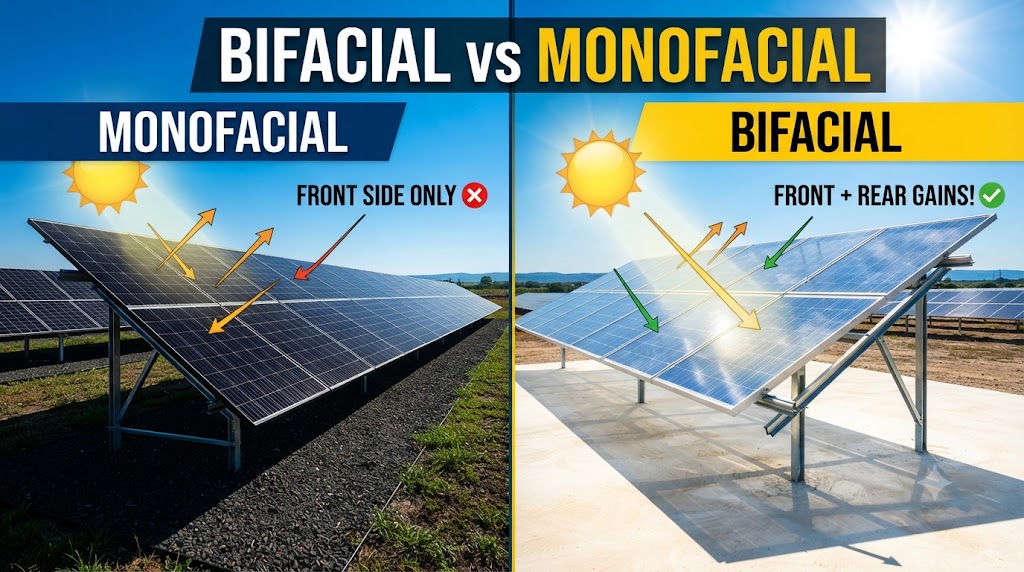
Solar panel technology offers different ways to convert sunlight into electricity, and bifacial and monofacial panels are two important options. Both technologies use photovoltaic cells to generate electricity from sunlight, but they differ in how they capture solar energy. Monofacial panels generate electricity primarily from their front surface, while bifacial panels can generate electricity from both their front and rear surfaces. This difference can influence energy production, installation requirements, mounting arrangements and overall project costs.
Choosing between bifacial and monofacial solar panels depends on the installation location, available space, mounting height and surrounding surface. Bifacial panels can provide additional electricity when sunlight reaches their rear surface through reflection from the ground or nearby surroundings. Monofacial panels are generally simpler to install and can be more economical for conventional rooftop applications. Understanding their differences will help you choose the right solar technology for your property or project.
Quick Comparison Table
| Feature | Bifacial Solar Panels | Monofacial Solar Panels |
|---|---|---|
| Electricity Generation | Front and rear sides | Primarily front side |
| Rear-Side Generation | Yes | No meaningful rear-side generation |
| Energy Output | Can be higher | Depends mainly on front-side sunlight |
| Installation Cost | Generally higher | Generally lower |
| Mounting Requirement | Rear side needs light access | Conventional mounting is suitable |
| Best Installation | Elevated, ground-mounted systems | Standard rooftop installations |
| Reflective Surface Benefit | Yes | No significant benefit |
| Efficiency | Depends on front-side cell efficiency and bifaciality | Depends on module specifications |
| Maintenance | Similar basic cleaning requirements | Similar basic cleaning requirements |
| Installation Complexity | Can be higher | Generally simpler |
| Best For | Open and reflective installation areas | Conventional rooftops |
1. What Are Bifacial Solar Panels?
Bifacial solar panels are photovoltaic modules designed to generate electricity from both their front and rear surfaces. Their front side captures direct and diffuse sunlight, while their rear side can capture reflected and scattered light from the surrounding environment.
These panels are commonly installed in open areas, elevated structures and ground-mounted solar projects where sufficient light can reach the rear surface. Their additional electricity generation depends on factors such as ground reflectivity, mounting height, spacing, panel design and the amount of shade behind the modules.
Advantages of Bifacial Solar Panels
- Two-Sided Generation: They can generate electricity from both the front and rear surfaces.
- Potentially Higher Energy Output: Rear-side sunlight can increase total electricity generation.
- Better Use of Reflected Light: They can benefit from light reflected by white roofs, concrete, sand and other bright surfaces.
- Suitable for Open Installations: They are useful for elevated and ground-mounted solar projects.
- Long-Term Energy Benefits: Additional generation can improve project economics when installation conditions are favourable.
- Flexible Applications: They are available for residential, commercial and large solar installations.
Disadvantages of Bifacial Solar Panels
- Higher Initial Cost: They may cost more than comparable monofacial panels.
- Installation Requirements: Their rear surface needs sufficient light exposure to provide meaningful additional generation.
- Mounting Complexity: Proper spacing, height and structure design are important.
- Limited Benefits on Some Roofs: Installing them close to a dark roof can reduce rear-side electricity generation.
- Performance Depends on Surroundings: Trees, nearby buildings and mounting structures can create rear-side shading.
2. What Are Monofacial Solar Panels?
Monofacial solar panels are conventional photovoltaic modules designed to generate electricity primarily from their front surface. Their rear side is generally covered by an opaque or non-generating backsheet, although some products use other protective constructions.
These panels are widely used in residential rooftops, commercial buildings and solar power installations. They are generally suitable for conventional mounting arrangements because they do not depend on reflected sunlight reaching the rear surface.
Advantages of Monofacial Solar Panels
- Lower Initial Cost: They are generally more affordable than comparable bifacial modules.
- Simple Installation: They can be installed using conventional rooftop mounting structures.
- Suitable for Standard Rooftops: They work well when their rear side is close to the roof surface.
- Wide Availability: Many manufacturers offer different capacities and module designs.
- Straightforward System Design: Their electricity generation mainly depends on front-side sunlight.
- Established Technology: They have extensive experience in residential and commercial solar installations.
Disadvantages of Monofacial Solar Panels
- Single-Side Generation: They primarily capture sunlight from the front surface.
- No Meaningful Rear-Side Output: Reflected light reaching the back does not provide the same benefit as a bifacial design.
- Less Benefit from Reflective Ground: They cannot take full advantage of rear-side reflected sunlight.
- Lower Potential Output in Suitable Bifacial Installations: They may generate less total electricity than bifacial panels under comparable favourable conditions.
3. Bifacial vs Monofacial Solar Panels: Key Differences
A. Electricity Generation
Bifacial solar panels can generate electricity from both front and rear surfaces. The rear side captures reflected and scattered sunlight, which can increase the total energy produced by the system.
Monofacial panels generate electricity primarily from the front side. Their rear construction is not designed to produce meaningful additional electricity.
Winner: Bifacial Solar Panels when sufficient light reaches both surfaces.
B. Energy Output
Bifacial panels can produce more electricity than comparable monofacial panels when installed in suitable conditions. The additional rear-side output is commonly described using bifacial gain.
The actual gain varies significantly depending on ground reflectivity, mounting height, tilt, spacing and rear-side shading. It is not guaranteed simply because a panel is labelled bifacial.
Monofacial panels depend mainly on the sunlight reaching their front surface.
Winner: Bifacial Solar Panels for installations with good rear-side light exposure.
C. Initial Purchase Cost
Bifacial panels can have a higher purchase price because of their specialised construction, transparent rear surface and additional manufacturing requirements.
Monofacial panels are generally more economical for conventional installations. However, actual prices depend on brand, wattage, technology and market availability.
Winner: Monofacial Solar Panels for lower initial purchase cost in many comparable product selections.
D. Installation Requirements
Bifacial panels need a mounting arrangement that allows reflected sunlight to reach the rear surface. Their installation should consider panel elevation, ground clearance, spacing and surrounding objects.
Monofacial panels are easier to accommodate in conventional rooftop installations because their rear surface does not need access to reflected sunlight.
Winner: Monofacial Solar Panels for simpler installation.
E. Performance on Reflective Surfaces
Bifacial panels can benefit from bright surfaces such as white roofs, light-coloured concrete and reflective ground materials. These surfaces can reflect sunlight towards the rear side of the panels.
Monofacial panels cannot take comparable advantage of rear-side reflected sunlight.
Winner: Bifacial Solar Panels for reflective installation environments.
F. Performance on Conventional Rooftops
Bifacial panels can provide additional generation on rooftops if their rear side has sufficient space and reflected light. However, panels mounted very close to a dark roof may receive little useful rear-side sunlight.
Monofacial panels are generally practical for standard rooftop mounting structures where rear-side light access is limited.
Winner: Monofacial Solar Panels for many conventional close-mounted rooftop installations.
G. Maintenance Requirements
Both technologies require periodic cleaning, inspection and electrical maintenance. Dust, dirt, bird droppings and shading can reduce their electricity generation.
Bifacial panels may require attention to both surfaces because dirt or obstructions on the rear side can reduce additional generation. Monofacial panels mainly require front-surface cleaning.
Winner: Depends. Both need proper maintenance, although bifacial installations may require additional rear-side inspection.
H. Installation Space
Bifacial panels need an appropriate mounting arrangement and sufficient rear-side clearance to benefit from their two-sided design.
Monofacial panels are more flexible for installations where available space or mounting arrangements restrict access to the rear surface.
Winner: Monofacial Solar Panels for restricted mounting conditions; bifacial panels are better when sufficient clearance is available.
I. Long-Term Financial Value
Bifacial panels may provide better financial returns when additional rear-side generation is high enough to justify their extra purchase and installation costs.
Monofacial panels can provide better value when the installation does not offer suitable conditions for rear-side generation. Paying extra for bifacial technology may not be worthwhile if the rear surface receives very little light.
Winner: Depends on the additional energy generated and the total installation cost.
4. Which Solar Panel Is Better for Different Users?
| User Requirement | Better Choice | Reason |
|---|---|---|
| Conventional home rooftop | Monofacial | Simpler installation |
| Elevated solar structure | Bifacial | Rear-side sunlight access |
| Ground-mounted solar project | Bifacial | Can use reflected ground light |
| White or reflective rooftop | Bifacial | Potential additional rear-side generation |
| Lower installation budget | Monofacial | Generally lower initial cost |
| Large open solar farm | Bifacial | Better opportunity for bifacial gain |
| Limited rear-side clearance | Monofacial | Does not depend on rear-side sunlight |
| Maximum generation in suitable conditions | Bifacial | Generates from both surfaces |
5. Which One Should You Choose?
Choose bifacial solar panels if your installation has sufficient rear-side light exposure. They are particularly useful for elevated mounting structures, ground-mounted systems and installations over reflective surfaces. They can generate additional electricity without requiring a separate solar panel area, provided the surroundings support rear-side generation.
Choose monofacial solar panels if you want a simpler and generally more economical installation. They are a practical option for conventional residential rooftops where panels are mounted close to the roof and there is limited sunlight reaching the rear surface.
Before purchasing, ask the installer to estimate the expected bifacial gain for your specific location rather than relying only on the manufacturer’s maximum advertised figure.
6. Final Verdict: Bifacial vs Monofacial Solar Panels
Both bifacial and monofacial solar panels can provide reliable solar electricity, but their performance advantages depend on installation conditions.
Overall Winner: Bifacial Solar Panels for suitable installations.
They offer the advantage of generating electricity from both sides, potentially increasing total energy production when sufficient reflected sunlight reaches the rear surface.
However, monofacial panels remain a practical and economical choice for many conventional residential rooftops. If the rear surface cannot receive meaningful sunlight, their simpler installation and lower initial cost can make them the better option.
The right choice depends on installation design, available space, rear-side sunlight exposure, panel specifications and total project cost.
Frequently Asked Questions (FAQs)
1. Which is better, bifacial or monofacial solar panels?
Bifacial panels are generally better when their rear surfaces receive sufficient reflected sunlight. Monofacial panels are often more suitable for standard rooftops where rear-side light exposure is limited.
2. What is the main difference between bifacial and monofacial solar panels?
Bifacial panels generate electricity from both front and rear surfaces, while monofacial panels generate electricity primarily from the front surface.
3. How much extra electricity can bifacial solar panels generate?
Additional generation varies according to ground reflectivity, panel height, spacing, tilt and rear-side shading. There is no single guaranteed percentage for every installation.
4. Are bifacial solar panels more expensive?
They can cost more than comparable monofacial panels. However, actual prices depend on manufacturer, panel capacity, technology and market conditions.
5. Are bifacial solar panels suitable for home rooftops?
Yes. They can be used on residential rooftops, especially where elevated mounting arrangements and reflective roof surfaces provide sufficient rear-side light.
6. Do bifacial solar panels work at night?
No. Like other photovoltaic panels, they require sunlight to generate electricity. They do not generate power in complete darkness.
7. Which panels are better for solar farms?
Bifacial panels can be advantageous for solar farms because ground-mounted structures can provide rear-side light exposure. Actual performance depends on project design and ground conditions.
8. Can bifacial panels work on a black roof?
Yes, but a dark roof generally reflects less sunlight than a bright surface. Consequently, rear-side electricity generation may be lower.
9. Do bifacial solar panels require special inverters?
Not necessarily. They can use compatible conventional solar inverters. However, the inverter must support the panel’s electrical specifications, including current and voltage limits.
10. Are bifacial solar panels worth the extra cost?
They can be worthwhile when the additional rear-side electricity generation provides enough financial benefit to justify the extra cost. A project-specific energy estimate is important before purchasing.
Disclaimer
This comparison is intended for general educational purposes. Solar panel prices, efficiency, bifacial gain, electricity generation, warranties and durability vary by manufacturer, product model and installation conditions. Actual rear-side generation depends on ground reflectivity, mounting height, panel spacing, shading and surrounding surfaces. Consult a qualified solar installer and review product specifications before purchasing or installing solar panels.