Half-Cut vs Full-Cell Solar Panels
Introduction
Half-cut and full-cell solar panels are two different solar panel designs used in residential, commercial, and industrial solar installations. Both convert sunlight into electricity, but they differ in how their solar cells are manufactured, arranged, and connected. These design differences can affect electrical resistance, heat generation, shading performance, and overall energy output. Understanding these differences can help you choose a suitable solar panel for your rooftop or solar project.
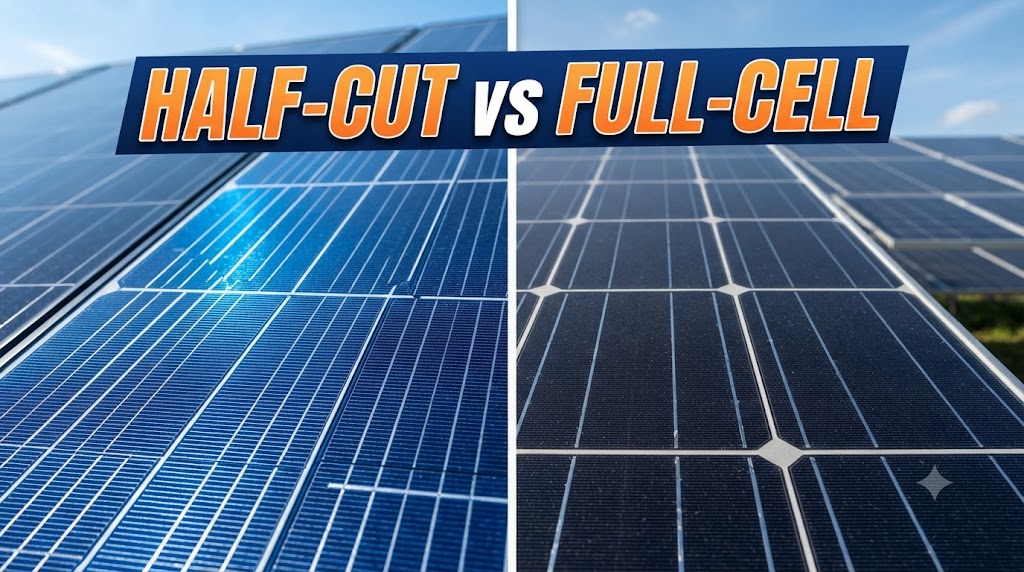
A half-cut solar panel uses solar cells that are cut into two smaller pieces, while a full-cell panel uses conventional, uncut solar cells. Half-cut technology is widely used in modern solar panels because it can reduce electrical losses and improve performance under certain conditions. However, full-cell panels can still be suitable for some installations, depending on availability, cost, and system requirements.
Quick Comparison Table
| Feature | Half-Cut Solar Panels | Full-Cell Solar Panels |
|---|---|---|
| Cell design | Cells cut into two halves | Conventional uncut cells |
| Electrical resistance | Generally lower | Generally higher |
| Internal current | Lower current in each cell section | Higher current through each cell |
| Heat generation | Can reduce resistive heating | Can experience higher resistive heating |
| Shading performance | Often better with suitable circuit design | Depends on panel circuit design |
| Efficiency | Can offer improved module performance | Depends on cell technology |
| Construction | More complex cell layout | Simpler conventional layout |
| Price | May cost more than comparable basic designs | May be cheaper where available |
| Common use | Modern residential and commercial systems | Older or conventional panel designs |
What Is a Half-Cut Solar Panel?
A half-cut solar panel uses solar cells that are physically divided into two smaller cells. These smaller cells are arranged in the panel and connected through a circuit design that allows the panel to operate with reduced current in each cell section.
Because the cells are smaller, the electrical current flowing through each section is generally lower. This helps reduce resistive power losses. Many half-cut panels also use separate sections, which can help limit the effect of shading on part of the panel.
Advantages of Half-Cut Solar Panels
- Lower electrical losses: Reduced current can lower resistive losses within the panel.
- Better shading response in many designs: Separate cell sections can help maintain output when part of the panel is shaded.
- Reduced heat generation: Lower resistive losses can reduce heat produced by electrical resistance.
- Modern technology: Half-cut cell construction is widely used in current solar panel designs.
- Good system performance: It can provide useful performance benefits when installed correctly.
Disadvantages of Half-Cut Solar Panels
- More complex construction: Cutting and arranging cells requires additional manufacturing steps.
- Potentially higher price: Some models may cost more than comparable conventional panels.
- Shading is not eliminated: Heavy shading can still reduce electricity generation.
- Quality varies: Actual performance depends on cell technology, circuit design, materials, and manufacturing quality.
What Is a Full-Cell Solar Panel?
A full-cell solar panel uses conventional solar cells that are not divided into smaller pieces. These cells are connected together to generate electricity from sunlight.
Full-cell panels have a simpler traditional cell layout. Their performance depends on factors such as cell efficiency, panel construction, temperature, and electrical design. Although half-cut technology is common in modern products, full-cell panels can still be found in some markets and applications.
Advantages of Full-Cell Solar Panels
- Simpler cell design: Uses conventional uncut solar cells.
- Established technology: Traditional solar cell construction has been used for many years.
- Potentially lower cost: Some conventional models may be less expensive.
- Straightforward construction: The cell layout can be simpler than half-cut designs.
- Suitable for many installations: They can work well when shading and system conditions are favourable.
Disadvantages of Full-Cell Solar Panels
- Higher current in cell sections: Conventional designs can have higher resistive losses.
- Shading limitations: Depending on the circuit design, shading on part of the panel can affect output.
- Potentially greater resistive heating: Higher current can increase resistive losses.
- Less common in newer product ranges: Many manufacturers now offer half-cut designs in their modern panels.
Key Differences Between Half-Cut and Full-Cell Solar Panels
1. Cell Structure
The main difference is the size of the solar cells. Half-cut panels use cells divided into two smaller pieces, while full-cell panels use conventional uncut cells.
2. Electrical Losses
Half-cut panels generally reduce current flowing through individual cell sections. Since resistive losses increase with the square of current, reducing current can help improve electrical performance.
3. Shading Performance
Half-cut panels often have separate electrical sections. This can reduce the impact of shading on the entire panel, depending on the internal circuit design. However, bypass diodes, string configuration, and the location of the shade also matter.
4. Temperature and Heat
Lower resistive losses can help half-cut panels reduce heat generated by electrical resistance. However, the actual operating temperature also depends on sunlight, ventilation, panel construction, and installation conditions.
5. Efficiency and Power Output
Half-cut construction can improve module performance, but it does not automatically mean every half-cut panel is more efficient than every full-cell panel. Compare the actual rated efficiency and power output of the specific models.
6. Price
The price difference depends on the manufacturer, wattage, cell technology, warranty, and market availability. Compare panels with similar specifications rather than choosing only by cell design.
Which Is Better for Different Applications?
| Application | Suitable Option |
|---|---|
| Residential rooftop | Half-cut panels are often a good choice |
| Commercial rooftop | Half-cut panels are worth considering |
| Partially shaded rooftop | Half-cut panels with suitable circuit design |
| Unshaded installation | Both can work well |
| Budget-focused project | Compare the actual price and specifications |
| Modern solar installation | Half-cut panels are commonly available |
Half-Cut vs Full-Cell Solar Panels: Which Should You Choose?
Choose half-cut solar panels if:
- You want a modern panel design with lower resistive losses.
- Your rooftop may experience partial shading.
- You find a suitable model with good efficiency and warranty.
- The price difference is reasonable for your project.
Choose full-cell solar panels if:
- You find a reliable conventional panel at a competitive price.
- Your installation has favourable sunlight conditions.
- Its rated power, efficiency, warranty, and overall value meet your requirements.
Final Verdict
Half-cut solar panels are generally the better choice for a new installation because their design can reduce resistive losses and improve performance under certain shading conditions. They are also widely used in modern solar panel products.
However, full-cell panels can still be a practical option when a reliable model is available at a lower price. Before purchasing, compare rated wattage, efficiency, temperature coefficient, product warranty, performance warranty, and manufacturer reliability. The actual panel specifications matter more than the cell design alone.
Frequently Asked Questions (FAQs)
1. What is the main difference between half-cut and full-cell solar panels?
Half-cut panels use solar cells divided into two smaller pieces, while full-cell panels use conventional uncut cells.
2. Are half-cut solar panels more efficient?
Half-cut construction can reduce resistive losses and improve module performance. However, actual efficiency depends on the complete panel design and specifications.
3. Do half-cut solar panels work better in shade?
They can perform better under certain partial-shading conditions because of their separate electrical sections. However, the result depends on circuit design, bypass diodes, and shade location.
4. Are half-cut solar panels more expensive?
They may cost more than some conventional panels, but the price depends on the manufacturer, technology, wattage, and market.
5. Which solar panel should I buy for my home?
For most new home installations, a good-quality half-cut panel is worth considering. Compare efficiency, warranty, rated output, and price before making a decision.
Disclaimer
Solar panel performance, efficiency, pricing, warranties, and availability vary by manufacturer and model. Half-cut construction does not guarantee better performance in every installation. Always check the manufacturer’s technical datasheet and consult a qualified solar installer before purchasing or installing a solar panel system.