Flat Plate vs Evacuated Tube Solar Water Heater
Introduction
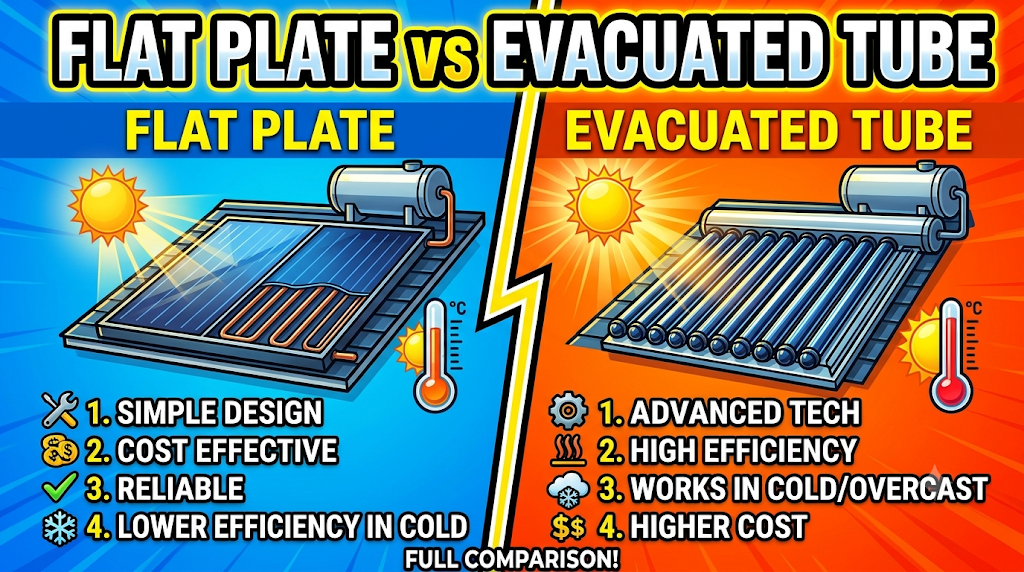
Solar water heaters are an energy-efficient way to heat water using sunlight instead of depending entirely on conventional electricity. Two widely used solar water heating technologies are flat plate collectors and evacuated tube collectors. Both systems absorb solar energy and transfer heat to water stored in an insulated tank. However, they use different collector designs and heating mechanisms. Flat plate collectors use an insulated box with an absorber plate and transparent cover, while evacuated tube collectors use glass tubes with a vacuum layer to reduce heat loss.
Choosing between a flat plate and an evacuated tube solar water heater depends on climate, water quality, household requirements, installation costs, and maintenance preferences. Flat plate collectors are known for their sturdy construction and straightforward design, whereas evacuated tube collectors can perform well in colder conditions because their vacuum insulation reduces heat loss. Understanding their differences helps homeowners choose a suitable solar water heating system for reliable performance and long-term value.
Quick Comparison Table
| Feature | Flat Plate Collector | Evacuated Tube Collector |
|---|---|---|
| Collector design | Flat absorber plate | Vacuum-insulated glass tubes |
| Heat absorption | Absorber plate | Absorbing surface inside tubes |
| Heat loss | Generally higher | Generally lower |
| Cold-weather performance | Good in suitable conditions | Often better |
| Direct sunlight | Effective | Effective |
| Diffuse sunlight | Can collect | Can collect |
| Initial cost | Generally higher in some markets | Often more affordable |
| Durability | Robust metal-and-glass construction | Glass tubes can break |
| Maintenance | Relatively simple | Tube inspection and replacement may be needed |
| Hard-water suitability | Depends on water circuit design | Depends on tube and heat-transfer design |
| Best application | Robust installations | Cold climates and suitable residential systems |
1. What Is a Flat Plate Solar Water Heater?
Sunrain Solar Flat Plate Collector – SRCC Solar Water Heater
A flat plate solar water heater uses a flat rectangular collector to absorb sunlight and transfer heat to water. The collector generally consists of a dark absorber plate, transparent glass cover, insulated backing, and pipes through which water or a heat-transfer fluid circulates.
When sunlight passes through the transparent cover, the absorber plate collects solar energy and converts it into heat. This heat is transferred to the water circulating through the collector. The heated water is then stored in an insulated tank for household use.
Flat plate collectors are commonly used in residential and commercial solar water heating installations. Their solid construction makes them suitable for locations where durability and straightforward maintenance are important.
Advantages of Flat Plate Solar Water Heaters
- Robust construction: They generally use strong metal absorber plates and protective glass covers.
- Long service life: Properly manufactured and maintained systems can provide years of operation.
- Simple design: Their construction makes inspection and servicing relatively straightforward.
- Good sunlight absorption: They efficiently collect solar energy under suitable conditions.
- Suitable for larger applications: They can be used in residential buildings, hotels, and commercial installations.
Disadvantages of Flat Plate Solar Water Heaters
- Greater heat loss: They generally lose more heat than evacuated tube collectors, particularly in colder conditions.
- Temperature limitations: Their performance can be affected by low ambient temperatures and wind.
- Heavy construction: The collector structure can require strong rooftop support.
- Glass-cover maintenance: Dust, dirt, and damage can affect sunlight collection.
2. What Is an Evacuated Tube Solar Water Heater?
KSIT | Best Engineering Colleges in Bangalore
An evacuated tube solar water heater uses multiple glass tubes to collect solar energy and heat water. Each tube contains a vacuum between its glass layers, which helps reduce heat loss to the surrounding environment.
The absorber surface inside the tubes collects sunlight and transfers heat to water directly or through a heat-transfer mechanism, depending on the system design. The heated water is then stored in an insulated tank.
Evacuated tube collectors are widely used in residential solar water heating systems. Their insulation design can make them particularly useful in colder regions where maintaining collected heat is important.
Advantages of Evacuated Tube Solar Water Heaters
- Lower heat loss: Vacuum insulation reduces heat transfer to the surrounding air.
- Good cold-weather performance: They can retain collected heat more effectively in colder conditions.
- Effective heat collection: Their tube design can collect both direct and diffuse solar radiation.
- Modular construction: Individual tubes can often be replaced without replacing the entire collector.
- Flexible installation: They are available in different capacities and configurations.
Disadvantages of Evacuated Tube Solar Water Heaters
- Glass tube breakage: Individual tubes can crack or break due to impact or handling.
- Regular inspection: Damaged or poorly performing tubes may need replacement.
- Performance variation: Output depends on tube quality, installation angle, and sunlight availability.
- Hard-water issues: Scaling can occur in systems where water circulates through the tubes or associated heat-transfer components.
3. Flat Plate vs Evacuated Tube Solar Water Heater: Key Differences
Heating Efficiency
Flat plate collectors absorb sunlight through a large flat absorber surface and transfer the collected heat to water.
Evacuated tube collectors use vacuum insulation to reduce heat loss, which can help maintain better thermal performance when the temperature difference between the collector and surrounding air is high.
Winner: Evacuated Tube Collector for heat retention, particularly in colder conditions. Actual efficiency depends on collector design and operating temperature.
Performance in Winter
Flat plate collectors can heat water effectively during winter when sufficient sunlight is available. However, their heat losses can increase in cold and windy weather.
Evacuated tube collectors reduce heat loss through their vacuum insulation, making them particularly useful in colder environments.
Winner: Evacuated Tube Collector for colder conditions.
Initial Cost
Flat plate systems have a relatively substantial collector structure with an absorber plate, glass cover, and insulation.
Evacuated tube systems use multiple glass tubes and are often competitively priced in residential markets. However, actual prices depend on capacity, brand, materials, and system design.
Winner: Depends on manufacturer and local market pricing. Compare the complete installed cost rather than the collector price alone.
Durability
Flat plate collectors generally have sturdy construction with protective glass covers and metal absorber components. They can withstand normal outdoor conditions when properly installed.
Evacuated tube collectors have individual glass tubes that can break if subjected to impact or improper handling. However, individual damaged tubes can often be replaced.
Winner: Flat Plate Collector for structural robustness.
Maintenance Requirements
Flat plate systems generally require cleaning, plumbing inspection, and periodic checks of the storage tank and collector.
Evacuated tube systems also require cleaning and plumbing inspection, along with checking individual tubes for cracks, vacuum loss, or other damage.
Winner: Flat Plate Collector for simpler collector maintenance.
Cold and Windy Weather
Flat plate collectors are exposed to surrounding air through their external collector surfaces, which can increase heat loss in windy and cold conditions.
Evacuated tube collectors use vacuum insulation to reduce heat transfer, helping them retain collected heat more effectively.
Winner: Evacuated Tube Collector in colder and windy conditions.
Hard Water Performance
Hard water contains dissolved minerals that can form scale inside solar water heating systems. Scaling can reduce heat transfer and affect water circulation.
The actual impact depends on whether the system uses direct water circulation, a heat exchanger, or a separate heat-transfer fluid. Both collector types may require suitable water treatment and periodic descaling.
Winner: Depends on the system’s water circuit design and local water quality.
4. Which Solar Water Heater Is Better for Different Conditions?
Residential Homes
Both systems can work well in residential buildings. Evacuated tube collectors are a popular option for households looking for effective heat collection, while flat plate systems are suitable for homeowners who prefer robust collector construction.
Cold Climate Regions
Evacuated tube collectors are often a suitable choice in colder regions because their vacuum insulation reduces heat loss. Proper freeze protection is still necessary where freezing temperatures occur.
Commercial Buildings
Hotels, hostels, hospitals, and other buildings with substantial hot-water requirements can use either technology. The correct selection depends on daily hot-water demand, collector sizing, operating temperatures, and installation costs.
Areas With Hard Water
Both systems can experience scaling problems. Buyers should check the water circuit design and consider appropriate water treatment or maintenance arrangements before installation.
Locations With Strong Sunlight
Both collector types can perform effectively in sunny locations. The better choice depends on required water temperature, system design, cost, and maintenance preferences.
5. Which Solar Water Heater Should You Choose?
Choose a Flat Plate Solar Water Heater If:
- You prefer a robust collector structure.
- You want straightforward collector maintenance.
- Your location receives good sunlight.
- You want a system with a solid absorber plate design.
- Structural durability is an important consideration.
Choose an Evacuated Tube Solar Water Heater If:
- You live in a colder region.
- You want reduced heat loss from the collector.
- Your installation needs good thermal insulation.
- You prefer a modular collector with individually replaceable tubes.
- You want to maintain heat effectively during cooler conditions.
6. Is an Evacuated Tube Solar Water Heater Always Better?
No. Although evacuated tube collectors have an advantage in reducing heat loss, they are not automatically the best choice for every installation.
Flat plate collectors can provide reliable heating in locations with suitable sunlight and moderate environmental conditions. They also offer robust construction and straightforward maintenance.
The best system depends on the local climate, required water temperature, water quality, installation design, purchase cost, and maintenance arrangements. Comparing actual performance specifications and warranty conditions is more useful than selecting a system based only on its collector technology.
Conclusion
Flat plate and evacuated tube solar water heaters both use sunlight to provide hot water, but their collector designs affect heat retention, durability, and maintenance. Flat plate collectors are known for their robust construction and relatively simple maintenance, while evacuated tube collectors offer better insulation and can perform particularly well in colder conditions.
Overall Winner: Evacuated Tube Solar Water Heater is a strong choice for colder regions and installations where reduced heat loss is important. Flat Plate Solar Water Heater is a practical choice for locations with suitable sunlight where durability and straightforward maintenance are priorities.
Frequently Asked Questions (FAQs)
1. Which is better, a flat plate or evacuated tube solar water heater?
Evacuated tube collectors are generally better at reducing heat loss, particularly in colder conditions. Flat plate collectors are attractive for their robust construction and simpler maintenance.
2. Which solar water heater works better in winter?
Evacuated tube solar water heaters generally perform better in colder conditions because their vacuum insulation reduces heat loss.
3. Do evacuated tube solar water heaters work on cloudy days?
Yes. They can collect diffuse solar radiation during cloudy conditions, but heating performance decreases when available sunlight is limited.
4. Are flat plate solar water heaters more durable?
Flat plate collectors generally have robust metal-and-glass construction. Evacuated tube collectors use glass tubes that can break, although individual tubes can often be replaced.
5. Which solar water heater requires less maintenance?
Flat plate collectors generally have simpler construction and may require less collector-specific maintenance. Both systems still need periodic inspection and cleaning.
6. Can hard water damage a solar water heater?
Yes. Minerals in hard water can create scale deposits that reduce heat transfer and affect circulation. Both types may require water treatment or descaling.
7. Can evacuated tube solar water heaters work without electricity?
Some thermosiphon evacuated tube systems can operate without electricity. Systems using circulation pumps require an electrical supply.
Disclaimer
The information in this article is provided for general educational and comparison purposes. Solar water heater prices, collector efficiency, heating performance, capacity, and maintenance requirements may vary depending on the manufacturer, model, climate, water quality, installation design, and usage conditions. Consult a qualified solar water heating professional before purchasing or installing a system.