Fully Automatic vs Semi-Automatic Washing Machine
Introduction
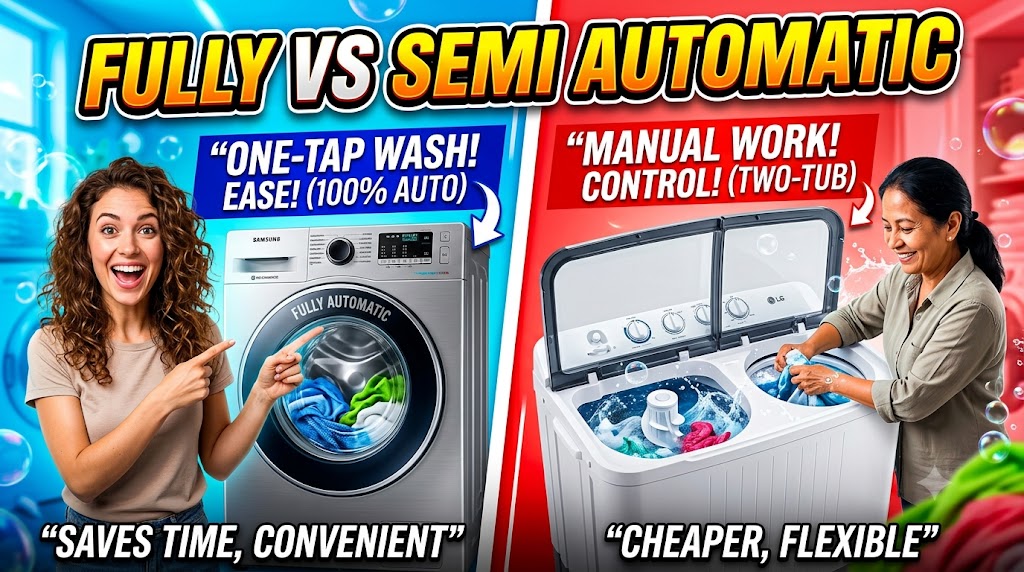
Choosing between a fully automatic and a semi-automatic washing machine depends on your budget, water supply, available space, and how much effort you want to spend doing laundry. A fully automatic washing machine handles the washing process with minimal manual intervention, and many models also manage rinsing and spinning automatically. A semi-automatic washing machine usually has separate wash and spin tubs, requiring you to move clothes between them. Both types can clean everyday laundry effectively, but their convenience, water requirements, and operating procedures are different.
For Indian households, the choice often comes down to convenience versus initial cost. A fully automatic machine can simplify regular laundry, particularly for busy families who want to start a wash and attend to other tasks. A semi-automatic machine may suit households with a limited budget or an irregular water supply because users can control how much water to add. However, actual performance and operating costs depend on the model, load size, and usage. Comparing these differences can help you choose a washing machine that fits your daily routine.
Quick Comparison Table
| Feature | Fully Automatic | Semi-Automatic |
|---|---|---|
| Operation | Washing process runs automatically | Requires some manual intervention |
| Wash and spin tubs | Usually one drum | Usually separate wash and spin tubs |
| Moving clothes | Not normally required between stages | Usually required between tubs |
| Water filling | Usually automatic | Usually manual |
| Water control | Depends on model and settings | More direct user control |
| Initial price | Often higher | Often lower |
| Electricity consumption | Depends on model and wash cycle | Depends on model and operating habits |
| Space | Usually one main appliance body | Often requires space for two tubs |
| Convenience | Higher | Lower |
| Best suited for | Busy households prioritising convenience | Budget-conscious households wanting manual control |
1. Washing Process and Operation

Fully Automatic
The machine generally handles washing, rinsing, and spinning through the selected program.

Semi-Automatic
You usually transfer clothes from the wash tub to the spin tub yourself.
A fully automatic washing machine is designed to complete the selected wash program without requiring you to move clothes between separate tubs. Depending on the model, it may also offer automatic water-level selection, multiple wash programs, and additional features.
A semi-automatic machine gives you more direct control over the washing process. You may need to fill the wash tub, set the wash timer, drain the water, transfer clothes to the spin tub, and start the spin cycle.
Winner: Fully Automatic for convenience and reduced manual work.
2. Water Consumption and Water Supply
Water use is an important consideration, especially in homes where supply is limited or irregular.
Fully automatic machines typically take in water through a connected supply and manage filling according to the selected program or water-level setting. Some models require a minimum water pressure or a suitable plumbing arrangement.
Semi-automatic machines usually allow users to fill the wash tub manually using a bucket or hose. This can be useful when water arrives at specific times or when the household needs to manage water quantities directly.
However, manual control does not automatically mean lower water consumption. Repeated rinsing, overfilling, and washing small loads inefficiently can increase usage. The exact water requirement depends on the machine and how it is operated.
Winner: Semi-Automatic for flexibility when the water supply is irregular. Neither type is universally more water-efficient.
3. Electricity Consumption
Electricity consumption depends on the motor, capacity, wash duration, spin speed, and additional features.
A fully automatic machine may use electricity for several stages of the wash cycle. Models that heat water can use considerably more electricity during hot-water programs than during cold-water washes.
A semi-automatic machine allows users to control the wash and spin durations, which can help avoid unnecessarily long cycles. However, longer manual operation does not guarantee energy savings, and motor efficiency varies by model.
Before buying, compare the energy-rating label and the manufacturer’s consumption information where available. If you wash clothes frequently, even modest differences in consumption can matter over time.
Winner: Depends on the specific model and usage.
4. Initial Purchase Price
Semi-automatic washing machines are often cheaper to purchase than fully automatic models with similar capacities. Their relatively simple operation and design can make them attractive to households with a limited initial budget.
Fully automatic machines generally cost more because they provide automatic wash-cycle management and may include additional programs, sensors, and convenience features.
However, prices vary by capacity, brand, motor technology, warranty, and product features. Compare machines in the same capacity range rather than comparing a basic semi-automatic model with a premium fully automatic model.
Winner: Semi-Automatic for buyers prioritising a lower initial purchase price.
5. Cleaning Performance
Both types can clean everyday clothing, towels, and bedsheets effectively when used correctly.
A fully automatic machine controls the wash stages according to its selected program. Some models offer dedicated cycles for delicate garments, heavily soiled clothes, and other laundry needs.
A semi-automatic machine can also provide effective cleaning, but the outcome depends on the wash timer, detergent quantity, water level, and how the user manages the load.
Neither type guarantees better stain removal in every situation. For stubborn stains, pretreatment and an appropriate wash program may be more important than whether the machine is fully automatic.
Winner: No universal winner. Compare the wash mechanism and available programs of individual models.
6. Convenience and Time Saving
A fully automatic machine generally requires less attention. You load the clothes, add detergent, select a program, and start the machine. It then performs the programmed stages with minimal intervention.
A semi-automatic machine requires more involvement. You may need to fill the tub, drain water, transfer clothes, and operate the spin tub. This takes additional effort, even if you prefer having direct control over each stage.
For people with busy work schedules, large households, or limited time for household chores, the reduced manual work of a fully automatic machine can be a major advantage.
Winner: Fully Automatic.
7. Installation and Space Requirements
Fully automatic washing machines generally have one main drum and require a suitable water connection, drainage, and electrical supply. Installation requirements vary by model, particularly between front load and top load designs.
Semi-automatic machines typically have separate wash and spin tubs. They may need enough surrounding space for water filling, drainage, and moving clothes between the tubs.
If your laundry area is small, measure the machine’s dimensions and leave sufficient room for opening lids, connecting hoses, and servicing the appliance.
Winner: Fully Automatic in many layouts, although actual space requirements depend on the machine’s dimensions and installation.
8. Maintenance and Repairs
Both washing machine types need regular cleaning and appropriate care.
Fully automatic machines may have electronic controls, sensors, pumps, and other components that require specialised servicing if a fault occurs. Maintenance requirements vary considerably by model.
Semi-automatic machines have a relatively straightforward operating process, but their wash and spin motors, timers, drainage system, and other components can still require repair. Their simpler design does not mean that every repair will be cheaper.
Check the warranty, availability of service centres, spare parts, and repair support in your area before buying.
Winner: Depends on the model, service availability, and repair costs.
9. Who Should Buy Each Type?
Choose a fully automatic washing machine if:
- You want to minimise manual work.
- You have a regular water connection suitable for the machine.
- You wash clothes frequently and value convenience.
- You prefer programmed washing, rinsing, and spinning.
- Your budget allows for the higher initial cost.
Choose a semi-automatic washing machine if:
- Your initial budget is limited.
- Your water supply is irregular.
- You prefer controlling water filling and wash duration manually.
- You do not mind transferring clothes between tubs.
- You have enough space for the separate wash and spin tubs.
Pros and Cons
| Fully Automatic | Semi-Automatic |
|---|---|
| Minimal manual intervention | Usually cheaper initially |
| Wash stages are handled by the program | More direct control over water filling |
| Convenient for regular laundry | Can suit irregular water supplies |
| Usually needs a suitable water connection | Requires more physical effort |
| Repairs may involve electronic components | Requires transferring clothes between tubs |
| Features and programs vary by model | Space for two tubs is generally needed |
Final Verdict: Fully Automatic vs Semi-Automatic Washing Machine
Fully automatic is the better choice for most households that prioritise convenience and time saving. It handles the main wash stages with minimal manual intervention and is particularly useful when laundry is a frequent household task.
However, a semi-automatic washing machine may be the more practical option if you have a limited budget, an irregular water supply, or a preference for manual control. It can meet everyday laundry needs without requiring you to pay for every automatic feature.
Before deciding, compare the purchase price, capacity, water requirements, electricity consumption, warranty, and service support. The best option is the one that fits your household’s actual needs and budget.
Frequently Asked Questions
1. Which washing machine is better for a family?
A fully automatic machine is often more convenient for families who wash clothes regularly. A semi-automatic model can also work well if the family wants to minimise the initial purchase cost.
2. Does a semi-automatic washing machine use less water?
Not necessarily. It allows manual water control, but actual consumption depends on how much water you add, the number of rinses, and the selected load size.
3. Can a fully automatic washing machine work with an irregular water supply?
It depends on the model and installation. Some machines require adequate water pressure and a suitable water connection. Check the manufacturer’s requirements before purchasing.
4. Which type is easier to maintain?
Neither is always easier. A semi-automatic machine may have a simpler operating design, while a fully automatic model may have more electronic components. Local repair support and parts availability also matter.
5. Is a fully automatic washing machine worth the extra money?
It can be worth the additional cost if you value convenience and want to reduce manual laundry work. If your priority is a low purchase price and direct water control, a semi-automatic model may be more suitable.
Disclaimer
Washing machine prices, energy ratings, water requirements, warranty coverage, and features vary by model and may change over time. Verify current specifications and installation requirements with the manufacturer before purchasing.