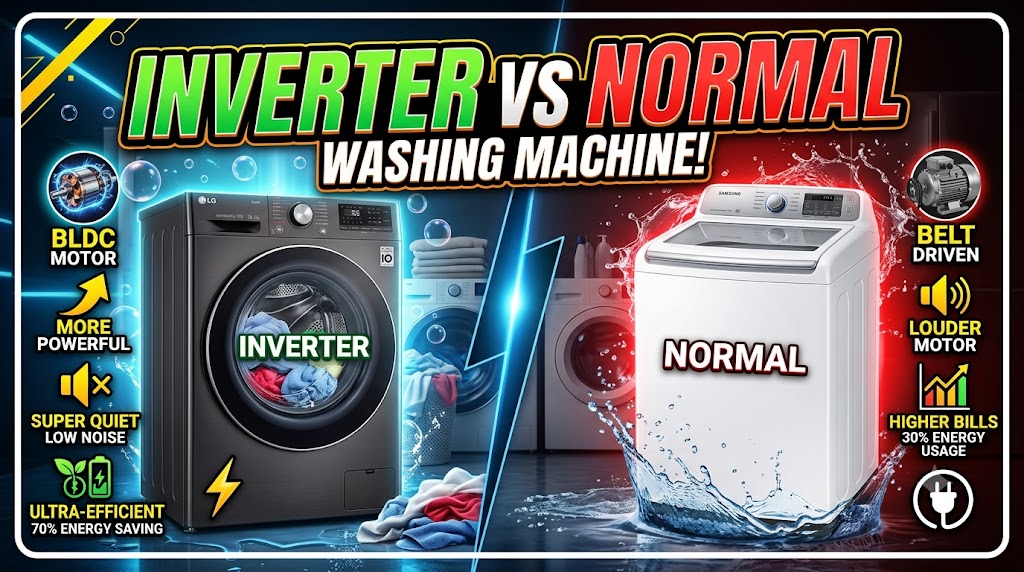
Inverter Washing Machine vs Normal Washing Machine
Introduction
Choosing between an inverter washing machine and a normal washing machine depends on your budget, laundry frequency, electricity usage, and preferred features. The main difference is how the motor is controlled. An inverter washing machine uses electronic control to adjust motor operation according to the load and selected program. A normal washing machine may use a conventional motor-control system that operates less flexibly, although designs vary between models. This difference can affect energy consumption, noise, performance, and long-term running costs.
An inverter washing machine may be a good choice for households that wash clothes frequently and want efficient motor operation. A normal washing machine may suit buyers who prioritise a lower purchase price and basic washing functions. However, the word inverter does not automatically mean that a machine will use less electricity in every situation. Capacity, wash temperature, program duration, motor design, and overall appliance efficiency also matter. Comparing the actual specifications and warranty is the best way to choose a machine that offers good value.
Quick Comparison Table
| Feature | Inverter Washing Machine | Normal Washing Machine |
|---|---|---|
| Motor control | Adjusts motor operation electronically | Depends on its conventional control system |
| Electricity consumption | Can be lower in suitable operating conditions | Depends on motor and appliance efficiency |
| Noise and vibration | Often quieter in well-designed models | Varies by motor and construction |
| Purchase price | Often higher | Often lower |
| Motor speed control | Usually more flexible | Depends on the motor and controls |
| Durability | Depends on design, use, and maintenance | Depends on design, use, and maintenance |
| Repair costs | Electronic components can add repair costs | Varies by the components used |
| Washing performance | Depends on the complete washing system | Can also provide excellent cleaning |
| Best suited for | Buyers prioritising efficiency and motor control | Buyers prioritising initial cost and basic functions |
1. Motor Technology and Working Principle

Inverter Washing Machine
Electronic controls adjust motor speed and operation to suit the wash cycle and load.

Normal Washing Machine
A conventional motor-control system operates the washing mechanism according to its design.
An inverter washing machine uses electronic circuitry to control motor operation. Depending on the design, the motor can run at different speeds for washing, rinsing, and spinning. This flexibility helps the machine adjust its operation to the selected program.
A normal washing machine may use a conventional motor and control arrangement. Some models have fewer motor-speed adjustment capabilities, while others use more advanced controls. Therefore, the term “normal washing machine” does not describe one single motor technology.
Winner: Inverter for flexible motor control, where the specific models are otherwise comparable.
2. Electricity Consumption
Electricity consumption is one of the main reasons people consider inverter washing machines.
An inverter motor can adjust its operation instead of running at a fixed speed whenever the selected task allows it. This can improve efficiency, particularly when motor speed and power requirements change during a wash cycle.
However, electricity consumption also depends on water heating, cycle duration, load size, spin speed, and the machine’s overall design. A normal washing machine with an efficient motor and short, appropriate cycles may use less electricity than a less-efficient inverter model in certain circumstances.
If you want to reduce your electricity bill, compare the machines’ energy ratings and published consumption figures where available.
Winner: Inverter, potentially, but actual savings depend on the model and usage.
3. Noise and Vibration
Inverter washing machines are often designed to operate more quietly because their motors can be controlled more precisely. Some models also use direct-drive technology, which can reduce mechanical parts such as drive belts.
However, inverter technology and direct-drive construction are not the same thing. Not every inverter washing machine uses a direct-drive motor.
Noise and vibration also depend on the machine’s suspension, drum balance, installation, flooring, and load distribution. An overloaded or incorrectly levelled machine may vibrate even if it has an inverter motor.
Winner: Inverter in many models, although the actual noise rating matters more than the label alone.
4. Purchase Price
Normal washing machines are often available at lower prices, particularly in basic models with fewer features. They can be suitable for buyers who want reliable washing functions without paying extra for advanced motor control.
Inverter washing machines may cost more because of their motor technology and electronic controls. The price difference varies by brand, capacity, wash programs, and other features.
Before buying, compare machines with similar capacities and features. A higher-priced inverter model is not automatically a better deal if you wash clothes infrequently.
Winner: Normal washing machine for a lower initial budget.
5. Washing Performance
The inverter label primarily describes motor control; it does not by itself guarantee superior cleaning.
An inverter machine can adjust drum or agitator movement according to the program, depending on its design. This can help optimise the washing process for different loads.
A normal washing machine can also clean clothes effectively. Cleaning results depend on the wash mechanism, water temperature, detergent, load size, cycle selection, and the type of dirt or stains.
When comparing two models, look at their wash programs, stain-removal options, fabric-care settings, and independent performance information where available.
Winner: No universal winner. Compare the actual washing performance and features of each model.
6. Durability and Motor Life
Some inverter washing machines are marketed with longer motor warranties. This can be useful, but the warranty period and its coverage must be checked carefully.
An inverter motor may have fewer mechanical wear points in certain designs. Nevertheless, the appliance also contains bearings, pumps, electronic controls, seals, and other parts that can require repair.
Normal washing machines can also last for many years when properly installed, used within their rated capacity, and maintained according to the manufacturer’s instructions.
Winner: Depends on the model’s build quality, usage, maintenance, and warranty.
7. Repair and Maintenance Costs
Inverter washing machines use electronic control components that may require specialist diagnosis if a fault occurs. Depending on the problem, replacement parts can be costly.
Normal washing machines may have a simpler motor-control arrangement, but that does not guarantee cheaper repairs. Parts availability, labour charges, motor design, and the age of the appliance all affect repair costs.
Before buying, check local service availability, spare-parts support, warranty conditions, and whether the motor warranty covers labour or only the motor component.
Winner: No universal winner. Compare warranty coverage and service costs for the specific models.
8. Which Is Better for Indian Households?
The best choice depends on how you use your washing machine.
- Frequent laundry: An inverter model may be worth considering if its efficiency and operating costs suit your household.
- Limited budget: A normal model may offer better initial value.
- Noise-sensitive home: Compare published noise levels, motor construction, and vibration control.
- Long-term ownership: Consider energy consumption, warranty coverage, service support, and expected repair expenses together.
- Occasional washing: Paying extra for inverter technology may not produce enough savings to justify the higher purchase price.
Pros and Cons
| Inverter Washing Machine | Normal Washing Machine |
|---|---|
| Flexible motor-speed control | Often lower initial cost |
| Can offer lower electricity consumption | Basic models can meet everyday needs |
| Often quieter in comparable models | Noise depends on motor and construction |
| May offer advanced wash programs | Can provide effective cleaning |
| May cost more to purchase | Efficiency varies by model |
| Electronic repairs may be expensive | Repair costs still depend on parts and service |
Final Verdict: Inverter Washing Machine vs Normal Washing Machine
An inverter washing machine is often the better choice if you wash clothes frequently and prioritise efficient motor operation, flexible speed control, and potentially quieter performance. It can be a sensible long-term purchase, provided the model offers good overall efficiency and a suitable warranty.
A normal washing machine may be better if you have a limited budget, wash clothes less frequently, or simply need basic washing functions. It can deliver excellent results without requiring you to pay extra for inverter technology.
Do not decide on the motor label alone. Compare the energy rating, capacity, wash programs, noise level, price, and warranty before purchasing.
Frequently Asked Questions
1. Does an inverter washing machine save electricity?
It can save electricity through more flexible motor control, but the actual savings depend on the appliance design, wash settings, and usage.
2. Is an inverter washing machine quieter?
Many inverter models are designed for quieter operation, but noise also depends on the machine’s construction, installation, and load balance.
3. Does an inverter washing machine last longer?
Not necessarily. Durability depends on the motor, other components, build quality, maintenance, and how the machine is used.
4. Is a normal washing machine a bad choice?
No. A well-designed normal washing machine can clean clothes effectively and may be more affordable to purchase.
5. Is an inverter washing machine worth the extra money?
It may be worthwhile for frequent users if the expected energy savings, convenience, and other features justify the price difference. Compare actual specifications rather than assuming every inverter model is more efficient.
Disclaimer
Washing machine prices, energy ratings, motor warranties, specifications, and features vary by model and may change over time. Check the manufacturer’s current product information and warranty conditions before purchasing.