Glass-Glass vs Glass-Backsheet Solar Panels
Introduction
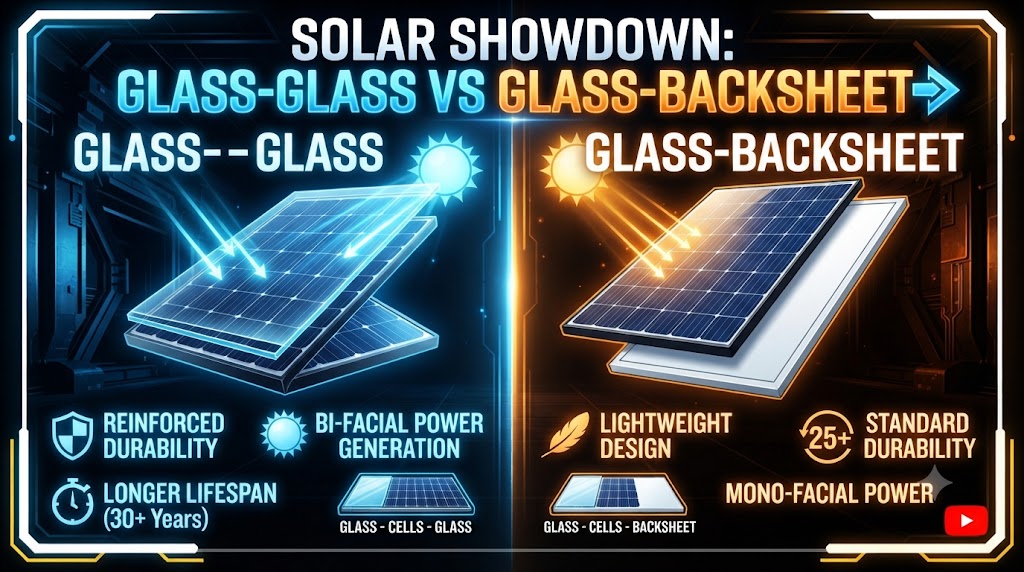
Glass-glass and glass-backsheet solar panels are two common solar panel constructions. The main difference is the material used on the rear side of the panel. Glass-glass panels use glass on both the front and back, while glass-backsheet panels use front glass and a protective polymer backsheet. This construction affects durability, weight, moisture protection, installation requirements, and sometimes the overall cost of a solar system.
Both panel types can generate electricity effectively when manufactured and installed properly. Glass-glass panels are often selected for projects where long-term durability and resistance to environmental exposure are important. Glass-backsheet panels remain popular because they are generally lighter and can be more economical. The right choice depends on your installation location, roof structure, budget, and the specifications of the individual panel.
Quick Comparison Table
| Feature | Glass-Glass Solar Panels | Glass-Backsheet Solar Panels |
|---|---|---|
| Front layer | Glass | Glass |
| Rear layer | Glass | Polymer backsheet |
| Weight | Generally heavier | Generally lighter |
| Mechanical protection | Glass on both sides | Glass front with polymer rear |
| Moisture protection | Can offer strong protection with proper sealing | Depends on backsheet quality and sealing |
| Durability | Often designed for demanding conditions | Depends on materials and construction |
| Installation | May require suitable handling and mounting | Generally easier to handle |
| Cost | Can be higher | Often more affordable |
| Transparency | Some models are transparent or semi-transparent | Usually opaque |
| Common applications | Residential, commercial, and bifacial projects | Residential and commercial rooftops |
What Are Glass-Glass Solar Panels?
Glass-glass solar panels use a glass layer on both the front and rear sides of the solar module. Solar cells are placed between these protective layers and sealed to protect them from environmental exposure.
This construction can provide strong protection against moisture and mechanical stress when the glass, encapsulation, and edge sealing are properly designed. Some glass-glass panels are also available in bifacial designs, allowing them to generate electricity from light reaching the rear side.
Advantages of Glass-Glass Solar Panels
- Protection on both sides: Glass covers the front and rear of the module.
- Moisture resistance: Properly manufactured glass-glass modules can provide strong protection against moisture.
- Durability: They can be suitable for installations exposed to challenging environmental conditions.
- Bifacial compatibility: Many glass-glass panels support bifacial cell designs.
- Long-term reliability: Some models offer long performance warranties, depending on the manufacturer.
Disadvantages of Glass-Glass Solar Panels
- Higher weight: Two glass layers generally make the panel heavier.
- Handling requirements: Installation teams need to handle and mount the panels carefully.
- Potentially higher price: Some glass-glass models cost more than comparable glass-backsheet panels.
- Roof suitability: The mounting structure and roof load capacity must be checked.
What Are Glass-Backsheet Solar Panels?
Glass-backsheet solar panels use tempered glass on the front and a polymer-based protective sheet on the rear. The backsheet provides electrical insulation and protects the internal components from environmental exposure.
This construction has been widely used in conventional solar panels. It generally produces a lighter module than a comparable glass-glass design and can help reduce handling and installation difficulties.
Advantages of Glass-Backsheet Solar Panels
- Lower weight: They are generally lighter than comparable glass-glass panels.
- Easy handling: Their lower weight can make transportation and installation more convenient.
- Competitive price: Many models are available at affordable prices.
- Established construction: This design has a long history of use in solar installations.
- Wide availability: Glass-backsheet panels are available in many power ratings and technologies.
Disadvantages of Glass-Backsheet Solar Panels
- Rear material depends on quality: The backsheet’s resistance to heat, moisture, and UV exposure varies by product.
- Ageing concerns: Some polymer backsheets can deteriorate over time depending on their material and operating conditions.
- Limited bifacial options: Conventional opaque backsheets are not suitable for typical bifacial designs.
- Potential maintenance concerns: Damage or deterioration of the rear protective layer can affect module reliability.
Key Differences Between Glass-Glass and Glass-Backsheet Solar Panels
1. Panel Construction
Glass-glass panels have glass on both sides, whereas glass-backsheet panels have front glass and a polymer rear layer. This is the fundamental construction difference.
2. Weight
Glass-glass panels are generally heavier because they use two glass layers. Glass-backsheet panels usually weigh less, which can make them easier to transport and install.
3. Durability
Glass-glass construction can offer strong mechanical and environmental protection. However, actual durability depends on glass thickness, encapsulation, edge sealing, frame design, and manufacturing quality.
4. Moisture and Environmental Protection
Both designs are built to protect solar cells from environmental conditions. Glass-glass construction can provide an effective moisture barrier, while glass-backsheet performance depends partly on the quality and long-term stability of the polymer material.
5. Bifacial Performance
Glass-glass construction is commonly used in bifacial solar panels because the rear side can allow light to reach the cells. However, not every glass-glass panel is bifacial. Check the product specifications.
6. Price
Glass-backsheet panels are often more economical, while glass-glass panels may have a higher purchase price. Compare the total system cost, warranty, and expected energy generation rather than choosing based only on construction.
Which Is Better for Different Applications?
| Application | Suitable Option |
|---|---|
| Residential rooftop | Both can be suitable |
| Lightweight rooftop installation | Glass-backsheet |
| Bifacial solar installation | Glass-glass bifacial panel |
| Challenging environmental conditions | Consider a suitably rated glass-glass model |
| Budget-focused project | Glass-backsheet |
| Long-term commercial project | Compare glass-glass and glass-backsheet warranties |
| Roof with weight restrictions | Check the actual panel weight before choosing |
Glass-Glass vs Glass-Backsheet Solar Panels: Which Should You Choose?
Choose glass-glass solar panels if:
- You want glass protection on both sides of the module.
- You are considering a bifacial solar panel.
- Your installation structure can support the panel weight.
- The model offers suitable durability and warranty specifications.
Choose glass-backsheet solar panels if:
- You want a generally lighter panel.
- Your project has a limited budget.
- You prefer easier handling and installation.
- A reliable model offers suitable performance and warranty terms.
Final Verdict
Glass-glass solar panels are often a better choice when durability, rear-side protection, and bifacial compatibility are important. They can be particularly attractive for long-term projects where the mounting structure can support their weight.
Glass-backsheet solar panels remain a practical option for many homes and businesses because they are generally lighter and can cost less. For a residential rooftop, either type can work well. Compare panel weight, efficiency, product warranty, degradation warranty, environmental ratings, and total installation cost before making your decision.
Frequently Asked Questions (FAQs)
1. What is the main difference between glass-glass and glass-backsheet solar panels?
Glass-glass panels use glass on both sides, while glass-backsheet panels use glass on the front and a polymer backsheet on the rear.
2. Are glass-glass solar panels better?
They can offer advantages in durability and bifacial applications, but they are generally heavier. Whether they are better depends on the installation and product specifications.
3. Are glass-backsheet solar panels less durable?
Not necessarily. Quality glass-backsheet panels can provide reliable long-term performance. Their durability depends on the backsheet material, manufacturing quality, and operating conditions.
4. Are glass-glass solar panels heavier?
Generally, yes. The second glass layer usually increases the panel’s weight compared with a similar glass-backsheet design.
5. Which type is better for home solar installation?
Both can be suitable. Glass-backsheet panels may be attractive when weight and budget matter, while glass-glass panels may be worth considering when their durability and other features justify the cost.
Disclaimer
Solar panel weight, durability, moisture resistance, efficiency, pricing, and warranties vary by manufacturer and model. Glass-glass construction does not guarantee better performance in every environment. Always check the manufacturer’s technical datasheet, installation requirements, and warranty documents before purchasing.